Quantum Engine vs. Carnot's Barrier: Power and Efficiency Without Compromise ✛ ✦
In classical thermodynamics, heat engines are like a virtuoso musician on stage: the closer to perfection in performance (Carnot efficiency), the slower the tempo (power). This agonizing trade-off, captured by the Shiraishi–Saito–Tasaki inequality, was long seen as a direct consequence of entropy and the second law — principles polished by Ludwig Boltzmann and Max Planck. It seemed any engine operating in finite time inevitably breeds thermal chaos and loses efficiency.
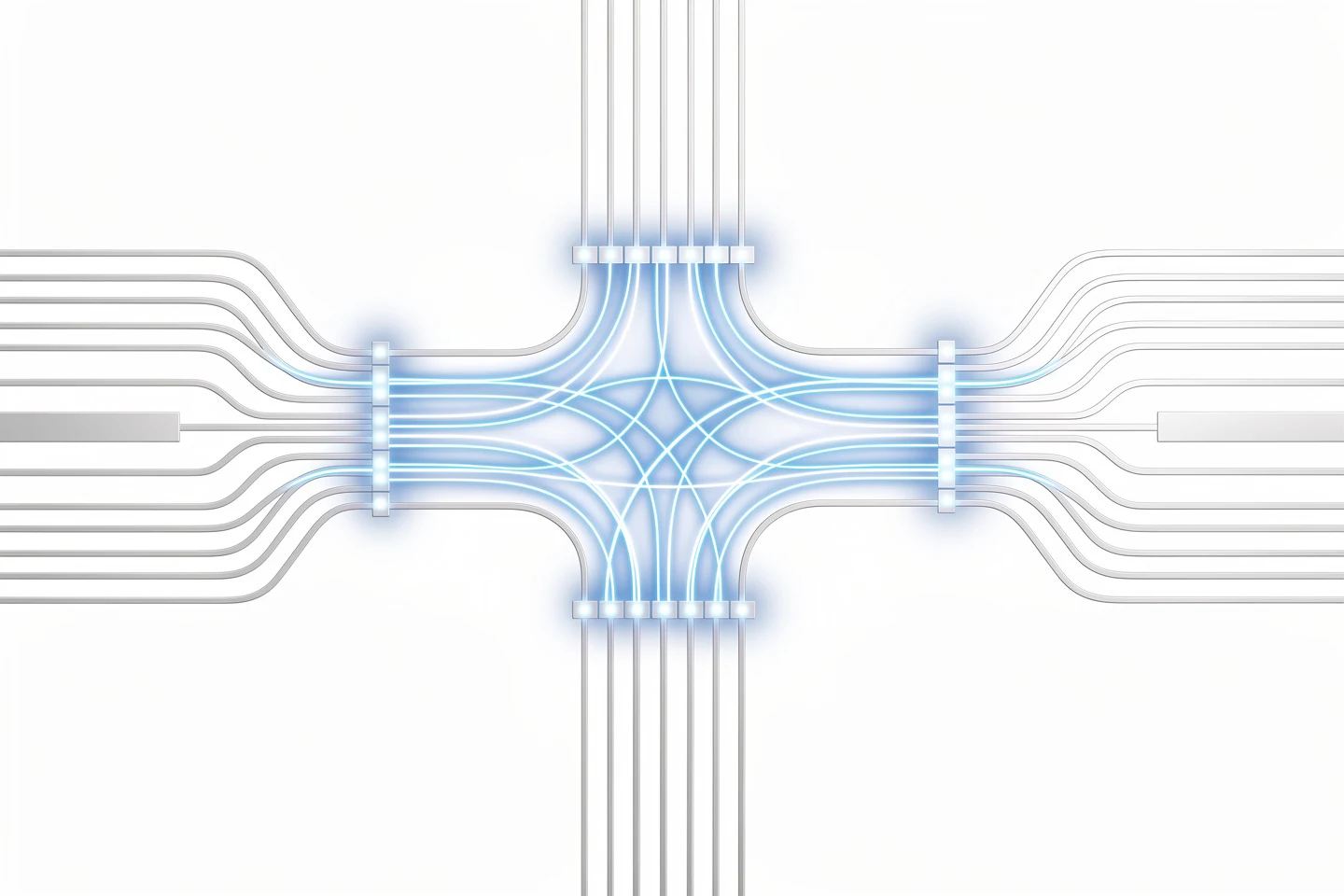
But physicists have proposed a quantum choreography. Imagine an ensemble where all dancers move in sync, and each step is amplified many times by its neighbors. In their device, the working body — two superconducting microwave resonators and a qubit — is orchestrated so that photons execute a collective quantum jump called CAS-2. Driven by a drive, two electromagnetic photons from one resonator, like a pair of duelists, simultaneously leap to the other, and the qubit changes state, like a conductor setting the rhythm with a baton. This process, described by the quantum-optical Lindblad equation, dramatically boosts the system's activity — the total transition rate — in proportion to the square of the photon number N.
Numerical simulations confirmed: as N grows, power increases linearly, and the gap between real efficiency and the Carnot limit melts away as 1/N. Already at N=15, efficiency reaches 99.9% of the theoretical maximum. This challenges the dogma that ‘slow means efficient.’ The working body’s entropy, computed à la John von Neumann, stays under control and cycles back to its initial value, while the total entropy production still obeys the second law.
This architecture paves the way for fundamentally new thermodynamic machines. By scaling the idea to higher-order CAS processes, even more explosive growth in activity is possible — up to O($N^c$). In the long run, this could mean quantum batteries with record charging speeds or ultra-sensitive quantum information sensors. However, the road to practice runs through the battle against quantum decoherence and parasitic losses — a new engineering challenge for the quantum computing community. The work blurs the line between abstract theory and laboratory realization, compelling a rewrite of thermodynamics textbooks for the quantum era.
At 50 millikelvins, each photon is worth its weight in gold: thermal noise is so feeble that a single quantum of energy becomes significant, like a droplet in an ultra-vacuum. It is this regime that reveals how quantum mechanics circumvents classical prohibitions.