Light Amplifier Sees What Is Hidden express
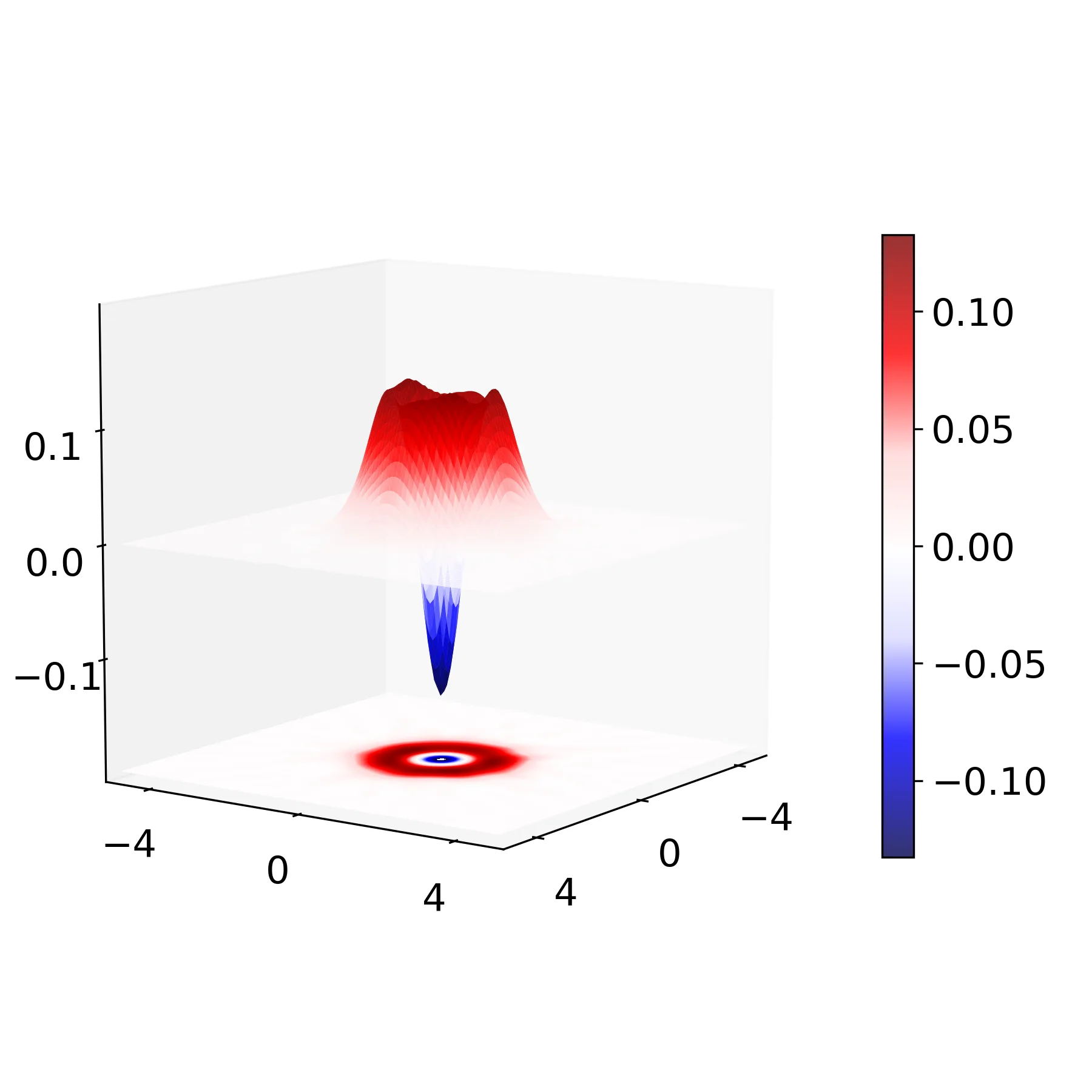
A delicate watermark on wet paper, and a fogged-up glass before your eyes. That's roughly what reading quantum states of light looks like: fragile photon patterns get distorted by losses, and detectors catch only a small fraction of the signal. The usual approach, homodyne tomography, demands nearly ideal conditions, but in the real world light dims and instruments are imperfect.
The authors propose a different path. The light is passed through a phase-sensitive parametric amplifier — a device that works like a musical resonator. It responds only to notes of a certain phase, making them louder while the noise becomes quieter. The amplified signal is measured with a simple power meter, like a household lux meter but for quantum light. Then a mathematical algorithm, similar to solving a puzzle with missing pieces, reconstructs the original pattern. The method is not afraid of losses and works even with mediocre detectors.
The researchers tested their approach on three types of states: single photons, "Schrödinger cats" (light pulses existing in two phases simultaneously), and GKP states — exotic "combs" of peaks that are especially resilient to errors. In all cases, the algorithm accurately reconstructed the state's shape and even measured its degree of nonclassicality — the so-called stellar rank and the negativity of the Wigner function. These quantities show how strongly the state differs from an ordinary laser beam.
The practical value of the method is that it combines three tasks in one experimental setup: lossy measurement, state reconstruction, and verification of its nonclassicality. There's no need to reconfigure the setup or change detectors. It's as if one and the same device could listen to music, identify the notes, and assess the performer's skill. For quantum optical technologies, this approach means faster and cheaper verification of the complex states needed for computation and secure communication. The water on the paper becomes visible even if the glass is more fogged than usual.
Original abstract
as written by the authors arXiv:2607.17023
Characterizing non-Gaussian quantum states is of paramount importance for continuous-variable quantum information processing, yet conventional homodyne-measurement-based state tomography remains limited by optical loss, detector efficiency, and measurement bandwidth. Here, we introduce an integrated framework for loss-tolerant characterization and certification using high-gain phase-sensitive optical parametric amplification and power measurements. Our computationally efficient semidefinite programming approach enables faithful reconstruction of parity-symmetric quantum states from amplified quadrature measurements while substantially relaxing detector-efficiency requirements and increasing the measurement bandwidth. We further develop a certification framework that directly quantifies non-Gaussianity via stellar-rank witnesses and Wigner negativity, using the same quadrature-power measurements. We demonstrate the efficacy of the proposed framework through both simulated and experimental data for representative quantum states, including single-photon, Schrodinger cat, and Gottesman-Kitaev-Preskill (GKP) states. By unifying loss-tolerant measurements, state tomography, and nonclassical-state certification within a single experimentally accessible framework, our approach provides a practical pathway toward verifying increasingly complex states and can be readily implemented with current quantum photonic technologies.
An ordinary laser beam can be described as a wave with small random jitters. But if you squeeze those jitters to the limit in one direction, they inevitably grow in another, such is the quantum uncertainty principle. It is this squeezing that parametric amplifiers use to hide noise where it doesn't interfere with the measurement.
In Ted Chiang's novella "Light Shadows," the protagonist uses quantum states of light to communicate with parallel versions of himself. The method described here could become a tool to check whether foreign "shadows" have been mixed into the signal.