Two Orders in One Crystal express
A mosaic of squares and triangles covers the floor without gaps, yet it never settles into a simple repeating pattern. Such a pattern is a quasicrystal — a solid where atoms are arranged not periodically but according to a pattern of several waves of different lengths. These waves are incommensurate with each other, and together they create long-range order.
In ordinary crystals, any displacement of atoms gives rise to sound waves — phonons. Quasicrystals are more complex: because of the competition between two wave vectors, two types of vibrations emerge. Phonons shift the entire lattice as a whole, while phasons make the waves slide relative to each other. The authors of the paper found that in a one-dimensional quasicrystal, it is possible to suppress vibrations of only one vector (it freezes, as it were) while the other continues to oscillate freely. As a result, along one axis true long-range order appears, while along the other only quasi-long-range order remains, similar to what occurs in two-dimensional crystals at finite temperature.
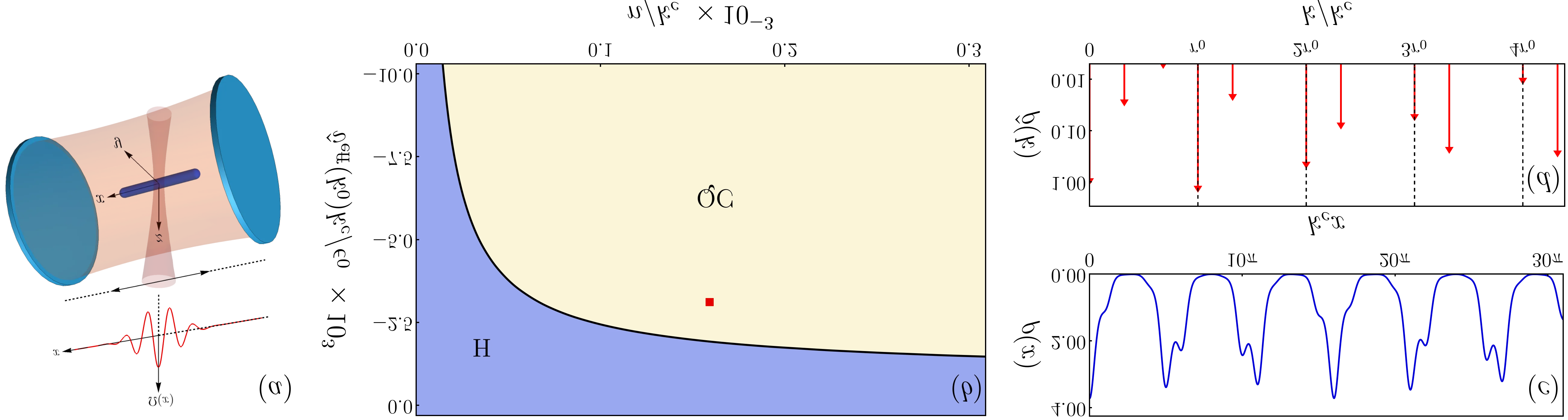
They propose observing this behavior using ultracold atoms in optical cavities. The atoms are cooled to near absolute zero and placed between mirrors, where light creates a periodic potential for them. By tuning the laser parameters, one can obtain competing waves and watch as one of them loses its mobility. This mechanism is a unique feature of quasicrystals; there is no analogue in ordinary crystal physics.
Original abstract
as written by the authors arXiv:2607.17334
Quasicrystals exhibit long-range positional order without periodicity, arising from multiple incommensurate wave vectors. In self-assembled quasicrystals, the spontaneous breaking of translational invariance gives rise to two Goldstone modes-phonons and phasons-associated with two competing wave vectors. Here, we demonstrate a unique scenario exclusive to quasicrystals: a mechanism that gaps out only one Goldstone mode (associated with one wave vector), while the other remains gapless. In one dimension, this leads to the coexistence of long-range order at the gapped wave vector and quasi-long-range order at the gapless one, due to sustained fluctuations. We show that this phenomenon can be realized using ultracold bosonic atoms in optical cavities.
In ordinary crystals, lowering the temperature damps thermal vibrations for all atoms simultaneously. In a quasicrystal, however, one mode can freeze while another retains quantum fluctuations even near absolute zero.
In Neal Stephenson's novel 'Anathem', 'aperiodic crystals' are mentioned — structures that store information in a non-periodic order. The effect described here resembles the selective 'freezing' of individual information layers.