The Cosmic Top That Brakes Too Fast express
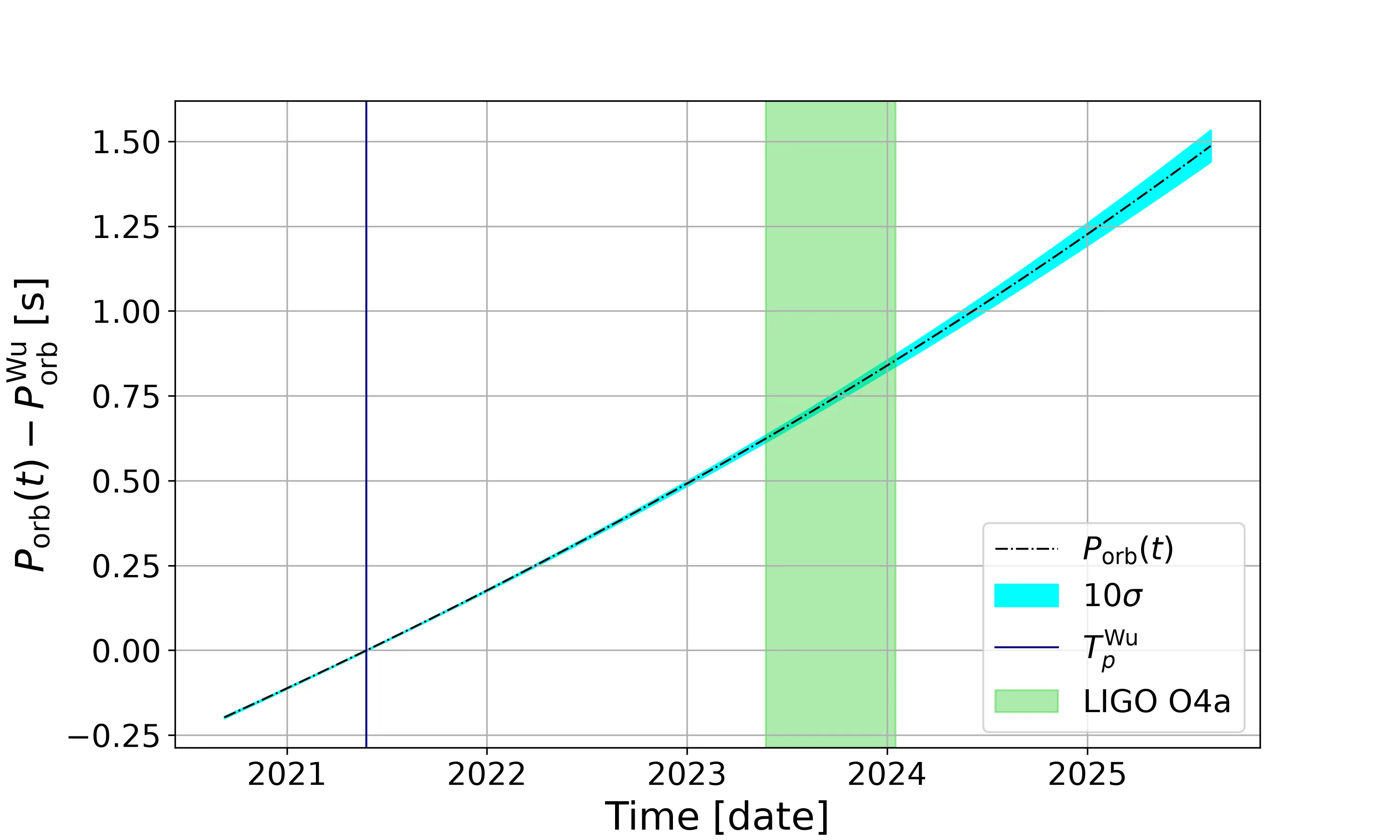
A spinning top that makes a hundred turns per second suddenly starts losing speed dramatically — much faster than any known top. That's exactly what pulsar J0435+3233 is doing. It's a dead star, crushed to the size of a city, but whirling at a furious rate. Its period is less than 10 milliseconds, and it has set a record: never before have we seen such a fast pulsar slow down so much (its spin-down exceeds $10^{-12}$ Hz/s).
Such a sharp slowdown is like the screech of brakes on a speeding car. But instead of sound, it could create ripples in spacetime — gravitational waves. Scientists from the LIGO collaboration analyzed observational data and tried to catch this "whisper" from J0435+3233. They looked for a signal at exactly twice the pulsar's spin frequency, in a narrow band around it, and at frequencies corresponding to special oscillations of stellar matter — the so-called r-modes.
The detectors picked up nothing. But the silence is also a result. It allowed setting an upper limit on the gravitational wave amplitude: $h_0 = 5.8 \times 10^{-27}$. That's ten times stricter than the limit you could get from the spin-down alone. In other words, if the pulsar were slowing down only due to gravitational wave emission, its "oblateness" (deviation from a perfect sphere) would be no more than $1.6 \times 10^{-8}$. That's in a physically very interesting range, like having a perfectly smooth billiard ball the size of Earth with no bump taller than a couple of centimeters.
So, the top isn't just slowing down: it's doing so mysteriously. We didn't hear its gravitational screech, but we did get a glimpse into the very heart of the physics of ultra-dense objects. And who knows, maybe next time, when LIGO becomes even more sensitive, we'll finally catch that cosmic rhythm.
If pulsar J0435+3233 were a perfectly smooth sphere, its rotation wouldn't produce gravitational waves. You need at least a tiny "bump" on the surface — a deviation from sphericity. The upper limit on such a bump for this pulsar is less than the thickness of a human hair on an object the size of Manhattan.
In Carl Sagan's novel "Contact," a signal from an alien civilization is hidden in the pulsations of a neutron star — maybe someday we'll find something more than just gravitational waves in such data.