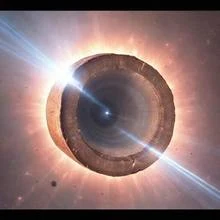
A continuous gravitational wave is a persistent, nearly monochromatic signal emitted by a rotating, asymmetric object, such as a neutron star with a slight deformation. Unlike the short bursts from black hole mergers, these waves are constant, like a cosmic hum. The signal's frequency is typically twice the rotation frequency of the star, and its amplitude depends on the star's ellipticity and distance.
History
The theoretical prediction of gravitational waves from rotating bodies dates back to Albert Einstein's 1918 quadrupole formula. The first search for continuous waves from neutron stars was conducted in the 1990s using early bar detectors, but systematic searches with modern interferometers began in the 2000s.
How it works
A rotating object emits gravitational waves only if it is not perfectly symmetric around its rotation axis. The asymmetry creates a time-varying quadrupole moment, which generates ripples in spacetime. For a neutron star, the deformation could be as small as a fraction of a millimeter on a 10-kilometer radius, yet the resulting waves carry away rotational energy, causing the star to spin down gradually. Detectors like LIGO and Virgo search for these signals by looking for a continuous, slowly drifting frequency in their data.
In practice
Detecting a continuous gravitational wave would reveal the ellipticity of neutron stars and provide a new way to study their internal structure, including the equation of state of nuclear matter.
Fun fact
The Crab pulsar, a rapidly spinning neutron star, is expected to emit continuous gravitational waves, but its signal is so weak that even with current detectors, it would take years of data to detect it—if it exists at all.
Water in a tank spins at nearly four revolutions per second, and, as if by magic, a column the size of a dinner table emerges. The vortex lives for dozens of rotations, even though everything around it churns and trembles. Where does such stability come from?
The secret is that the vortex is not isolated.
The spiral of water draining into a sink spins faster and faster toward the center. In an ordinary black hole, that funnel ends in an infinitely sharp point — a singularity where the laws of physics break down. But this new work considers a different picture: the funnel doesn't taper to a needle but ends in a smooth, swelling bubble.
A spinning top that makes a hundred turns per second suddenly starts losing speed dramatically — much faster than any known top. That's exactly what pulsar J0435+3233 is doing. It's a dead star, crushed to the size of a city, but whirling at a furious rate.
A runner on the middle of a track suddenly switches to a walk — not speeding up or slowing down, but maintaining a constant pace. Something similar may have happened to the universe itself shortly after the Big Bang.
When two superdense stars circle in a tight dance, the space around them shudders. This shudder, gravitational waves, is caught by giant detectors on Earth. But deciphering the signal is tricky: you need to figure out what exactly you're dealing with — a pair of black holes or neutron stars.
A figure skater pulls their arms in, and their spin suddenly accelerates. When a massive star exhausts its fuel and its core collapses, something similar happens, but on a cosmic scale. The core shrinks to a city-sized sphere, and if it is spinning rapidly, a peculiar instability can arise.
A spinning top whirls at great speed and, instead of a steady hum, emits a quiet buzz — because it is slightly dented. Neutron stars work much the same way: city-sized spheres compressed to such density that a teaspoon of their material weighs as much as a mountain.
After a supernova explosion, a neutron star neutron star remains: a city-sized ball of unimaginably dense matter, spinning hundreds of times per second. Any tiny bump on its surface would make it wobble like an off-balance spinning top, humming faintly through the fabric of space.
According to theories beyond the Standard Model, our best description of elementary particles and their interactions, pairs of magnetic monopoles were born in the first instants after the Big Bang. These hypothetical particles carry only one magnetic pole—'north' or 'south'—unlike familiar magnets where poles are inseparable.
The neutron star 1E 161348-5055 in the supernova remnant RCW 103 pulses with a period of 6.67 hours. That's very slow for such a compact object, and astronomers long puzzled over what was going on.
The ocean is like a layered cake: warm, light water on top, cold, heavy water below. Between the layers, at the interface, invisible waves roam. They don't lift crests like a storm; instead, they slowly rock the entire water column, as if someone were shaking a giant aquarium from within.
Gamma-ray burst 230307A lit up the sky like a thunderclap: in seconds, it released more energy than the Sun will emit over billions of years. Three detectors—GECAM-B, GECAM-C, and Fermi/GBM—were looking in the right direction at that moment.