How Black Holes Spit Out Energy express
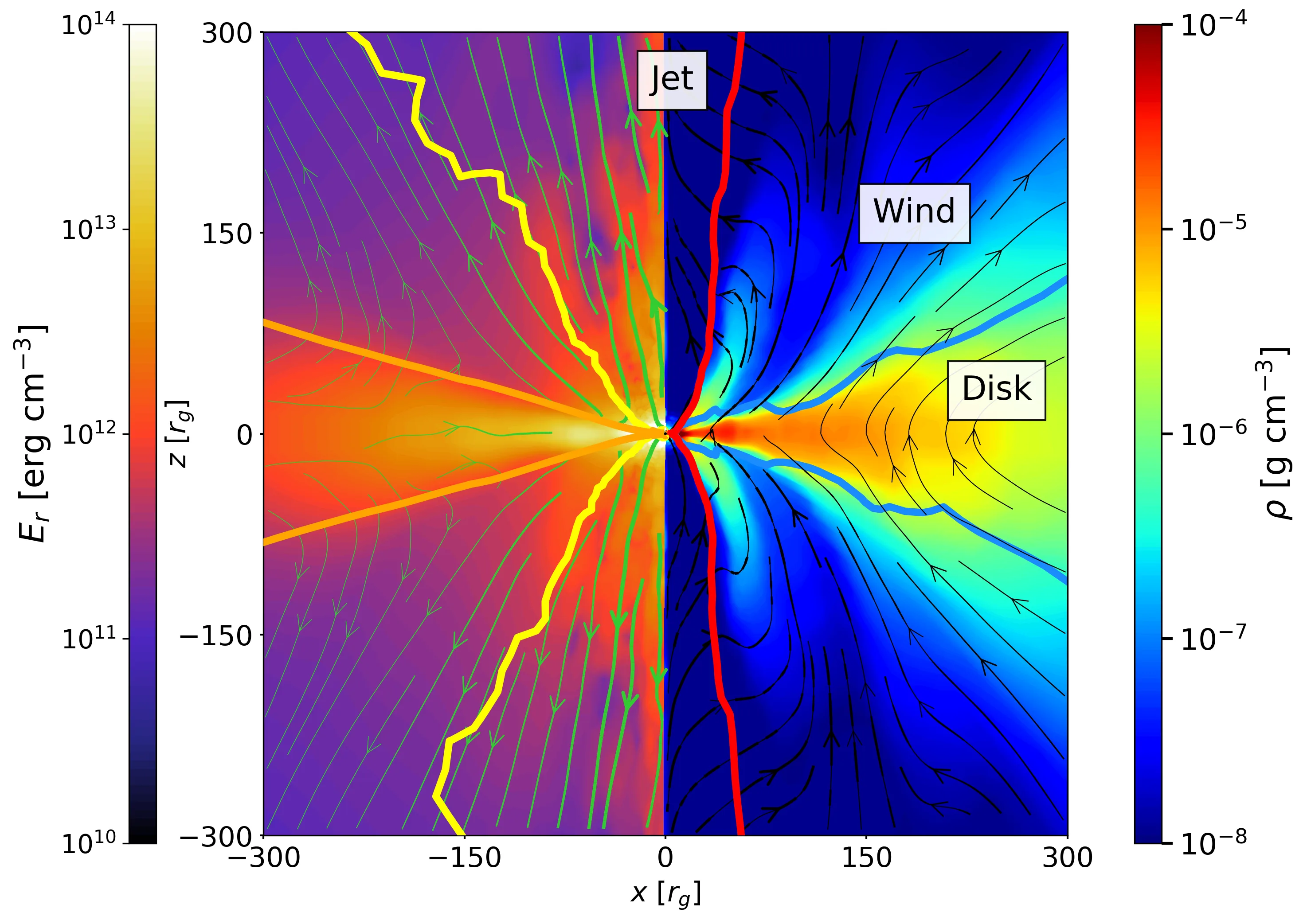
A whirlpool gulps down water, but splashes most of it back out. That's roughly how a black hole behaves when too much matter falls onto it. In a new study, astrophysicists ran 32 computer simulations to understand how a black hole's parameters — mass, spin, and "appetite"—control these cosmic fountains.
It turns out that the black hole's mass (ranging from 5 to 30 solar masses, where one solar mass is the mass of the Sun) barely matters. The main conductors are the hole's spin and the rate of matter inflow. The black hole swallows only a small fraction of what comes its way: between 10 and 40 percent. The rest is flung away by powerful winds and narrow jets — streams of particles moving at near-light speed. The faster the spin, the more efficient this "engine" becomes: the energy of the wind and jet grows faster than the increase in the infalling matter flow.
The scientists derived formulas linking luminosity, jet power, and the fraction of matter swallowed to the black hole's parameters. These relationships will help astronomers better interpret observations of ultraluminous X-ray sources and other systems where black holes operate at their limits. In this way, we are gradually learning to read the story of each such whirlpool — by how much matter it returns to space.
Original abstract
as written by the authors arXiv:2607.28919v1
Strongly magnetized super-Eddington accretion flows power many important astrophysical systems, but how black hole parameters control their output is unclear. We present 32 general relativistic radiation magnetohydrodynamics simulations of super-Eddington magnetically arrested disks onto stellar-mass black holes, varying mass ($$M_{\rm BH}= 5, 15, 30\,M_{\odot}$$), spin ($$a=0,0.9$$), and accretion rate ($$\dot{M}_{\rm acc} \approx 1-2000\,\dot{M}_{\rm Edd}$$). We find that black hole spin and accretion rate jointly regulate wind loss rates and energy output efficiencies, while black hole mass has no effect over the mass range studied here. The BH accretes only $$10-40\%$$ of the mass supplied to the accretion flow, while the rest is expelled in winds. This accretion fraction decreases with mass supply rate and is lower for high-spin systems. Both spin states produce strong magnetically driven outflows. For $$a = 0$$, the wind kinetic, radiative, and electromagnetic efficiencies are modest and show little variation across the full simulated range of accretion rates. For $$a = 0.9$$, both wind power and jet power increase super-linearly with $$\dot{M}_{\rm acc}$$, with the jet power saturating beyond $$\dot{M}_{\rm acc} \sim 100\,\dot{M}_{\rm Edd}$$. Radiation is strongly beamed along the funnel, with inverse beaming factors exceeding $$100$$ for high-spin, high-$$\dot{m}$$ models viewed face-on. Our results establish that rapid BH spin boosts energy-extraction efficiency, while high accretion rate amplifies total power. We provide scaling relations for luminosities, jet power, accretion ratio, and beaming, offering a framework for interpreting observations of ULXs and other super-Eddington systems.
A black hole with the mass of a star but spinning rapidly can emit more energy into space than the Sun would produce over its entire lifetime.
In Charles Stross's novel Accelerando, an alien probe uses a micro-black hole as an energy source, extracting power from its accretion disk — much like what is described in this work.