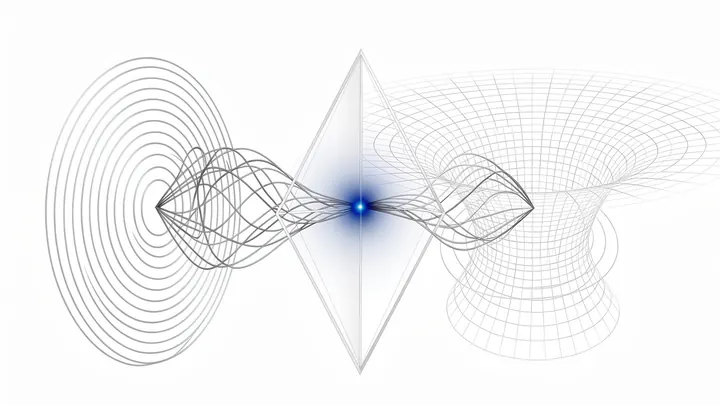
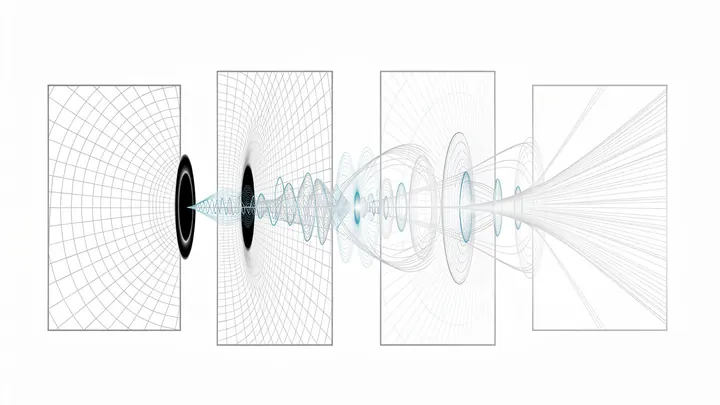
The charge-to-mass ratio is a fundamental property of any charged object, defined as its electric charge divided by its mass. For black holes, this ratio is a key parameter in the Reissner-Nordström and Kerr-Newman solutions of general relativity, determining the structure of the event horizon and the geometry of spacetime around the black hole. It influences how the black hole interacts with electromagnetic fields and how it emits radiation.
History
The concept of charge-to-mass ratio was first measured for the electron by J.J. Thomson in 1897. For black holes, the charged solutions were found by Hans Reissner and Gunnar Nordström in the 1910s, and later generalized to rotating charged black holes by Roy Kerr and Ezra Newman in the 1960s.
How it works
In classical physics, the charge-to-mass ratio determines how a particle responds to electric and magnetic fields. For a black hole, this ratio is set by the total charge and mass it has accumulated. A higher ratio means the black hole's electrostatic repulsion is stronger relative to its gravitational pull, which can lead to the existence of multiple horizons or even a naked singularity if the ratio exceeds a critical value.
A black hole with a charge-to-mass ratio exceeding one would theoretically expose its singularity, a scenario known as a naked singularity, which is forbidden by the cosmic censorship conjecture.
Somewhere in the center of a galaxy, a black hole is spinning. It doesn't hang in a void — around it swirls an invisible swarm of dark matter particles. Until now, this swarm was described for non-rotating holes, but in reality, holes always rotate.
A black hole is not an eternal vacuum cleaner. It slowly loses mass by emitting particles, much like a heated stone cooling as it radiates heat. This process, discovered by Stephen Hawking, is barely noticeable for large holes, but for tiny ones, with masses comparable to a mountain, it becomes a violent evaporation.
A classical black hole is a bottomless well: everything that falls past the horizon disappears into a point of infinite density. But in loop quantum gravity (one approach to quantum gravity), that point is replaced by a quantum 'bounce'—a sphere of finite size where spacetime doesn't tear but rearranges itself.
A rotating black hole is no calm whirlpool. Space around it shudders and rings at the slightest disturbance, like a guitar string after a pluck. These oscillations are described by the Teukolsky equation — a complex mathematical construct that physicists have studied for half a century.
Recently, a strange symmetry was noticed in this equation.
An old house. The facade is freshly painted, the stairs don't creak. A pretty picture. But try to move in heavy furniture, and the floorboards give way. The beauty of the facade says nothing about the strength of the floors.
It's much the same with black holes without singularities.
A whirlpool gulps down water, but splashes most of it back out. That's roughly how a black hole behaves when too much matter falls onto it. In a new study, astrophysicists ran 32 computer simulations to understand how a black hole's parameters — mass, spin, and "appetite"—control these cosmic fountains.
A black hole is not a perfect vacuum cleaner. It is surrounded by a swarm of particles and fields, and this swarm alters its fate. In a new study, astrophysicists examined how a massive vector field, a hypothetical form of dark matter, behaves near a rotating black hole.
A pot of boiling water is covered with two lids — an inner and an outer one. The thermometer under each shows its own temperature, but their harmonic mean (a special averaging method where you add the reciprocals) always remains unchanged. Heat seems to obey an invisible rule.
Three milliseconds before the merger. A gargantuan black hole spinning at breakneck speed drags in a neutron star — a ball the size of a city but with 1.5 times the Sun's mass. Tidal forces stretch the star into a thread as thin as a needle and fling its matter outward.
A swarm of tiny invisible particles, like a cloud of pollen, drifts through space. A black hole sits in its path. Some particles fall in and vanish forever; others swing around the trap and fly away. The physicists built a map showing exactly how much matter gets swallowed and how much survives.
Gravity is the invisible glue that holds stars and planets together. But what if this glue has a tiny mass? In massive gravity, the carrier particles (called gravitons) weigh a minuscule but nonzero amount. This changes the rules near black holes.
The authors of the new study built on a mathematical tool — eigenvalue decomposition.
Gas passing through a narrow valve can heat up or cool down: this is the Joule–Thomson effect, which powers refrigerators and air liquefiers. It turns out black holes can do the same.
A black hole with an electric charge is like a vacuum cleaner that not only sucks in everything around it but can also hold light particles in orbit. These particles form a kind of fuzzy cloud around the hole — physicists call it a quasi-bound state.
At the center of galaxy M87, 55 million light-years away, lurks a black hole with a mass of 6.5 billion Suns. In 2019, the Event Horizon Telescope (EHT) gave us its first portrait: an orange donut with a dark core. But the donut is not the abyss itself.
A figure skater spins on the ice, gradually spiraling inward. Similarly, a small star or black hole orbiting a massive black hole loses energy. It emits gravitational waves — ripples in spacetime that detectors on Earth pick up.
But the dance of this pair is more intricate than it seems. The small companion isn't just a point.
In the search for the nature of dark matter, one of the most intriguing hypotheses traces back to the first moments after the Big Bang. Back then, quantum fluctuations of the inflation field gave rise to clumps of matter that could collapse into primordial black holes.
The universe as painted in Einstein’s textbooks is a smooth four-dimensional canvas. But string theory adds a frame of extra dimensions — invisible, yet tangible to gravity. Imagine our universe as a membrane that trembles under the pressure of hidden layers.
When massive bodies accelerate (say, two stars orbiting each other) the space around them doesn't stay calm. It trembles like the surface of a pond after a stone is thrown. These tremors are called gravitational waves. They carry energy away, and the source gradually loses mass.
The focus is on a black hole, but not an ordinary one. It carries a magnetic monopole and is surrounded by a dilaton — a field that blurs the familiar boundaries of space. The authors tested how stable such a system is to thermal jolts.
A magnetic monopole is a hypothetical particle with a single magnetic pole.
Two magnets collide in a dark room, stick together into a clump, and a dull thud echoes. Black holes behave much the same way, except instead of magnets they carry electric charge, and instead of a thud, there's a burst of gravitational waves. But there's a third player in this story — an invisible field that physicists call scalar.
A black hole is a place where gravity is so strong that even light cannot escape. But around it there is a glowing ring of gas, and in the center a dark void known as the shadow. The size of this shadow depends on how spacetime is curved.
A black hole is like a spinning top: the faster it spins, the more noticeable its behavior. It has two boundaries — the outer and inner horizons, the edges beyond which even light cannot return. In the new work, physicists looked inside a rotating charged black hole and multiplied the areas of these two surfaces.
A swarm of tiny ice balls is scattered across a warm room. Some melt faster, others slower, but when only wet spots remain, they all vanish in the same way: the last drop evaporates according to the same law. This is roughly how primordial black holes behave — hypothetical objects born in the first moments after the big bang.
A black hole is like a bottomless well. You can measure how much water has flowed into it by watching the level from outside. But how do you find the mass of the water itself if you're standing inside the well? That's roughly the problem the authors of a new paper tackle.
Light passing by a black hole swirls like water down a bathtub drain. The most intriguing part is the thin ring where rays can orbit forever, neither falling in nor escaping. This is the photon sphere — an invisible boundary that paints the hole's shadow on the sky.
If you squeeze a handful of sand, it gets denser, but at some point the grains press against each other: there's no more room to compress. Some theorists think space behaves similarly at ultra-small distances: it has a limit to divisibility, a kind of 'grain.' In this new study, that principle was applied to the birth of black holes in the early universe — the very ones that…
A black hole is a cosmic pocket into which everything, even light, falls. But the pioneering work of John Wheeler, Stephen Hawking, and Roger Penrose showed: sometimes, due to the colossal spacetime curvature, the pocket turns inside out.
Light falling into a black hole carries information — for instance, the path a photon took. The horizon (the surface from which nothing returns) responds by changing its entropy — a measure of disorder, akin to the number of shuffled pages in a book.
Imagine an air mattress being stretched, with a whirlpool of water spinning on it. As you stretch, the whirlpool tightens: its size relative to the whole surface shrinks.
Usually, a black hole is an abyss with a point-like dip at the center, where density is infinite and everything breaks down. Einstein and Schwarzschild described such a scenario. But infinity is a sign that the theory stumbled.
Physicists have mastered an elegant mathematical trick that lets them translate gravitational equations into the language of electricity. This method — double copy — works like a kind of dictionary: it replaces the complex geometry of curved spacetime, described by high-dimensional tensor fields, with the simpler rules of…
A whirlpool in a river sucks everything in. Now imagine adding an invisible jelly to the water that thickens near the vortex and suddenly vanishes at its edge: that's roughly what a black hole looks like in a new mathematical model.
When a massive star exhausts its fuel, the core collapse can spawn a supernova and a neutron star, but with enough mass, nothing halts the crush — a black hole is born.
Black holes aren't faceless devourers. Sometimes they behave like water: they can 'freeze' or 'boil', changing their internal state. Scientists described this by modeling light near a black hole as a gas.
A magnetic field can hold a star against complete collapse: that's the idea behind a new kind of black hole. Instead of the usual point of infinite density, inside there is a field that prevents space from crunching down to zero. It's like a spring: the harder you squeeze, the more it pushes back.
Classical general relativity predicts: a singularity hides inside every black hole. In this region, spacetime curvature skyrockets to infinity, and Einstein's equations lose meaning.
A stone falls into a pond, and ripples spread across the water. Similarly, a black hole resting in the void may encounter a gravitational wave or a cloud of gas. It does not remain indifferent: its surface (the event horizon) bends slightly, like a stretched membrane under the weight of a drop.
A black hole is not just a void but a massive object that warps the space around it. If it finds itself in a cloud of invisible dark matter, matter that emits no light but makes itself known through gravity, its behavior changes.
A black hole is like a dark ball in space onto which luminous matter falls. A black hole has a shadow — a region from which rays cannot escape. But due to light bending, the shadow appears larger than the hole itself: just like a ball's shadow on a wall grows bigger when the lamp is far away.