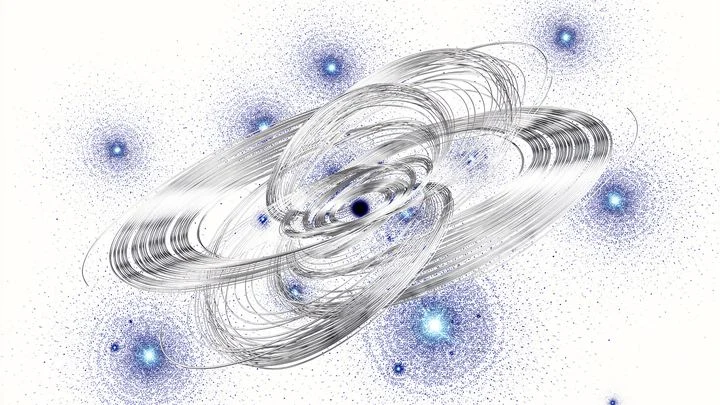
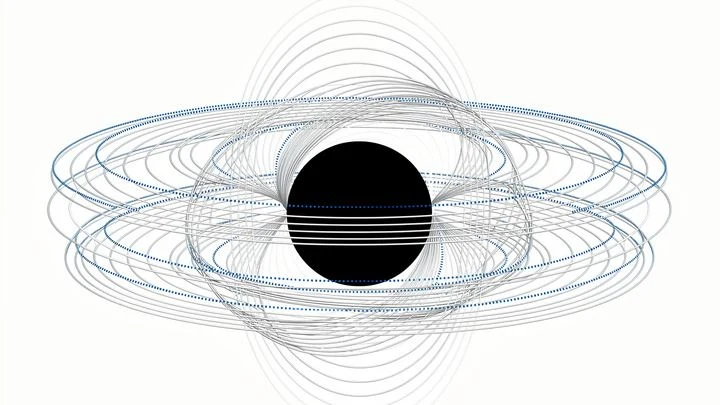
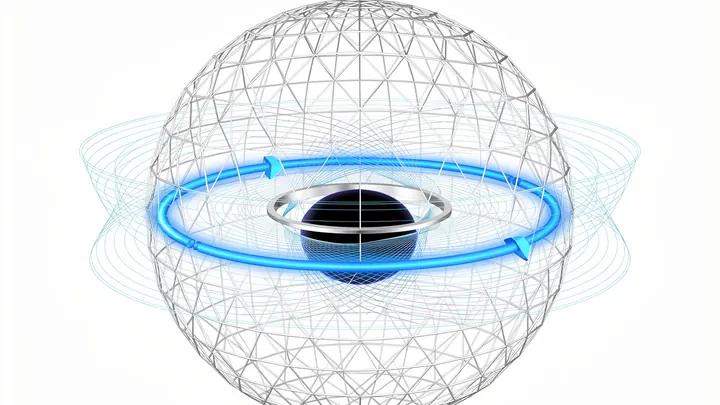
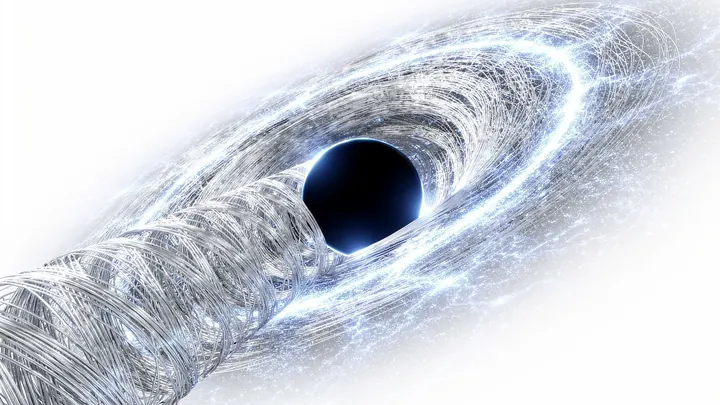
The spin parameter is a dimensionless number that quantifies how fast a black hole rotates relative to its maximum possible rate. It is defined as a = cJ/(GM²), where J is the angular momentum, M is the mass, G is the gravitational constant, and c is the speed of light. The value ranges from 0 for a non-rotating (Schwarzschild) black hole to 1 for a maximally rotating (extremal Kerr) black hole. This parameter determines the size and shape of the ergosphere, the innermost stable circular orbit, and the efficiency of energy extraction from the black hole's rotation.
History
The concept of a spinningblack hole was solved by Roy Kerr in 1963. The spin parameter as a measurable quantity became a focus of astrophysics in the 1990s with X-ray observations of galactic black holes, and later with gravitational wave detections starting in 2015.
How it works
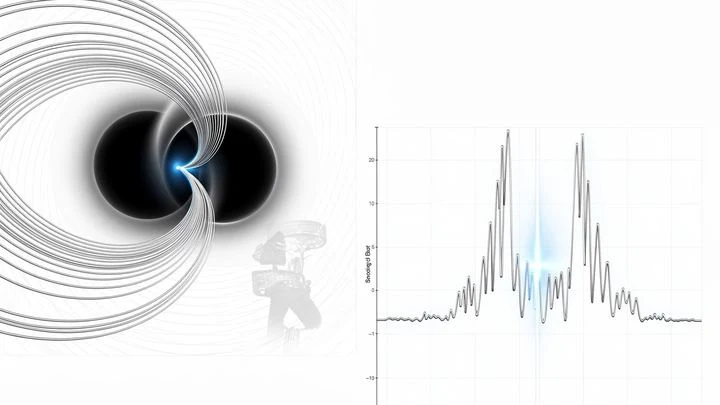
Astronomers measure the spin parameter by observing the effects of strong gravity near the black hole. One method involves fitting the shape of the iron K-alpha emission line, which is broadened and skewed by relativistic effects (gravitational redshift and Doppler beaming) in the accretion disk. Another method uses the continuum spectrum of the disk, which depends on the location of the innermost stable orbit — a smaller orbit (closer to the black hole) implies higher spin. Gravitational wave signals from merging black holes also encode the spin of each component in the waveform's phase and amplitude.
In practice
Measuring spin parameters helps test general relativity, understand how black holes grow (via accretion or mergers), and probe the nature of jets in active galactic nuclei.
Fun fact
A maximally spinningblack hole could theoretically be used to extract energy via the Penrose process, converting up to 29% of the infalling mass into energy — far more efficient than nuclear fusion.
A taut string sounds higher when you pull it tighter. Magnetization in an antiferromagnet behaves similarly: the stronger the external field, the faster it oscillates. But in chromium oxide crystals, something goes awry.
In fields from 20 to 30 tesla, the resonance frequency grows more slowly than it should.
In 2015, the LIGO detectors caught the first ripple of spacetime from a black hole merger. Since then, hundreds of such events have piled up, each carrying the imprint of its ancestry: whether the holes were born together from a single pair of stars or met by chance in a dense cluster. The difference shows in the direction of their spin axes.
When two heavy balls merge into one, ripples spread across the water's surface for a long time. A black hole behaves similarly: after a merger, it 'rings' for a while, emitting special gravitational oscillations — quasinormal modes. Usually, this ring fades quickly, like an echo dying out in an empty hall.
Somewhere in the depths of space, two supermassive black holes are circling each other. Their dance is not smooth — the orbit is stretched, like a rubber band that alternately tightens and relaxes. Each revolution sends ripples through the fabric of spacetime — gravitational waves.
A dance floor where couples whirl. At the center, an invisible master of ceremonies sets the rhythm. This is the supermassive black hole at the heart of the Milky Way, and the couples are stars whose orbits astronomers have tracked for years. But what if the master himself is wrapped in a fluffy fur coat of tenuous matter?
A black hole is like a perfect safe: everything that falls in disappears without a trace. But quantum mechanics whispers that on the microscopic level, information is not lost but recorded on an invisible "surface." Understanding this record means unraveling the fabric of gravity.
Two black holes circle in a cosmic dance, spiraling closer together. In the end, they merge into one, and that moment unleashes a powerful burst of gravitational waves, ripples in spacetime itself. But what remains after the merger?
A whirlpool gulps down water, but splashes most of it back out. That's roughly how a black hole behaves when too much matter falls onto it. In a new study, astrophysicists ran 32 computer simulations to understand how a black hole's parameters — mass, spin, and "appetite"—control these cosmic fountains.
A black hole is not a perfect vacuum cleaner. It is surrounded by a swarm of particles and fields, and this swarm alters its fate. In a new study, astrophysicists examined how a massive vector field, a hypothetical form of dark matter, behaves near a rotating black hole.
Cut a spin chain, and particles without an energy gap appear at the edges. They are called zero modes, and they live only at the boundary. Previously, they were counted using complex topological invariants, but now there is a simpler way.
At the center of a distant galaxy, where a supermassive black hole weighing a hundred million suns spins, space is threaded with magnetic fields. They coil into tight vortices, like a drain in a sink, but instead of water, there's plasma whipped up to near-light speeds.
The spiral of water draining into a sink spins faster and faster toward the center. In an ordinary black hole, that funnel ends in an infinitely sharp point — a singularity where the laws of physics break down. But this new work considers a different picture: the funnel doesn't taper to a needle but ends in a smooth, swelling bubble.
The event horizon's edge is never calm. Quantum vacuum boils there, and particles sometimes burst out of this foam: that is how Stephen Hawking in 1974 discovered black hole radiation, forever linking gravity with quantum field theory.
Dark matter is invisible to telescopes, but its gravity was revealed half a century ago by Vera Rubin. Since then, physicists have explored dozens of hypotheses, and one of the most elegant is primordial black holes, formed in the first moments after the Big Bang.
At the center of most galaxies lurk supermassive black holes — the overlords of gravity. Since 2019, thanks to interferometry with very long baselines, we’ve glimpsed their shadows: dark silhouettes set against a blazing gas backdrop. But what exactly is painting that shadow?
At the hearts of many galaxies, cosmic tops of incredible power spin — supermassive black holes. Their nature was first described by Schwarzschild right after Einstein gifted the world with general relativity.
At the center of attention is a black hole of unusual shape. Its geometry resembles a spindle: a slight elongation is added to the usual rotation. The parameter B measures this deformation.
The spindle deformation is not just a mathematical toy.
At the center of a classical black hole lurks a singularity — a point where the density and curvature of spacetime become infinite. Physics goes silent there.
Imagine a steam engine where instead of a steel piston there is an event horizon, and the cylinder is curved space itself. This metaphor has gained mathematical flesh: physicists have for the first time constructed a complete set of reversible heat cycles with a Schwarzschild black hole confined in a spherical cavity.
The mergers of black holes, first predicted by Karl Schwarzschild, are the main source of gravitational waves picked up by LIGO detectors. Over the years, 259 events have accumulated, each one an encrypted birth story of a pair. But is there a hidden system in this data?
A detective story unfolded in the GWTC-5 catalog. Hundreds of signals from merging black holes, captured by the detectors of Rainer Weiss and his colleagues, held the secret to the origin of the most massive and rapidly spinning stellar-scale objects.
Two black holes race past each other like Formula 1 cars on opposite lanes. In standard general relativity, they remain 'bald'—no extra fields appear around them. But if you add a scalar field to the equations (something like an invisible fog permeating space), the rules change.
At the centers of many galaxies lurk giant rotating black holes. Astrophysicists have long suspected that these objects are remarkably resilient: after swallowing a star or merging with another hole, they quickly settle down and forget the catastrophe.
A black hole is a place where gravity is so strong that even light cannot escape. But around it there is a glowing ring of gas, and in the center a dark void known as the shadow. The size of this shadow depends on how spacetime is curved.
A black hole is not just a dark spot in the sky. Its shadow falls on the glowing backdrop of infalling matter and carries the imprint of spacetime geometry itself. If gravity works even slightly differently than we think, the shadow will give it away.
In a new study, physicists traced light rays around a rotating black hole in so-called Rastall gravity.
Waves sort pebbles on a sandy beach. Small stones lie close together, nearly identical in size. Farther from shore, there's a scatter of larger and more varied ones. And right at the waterline, where the surf is strongest, the biggest and most rounded fragments pile up. Nature sorts black holes by mass in much the same way when they merge in pairs.
Gravitational waves from a tiny body falling into a black hole work like an X-ray image. Only instead of a bone, they illuminate the curved spacetime itself.
A spinning top whirling so fast that it forces light around it into spirals: that's a fitting image for what happens near a black hole's horizon. Hot plasma falls in and emits radio waves. Their polarization (the plane in which the wave oscillates) becomes an arrow pointing in the direction of energy flow.
Drop a pebble into a pond, and ripples spread across the water. A black hole 'sounds' much the same when matter falls into it or when its spacetime gets a gentle jolt. These fading oscillations are called quasinormal modes, like the tolling of a bell that gradually fades away.
Light passing by a black hole swirls like water down a bathtub drain. The most intriguing part is the thin ring where rays can orbit forever, neither falling in nor escaping. This is the photon sphere — an invisible boundary that paints the hole's shadow on the sky.
If you squeeze a handful of sand, it gets denser, but at some point the grains press against each other: there's no more room to compress. Some theorists think space behaves similarly at ultra-small distances: it has a limit to divisibility, a kind of 'grain.' In this new study, that principle was applied to the birth of black holes in the early universe — the very ones that…
A black hole can be compared to a bell: after being struck, it vibrates, emitting a decaying 'ring.' This ring is the gravitational waves that detectors on Earth pick up.
A massive top spins so fast that space itself twists into a spiral around it. This is a black hole — only instead of wood and metal, it's made of pure gravity. Add an unusual electromagnetic field that slightly changes the rules of the game, and you get a 'deformed' black hole: its shape and behavior differ a bit from the familiar ones described half a century ago.
The shadow of a black hole is not just a silhouette. It's the edge of the abyss, where space and time are twisted so tightly that even light is forced to swirl like a wood chip in a whirlpool. This 'cosmic whirlpool' arises from the monstrous mass warping spacetime.
Two figure skaters glide on the ice. One is light and cautious, barely rotating. The other is massive and fast, spinning with all its might, and in different directions at that. That's roughly the picture painted by gravitational waves from black hole mergers.
At the heart of our stellar metropolis — the Galaxy — lurks the supermassive black hole Sagittarius A*. Around it, star S2 whirls in a swift dance. But its movements reveal more than just the hole's pull: an invisible partner joins the dance — dark matter.
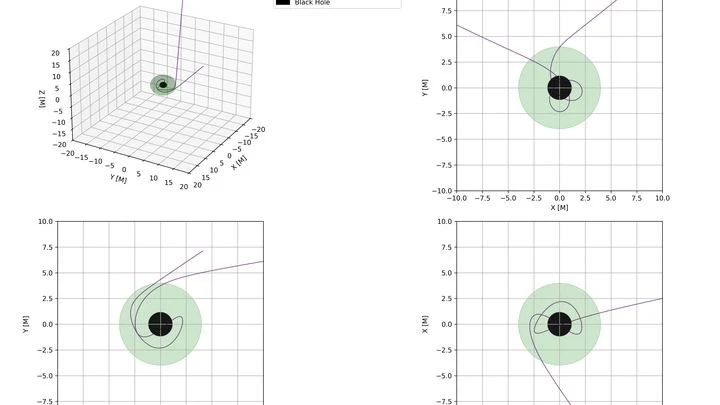
Light passing by a black hole falls into a gravitational trap: its trajectory curves and the particle bounces along a nearly closed orbit, like a pinball.
A whirlpool in a river sucks everything in. Now imagine adding an invisible jelly to the water that thickens near the vortex and suddenly vanishes at its edge: that's roughly what a black hole looks like in a new mathematical model.
Place two identical alarm clocks on a table and set them off at the same time. If one is on a slippery surface and starts to slowly slide, its timing will be thrown off, and within a minute they'll ring out of sync. That's roughly how the new method proposed by astrophysicists for supermassive black holes works.