The Superconductivity Dome: Why Pressure First Helps, Then Hinders express
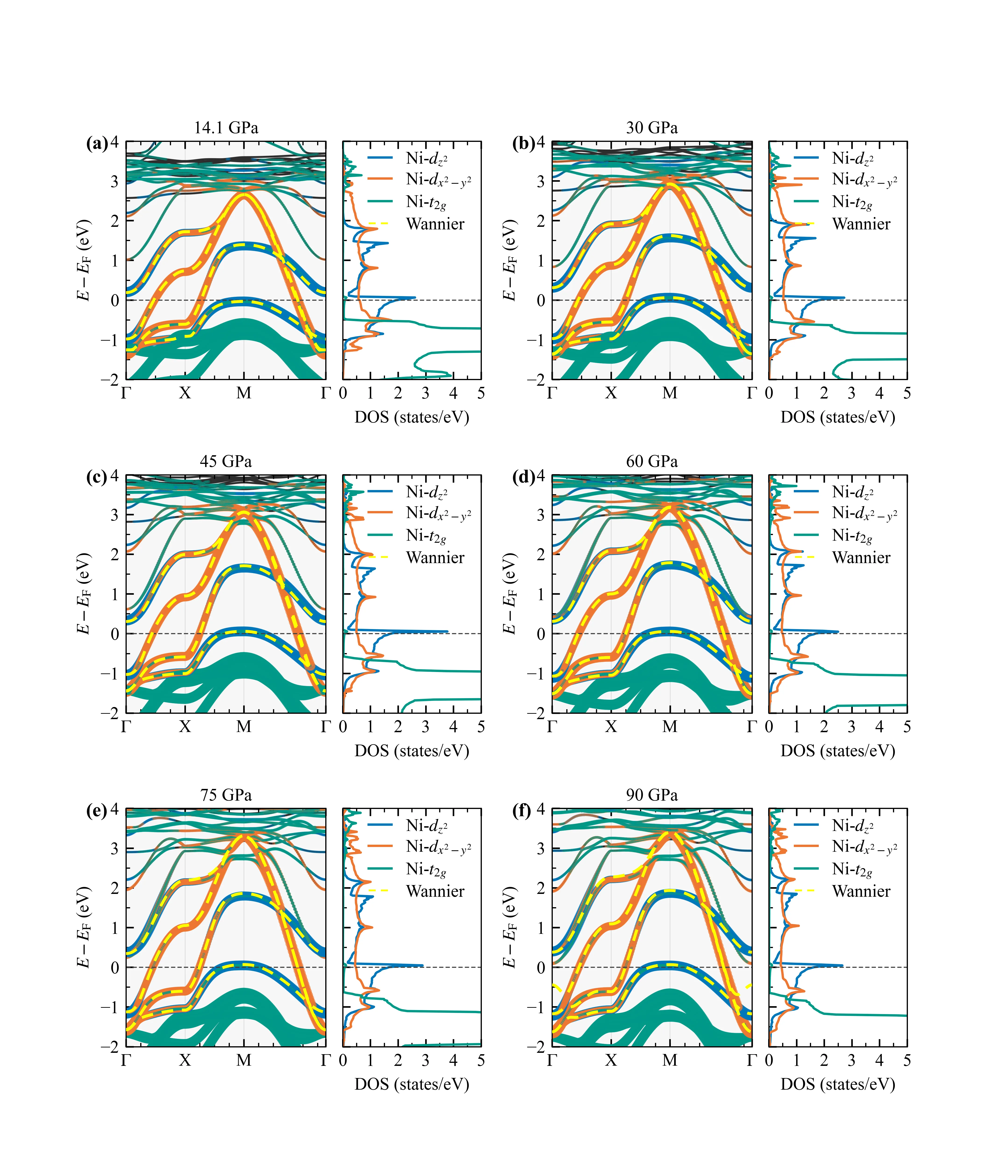
Under pressure, the layered crystal La₃Ni₂O₇ behaves like an orchestra where the conductor adjusts the volume of different instrument sections. Compression increases electron hopping between layers — which, one might think, should boost superconductivity. But at the same time, some electrons become too mobile.
The main intrigue lies in two types of nickel orbitals. Electrons in dx²-y² increasingly resemble free travelers, while their neighbors in dz² stay homebodies. When travelers become numerous, they start to screen the magnetic moments of the homebodies — an effect similar to Kondo screening (a phenomenon where a cloud of free electrons quenches the magnetic field of an impurity). The magnetic interaction that served as the glue for electron pairs weakens.
This is how the dome on the phase diagram is born: superconductivity first strengthens, then is extinguished by the very pressure that created it. The orbital duo regulates its own fate, like an orchestra where the solo section unexpectedly drowns out the rest.
Original abstract
as written by the authors arXiv:2608.02261v1
The recent discovery of high-temperature superconductivity in pressurized bilayer La3Ni2O7 has sparked intense research interest, yet the microscopic mechanism governing its pressure-dependent superconducting transition temperature (Tc) remains elusive. In this work, we investigate the electronic and magnetic correlations of La3Ni2O7 under high pressure using a combination of density-functional theory (DFT), constrained random phase approximation (cRPA), and dynamical mean-field theory (DMFT). We find that while hydrostatic pressure enhances the interlayer hopping and the bare superexchange energy scale (4t2/U), it simultaneously drives the system toward a more itinerant regime by reducing the relative correlation strength (U/W). Crucially, our results reveal a distinct orbital-selective evolution: the Ni dx2-y2 states become increasingly itinerant, whereas the Ni dz2 orbitals retain a more localized character. This pressure-induced itinerancy significantly enhances the hybridization between the two, leading to a dramatic amplification of the Kondo-like screening of the local dz2 moments by the itinerant dx2-y2 electrons. Consequently, the effective magnetic exchange coupling (Jeff), which serves as the pairing glue, is suppressed in the high-pressure regime. Our findings suggest that the monotonic decrease of Tc at high pressures is driven by the dominance of Kondo screening over superexchange interactions, providing a coherent microscopic explanation for the dome-shaped superconducting phase diagram in La3Ni2O7.
The term "Kondo" in physics comes from the name of Japanese scientist Jun Kondo, who in 1964 explained the mysterious rise in resistance in metals with magnetic impurities at low temperatures.