Rare Events in the Quantum World: How Noise Creates Tails ✛
A courtroom interpreter is distracted by every rustle: the creak of a chair, a cough in the back row, the rustle of papers. By the end of the day, they are translating not what the witness said, but what they heard through the noise. Rare translation errors are not the result of a single loud shout, but of the accumulation of many small disturbances.
Similarly, in quantum systems, rare events, such as a particle ending up far from its expected location, arise not from one giant leap, but from the coordinated behavior of many small quantum steps. Classical physics has long been able to describe such distribution tails through the 'theory of large deviations': the probability is exponentially suppressed, and the exponent is found by minimizing relative entropy. But for quantum systems, no analogous recipe existed.
The authors of the new work built a simple model — a quantum walk in which the 'steps' are set by auxiliary quantum particles. It turned out that the probability of a rare event is determined by minimizing not the usual quantum relative entropy, but a modification that takes into account the specific measurement basis. This is like an interpreter who, while writing down what they hear, additionally loses some information because they must choose words from a limited vocabulary.
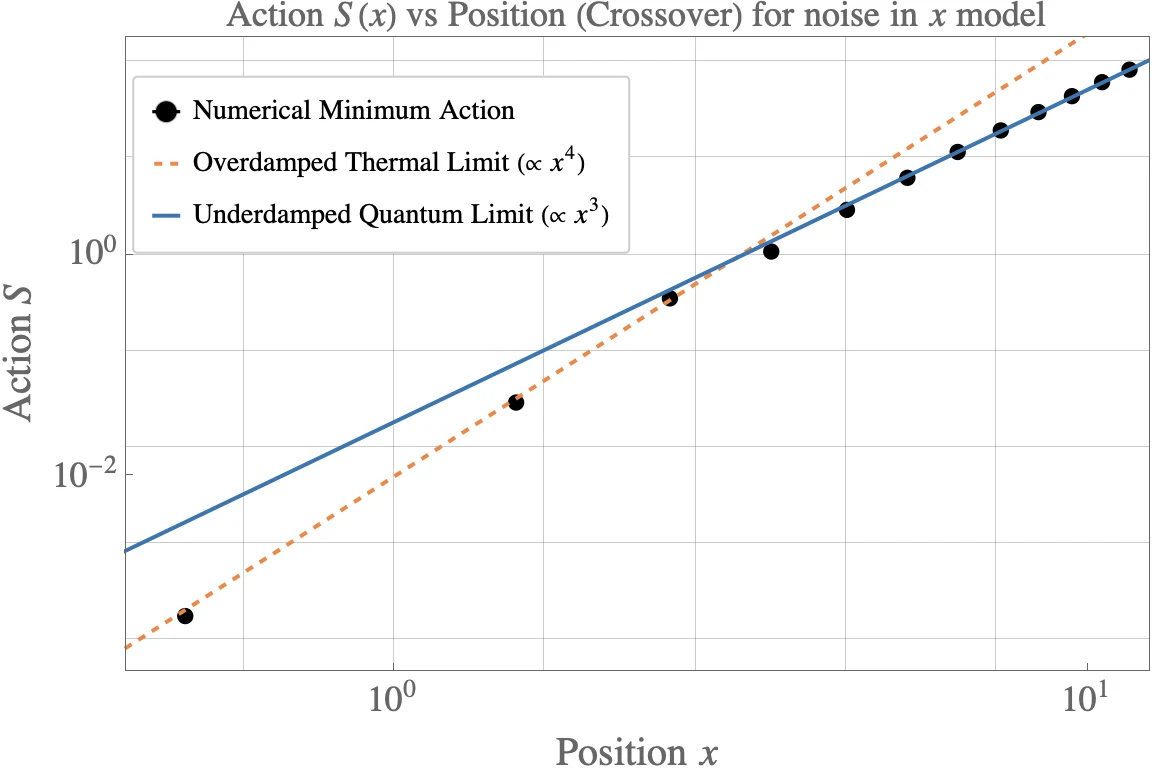
For an anharmonic oscillator at small deviations, the tail of the distribution is determined by thermal fluctuations, and at large deviations — by quantum tunneling. The transition between regimes occurs under the condition β√(V''(x)/m) ~ 1. This number is like a hearing threshold: as long as the noise is quiet, the interpreter works fine, but when the noise exceeds the threshold, they start missing entire phrases.
In cosmology, this approach was applied to stochastic inflation — the description of the evolution of long-wavelength modes of a scalar field in an expanding universe. It turned out that the standard description violates detailed balance and leads to constant entropy production. This means that calculations of the probability of primordial black hole formation, based on the classical Fokker–Planck equation, may be insufficient for extremely rare fluctuations.
Now the interpreter knows that their errors are not random: they obey a strict rule that can be computed. And this rule works not only in the courtroom, but also in the early universe, where rare fluctuations could have given birth to black holes that we might observe today.
In a classical random walk, the probability that all N steps go in the same direction is exponentially small, but it is precisely such collective fluctuations, not a single giant jump, that are usually responsible for rare events. In the quantum case, the situation is analogous: the distribution tail may be determined not by quantum tunneling but by the coordinated behavior of many small quantum steps.