Quantum Mechanics of Rare Events: From Quantum Walks to Stochastic Inflation ✛
Context
Rare events—from galaxy formation to primordial black holes—are determined by the tails of probability distributions. In classical statistical mechanics, large deviation theory provides a rigorous mathematical framework for their description: the probability is exponentially suppressed, and the exponent (the rate function) is found by minimizing relative entropy. For quantum systems, an analogous theory is much less developed. Yet all physical systems are fundamentally quantum, and understanding rare fluctuations is essential for statistical physics, cosmology, and quantum field theory. The problem is complicated by the dual nature of randomness in quantum mechanics: in addition to unavoidable classical noise, there is quantum uncertainty described by Born's rule. How these two sources of randomness compete in shaping distribution tails remained unclear.
Methods
The authors started with the simplest model—a quantum walk in which the 'steps' are governed by auxiliary quantum particles, and the walker's position is shifted by a translation operator. Using the density matrix formalism and path integrals (the open influence functional), they derived evolution equations for an anharmonic oscillator at finite temperature and in the presence of dissipation. To analyze distribution tails, they used the saddle-point method: they looked for classical (instanton) trajectories that minimize the action. The results were then generalized through the concept of measurement-induced relative entropy: the probability of a given empirical density matrix after a series of measurements is determined by this quantity. Finally, the developed formalism was applied to stochastic inflation—the description of the evolution of long-wavelength modes of a scalar field in de Sitter space.
Results
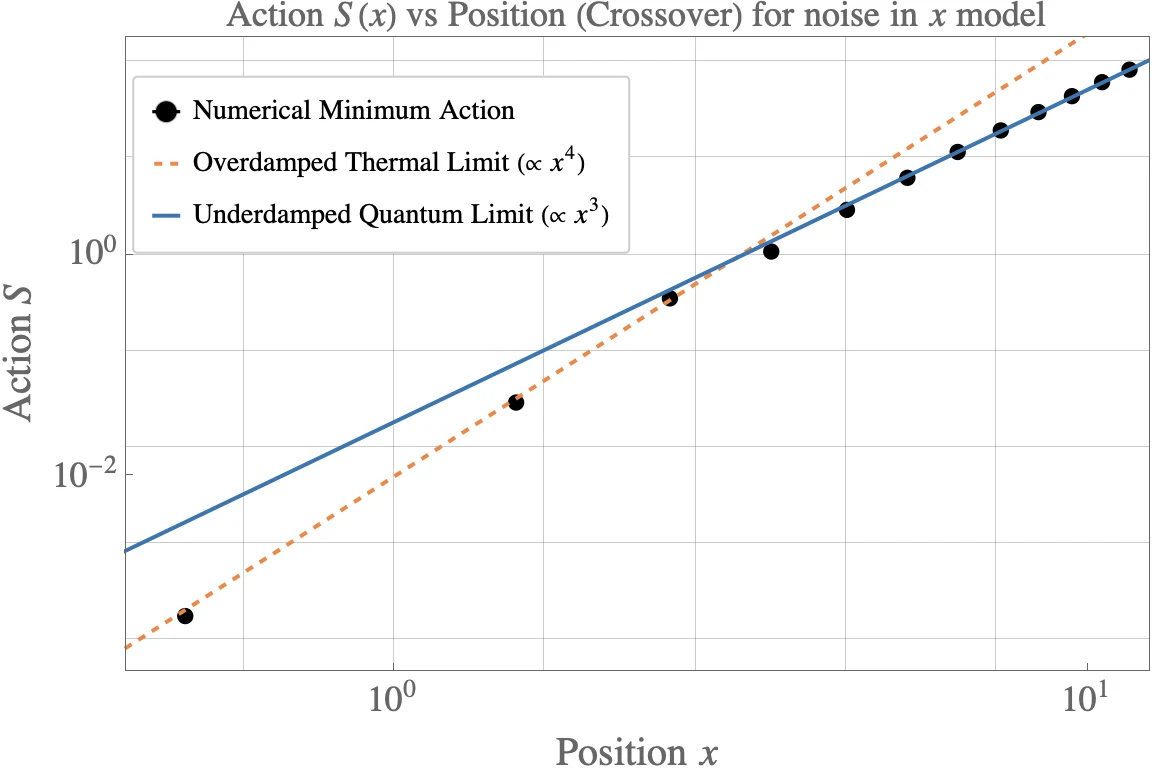
For the anharmonic oscillator, it is shown that for small deviations from the potential minimum, the distribution tail is determined by thermal fluctuations and has the form exp(−βV(x)), while for large deviations, quantum tunneling dominates, described by the WKB approximation. The transition between regimes occurs when β√(V''(x)/m) ~ 1. In the general case of a quantum walk, the probability of a rare event is given by minimizing the sum of the measurement-induced relative entropy for the steps and the logarithm of the initial probability density. This allows one to obtain lower bounds on distribution tails using only the WKB wave function. In the cosmological context, it is shown that stochastic inflation violates detailed balance and leads to a stationary state with nonzero entropy production (housekeeping entropy), which is related to the violation of KMS symmetry. For DBI inflation, an explicit lower bound on the field distribution tail is obtained.
Implications
The work fills a gap between classical large deviation theory and quantum mechanics, offering a practical tool for calculating rare events in open quantum systems. The key conclusion: in quantum walks, the relevant quantity is not the quantum relative entropy but its modification that accounts for the specific measurement basis. This clarifies why purely quantum effects may not dominate in distribution tails. For cosmology, the result means that standard stochastic inflation, based on the classical Fokker–Planck equation, may be insufficient for describing extremely rare fluctuations, and the quantum nature of noise must be taken into account.
Future development
A natural next step is to apply the developed formalism to more complex models, including multidimensional fields and interactions beyond λφ⁴. An open question remains how to incorporate gravitational backreaction and the finiteness of de Sitter entropy. It is also important to investigate whether the KMS symmetry violation found in the density matrix evolution can be related to the behavior of out-of-time-order correlators (OTOCs), recently studied in the literature.
Impact
The results may affect calculations of primordial black hole formation probabilities and the interpretation of non-Gaussianity in cosmological observables. Furthermore, the proposed approach may find applications in quantum thermodynamics and quantum metrology, where rare events are important.
Next steps
Plans include generalizing the method to measurements in an arbitrary basis, not just a fixed one, and investigating the connection with entropy production in more general nonequilibrium quantum systems.
Key open problems
In cosmology, the problem of reliably computing density distribution tails for predicting primordial black hole abundances remains unsolved. This work shows that standard stochastic inflation methods may give incorrect results in the strong non-Gaussian regime and offers an alternative approach based on relative entropy minimization. This is directly related to the fundamental question of the applicability of effective field theory for describing rare events in the early Universe.
The knowledge machine's view
This section is addressed to the author of the paper and their colleagues. Neighbouring works were found by meaning-based search across our archive, not by word overlap. We do not review: we show the field around the work.
What the work does
The authors developed a practical approach to rare fluctuations in quantum walks: the probability of a rare event is determined by minimizing the relative entropy induced by measurement. They applied the method to an anharmonic oscillator, revealing a transition from thermal tails to quantum tunneling, and to stochastic inflation, showing violation of detailed balance and obtaining a lower bound on the tail of the field distribution.
Where its strength is
This work provides a rigorous variational principle for tails in quantum systems with noise and measurements, linking rare events to measurement-induced relative entropy. It opens a path to estimating probabilities of extreme fluctuations in a wide class of models, including cosmological ones.
Where it could go next
- It might be interesting to compare the developed formalism with rare-event sampling methods in quantum systems, which also use large deviations and optimal control parameters.based on: Quantum sieve catches one-in-a-million glitches arXiv:2606.06316
- Closely related is work on branching stochastic trees in inflation: there, rare events lead to exotic black holes; perhaps your method could provide quantitative estimates for such processes.based on: Branching Inflation: How Stochastic Trees Revealed Exotic Black Holes arXiv:2606.30087
- The violation of detailed balance and entropy production in stochastic inflation resonates with the analysis of quantum measurements as hidden evolutionary paths; perhaps there is a common mathematical language.based on: Quantum Measurements: Hidden Paths of Evolution arXiv:2503.08296
Worth trying
- Test whether minimizing measurement-induced entropy reproduces known results for rare trajectory probabilities in quantum jump processes.
- Apply the method to compute curvature distribution tails in inflation models with non-smooth potentials, where stochastic effects are amplified.
- Investigate the connection between housekeeping entropy and observable non-Gaussianities in cosmological correlators.
Why this may matter
If rare fluctuations in quantum systems can be described by a unified variational principle, this could provide a universal tool for estimating probabilities of extreme events in quantum thermodynamics, cosmology, and condensed matter physics, where distribution tails often determine key phenomena.
Nearby works in our archive
- Quantum sieve catches one-in-a-million glitchessimilarity 0.66
- The Universe as a Quantum Fogsimilarity 0.63
- A Black Hole as a Fussy Thermometersimilarity 0.63
- Quantum Measurements: Hidden Paths of Evolutionsimilarity 0.63
- How the Quantum Vacuum Blurs Timesimilarity 0.62
- The Horizon Can't Remember Without a Tremorsimilarity 0.61
- Branching Inflation: How Stochastic Trees Revealed Exotic Black Holessimilarity 0.60
The closest work in the archive sits at 0.66 by meaning — the usual level for our corpus.
Original abstract
as written by the authors arXiv:2608.06319v1
Rare fluctuations in physical systems depend on the detailed microphysics responsible for the fluctuations. In classical statistical systems, the large deviation principle has elucidated the role of semi-classics in describing this regime, and has simultaneously provided a the mathematical foundation of statistical mechanics. Large deviation theory for quantum system is considerably less developed. As all physical systems are fundamentally quantum mechanical, this leaves a major gap in our understanding of rare fluctuations relevant to statistical physics, cosmology, and more. In this paper, we develop the practical aspects of the theory of large deviations relevant for calculating rare events in physical systems from quantum walks to cosmology. We first analyze the case of the anharmonic oscillator coupled to a bath, showing explicitly how the system evolves from dominantly statistical (e.g. thermal) to quantum fluctuations. We then generalize these results, showing that the dominant rare fluctuations minimize the measurement-induced relative entropy. This perspective provides a thermodynamic description of a wide range of open quantum systems. We apply these results to random walks that arise in cosmology through stochastic inflation. We show that the evolution of the density matrix of long wavelength fields on a fixed de Sitter background breaks the KMS symmetry, giving rise to a stationary density matrix that does not respect detailed balance.
In a classical random walk, the probability that all N steps go in the same direction is exponentially small, but it is precisely such collective fluctuations, not a single giant jump, that are usually responsible for rare events. In the quantum case, the situation is analogous: the distribution tail may be determined not by quantum tunneling but by the coordinated behavior of many small quantum steps.
Key numbers
- Transition criterion from thermal to quantum regime: β√(V''(x)/m) ~ 1
- Number of steps in the random walk: N
- Coordinate scale for a rare event: x = Nα, where α = O(1)
- Hawking–Gibbons temperature for de Sitter: T = H/(2π)
- Entropy production rate in the stationary nonequilibrium state: Ṡ_tot = μ²F²/g