How Gravitational Waves Expose Black Hole Impostors express
Drop two stones of different shapes into a pond — the ripples will tell you which one was smooth and which was jagged. Gravitational waves work the same way: when two ultra-dense objects merge, the trembling of spacetime carries details about their inner workings.
Black holes are thought to have no 'hair'—no extra features beyond mass and spin rate. This is the prediction of the no-hair theorem. Neutron stars or hypothetical exotic objects are more complex: their oblateness or pear-shape depends on the 'dough' they are made of (physicists call this the equation of state). When such bodies orbit in a pair, their spin creates slight deviations in shape — the quadrupole and octupole moments (deviations from a perfect sphere and subtler distortions). These differences slightly alter the rhythm of the emitted gravitational waves.
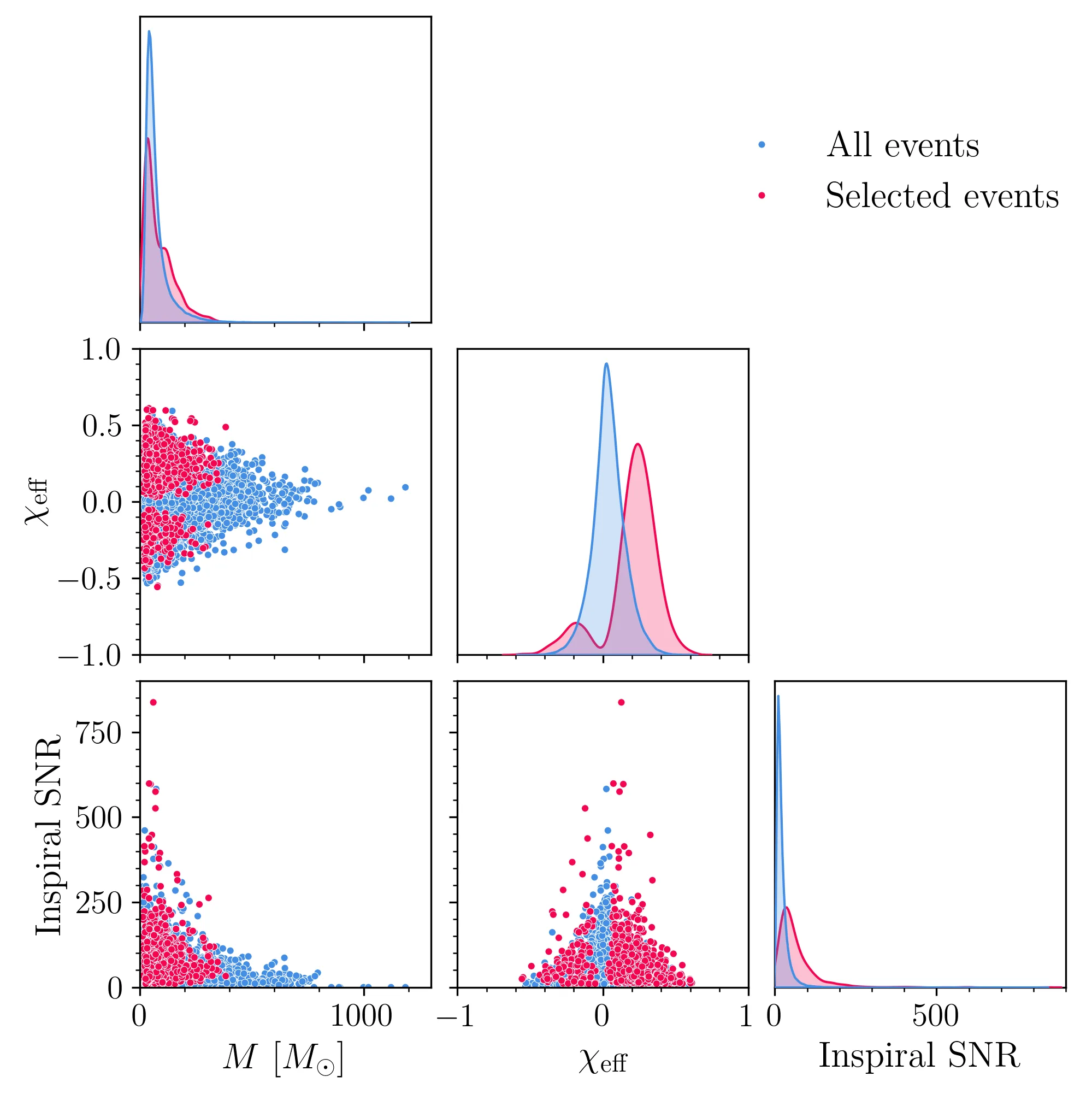
The authors of the study took a flexible method (FTI) that is not tied to any specific theory and added corrections to the signal waveform to account for these moments. They first tested the approach on synthetic signals, then applied it to real data collected by the LIGO-Virgo-KAGRA collaboration. It turned out that current detectors cannot yet reliably measure such subtleties. But future facilities, Einstein Telescope and Cosmic Explorer, could determine the quadrupole moment to within a few hundredths, and the octupole moment to tenths. That is a hundred times better than today's limits. If a signal shows a deviation from the black-hole template, we've caught an impostor — say, a neutron star or something truly unusual.
Original abstract
as written by the authors arXiv:2608.07237v1
According to the no-hair theorem, the multipole moments of an electrically neutral black hole in general relativity are entirely determined by its mass and spin. However, this is not in general true for compact objects: The multipole moments of neutron stars or exotic compact objects can depend on their formation history and internal processes, which are encoded in an equation of state. Furthermore, their spin-induced multipole moments differ from those of black holes of the same mass and spin, leaving an imprint on the dynamics and emitted gravitational waves of the binary. Gravitational waves can thus be used to test the nature of compact binary coalescences. Here, we present a test of the spin-induced quadrupole and octupole moments of compact objects based on the flexible theory-independent (FTI) framework. FTI is a parameterized inspiral test of general relativity which enables the addition of post-Newtonian coefficient deviations to the gravitational-wave phase of a generic aligned-spin frequency-domain waveform model. We use this test on synthetic signals to study the measurability of spin-induced quadrupole and octupole moments. Next, we apply the test to a subset of signals observed by the LIGO-Virgo-KAGRA Collaboration. Lastly, we present forecasts for next-generation ground-based detectors, such as Einstein Telescope and Cosmic Explorer. Our estimates suggest that these detectors will be capable of placing stringent constraints on the spin-induced quadrupole and octupole moments of $$\mathcal{O}(10^{-2})$$ and $$\mathcal{O}(10^{-1})$$ respectively, which is two orders of magnitude tighter than current constraints, and thus on the nature of black holes in a compact binary coalescence.
The name 'no-hair theorem' was coined by John Wheeler: black holes are so simple that they have no individual 'hairstyles'—only mass, charge, and spin.
In Isaac Asimov's novel 'The End of Eternity,' characters travel through the centuries, but even they would have to admit that gravitational ripples from colliding compact objects are the best detector of a black hole's authenticity.