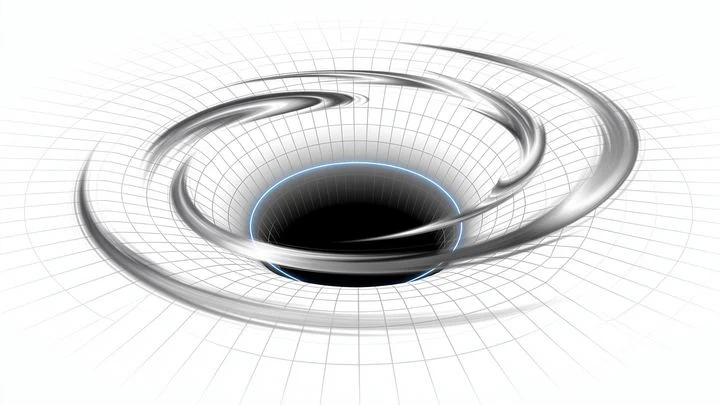
In theoretical physics, tidal charge is a parameter that appears in certain solutions of Einstein's equations inspired by higher-dimensional theories, such as string theory or braneworld models. It modifies the standard black hole spacetime, introducing an extra term that behaves like an electric charge but originates from the bulk geometry of extra dimensions. The name reflects its effect on tidal forces—the gravitational gradients that stretch and squeeze objects—which differ from those of a purely four-dimensional black hole.
History
The concept emerged in the early 2000s within braneworld scenarios, notably in work by Roberto Casadio and collaborators, who derived effective black hole solutions from the Randall-Sundrum model. The term 'tidal charge' was coined to distinguish this geometric effect from genuine electric charge.
How it works
In the Reissner-Nordström metric, a black hole's charge appears as a term proportional to Q²/r². Tidal charge enters the same mathematical position but with a sign that can be positive or negative, depending on the underlying theory. It arises from the projection of higher-dimensional gravitational effects onto our four-dimensional spacetime, effectively mimicking a charge without any actual electromagnetic source. This alters the horizon structure and the strength of tidal forces near the black hole.
In practice
Tidal charge is used in theoretical studies of black hole shadows and gravitational wave signals, where it provides a testable signature of extra dimensions.
Fun fact
A negative tidal charge can make a black hole's horizon smaller than its Schwarzschild radius for the same mass, potentially allowing matter to orbit closer than in general relativity.
A superconductor pushes out a magnetic field like a sponge squeezing out water. This Meissner effect has been known for nearly a century, but it's usually calculated in a flat world — without gravity. In the strong field of a black hole or at enormous speeds, the picture changes.
When two heavy balls merge into one, ripples spread across the water's surface for a long time. A black hole behaves similarly: after a merger, it 'rings' for a while, emitting special gravitational oscillations — quasinormal modes. Usually, this ring fades quickly, like an echo dying out in an empty hall.
Drop two stones of different shapes into a pond — the ripples will tell you which one was smooth and which was jagged. Gravitational waves work the same way: when two ultra-dense objects merge, the trembling of spacetime carries details about their inner workings.
A black hole is not an eternal vacuum cleaner. It slowly loses mass by emitting particles, much like a heated stone cooling as it radiates heat. This process, discovered by Stephen Hawking, is barely noticeable for large holes, but for tiny ones, with masses comparable to a mountain, it becomes a violent evaporation.
Drop a stone into a calm lake, and ripples spread in even circles. Spacetime around a massive body behaves similarly: if the body is perfectly round, the disturbances it causes are symmetric. A black hole in general relativity resembles a perfectly smooth mirror of water.
A black hole spun up almost to its limit is like an athlete balancing on the edge of a record. The most interesting action isn't inside the hole itself, but in the thinnest film of spacetime at its horizon. It's there that tiny corrections to Einstein's gravity can suddenly swell to gigantic proportions.
A black hole is like a perfectly smooth sphere. It has no features — only mass, charge, and spin. This rule is called "no-hair." But nature loves to complicate things: sometimes a cloud of a scalar field (a special field described by a single number at each point) spontaneously appears around a black hole.
A cosmic object spins, but its shadow isn't round. Astrophysicists examined a black hole in an unusual version of gravity — the so-called brane world (where our universe is a three-dimensional surface in a space of higher dimensions).
In the first 10⁻³⁵ seconds after the big bang, the most rapid part unfolded. Space expanded faster than light — that's expansion of the universe (inflation). Almost the entire score was performed by a single field, the inflaton, conducting the tempo and key.
A black hole sitting on a thin cosmic membrane (brane) resembles a heavy ball stretching an elastic sheet. In classical physics, it is bald — only mass, charge, and rotation. But add a scalar field (an invisible substance like temperature), and the hole can spontaneously grow 'fur' from this field.
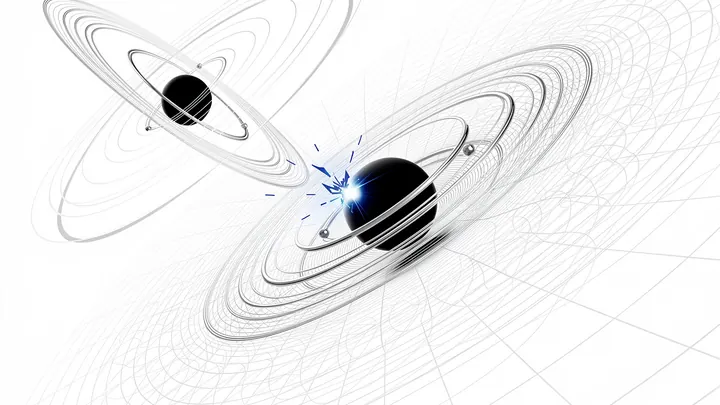
A pair of black holes circles in a dance, gradually drawing closer. They lose energy and spin — a process known as angular momentum radiation. In standard Einstein theory, only gravitational waves carry away angular momentum.
Gravity is the invisible glue that holds stars and planets together. But what if this glue has a tiny mass? In massive gravity, the carrier particles (called gravitons) weigh a minuscule but nonzero amount. This changes the rules near black holes.
The authors of the new study built on a mathematical tool — eigenvalue decomposition.
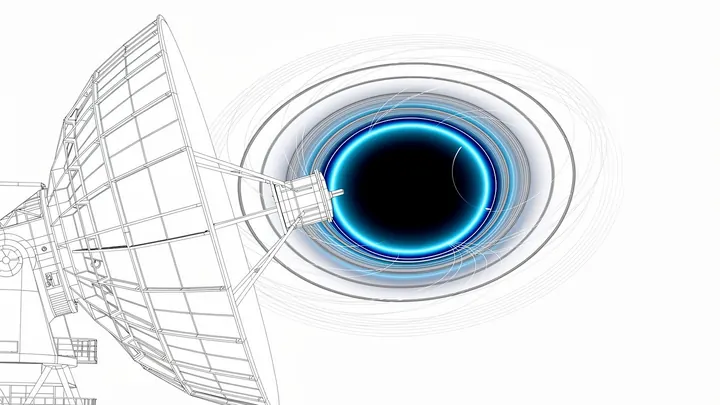
At the center of most galaxies lurk supermassive black holes — the overlords of gravity. Since 2019, thanks to interferometry with very long baselines, we’ve glimpsed their shadows: dark silhouettes set against a blazing gas backdrop. But what exactly is painting that shadow?
At the center of an ordinary black hole, according to classical ideas, lurks a singularity — a point of infinite density where the laws of physics break down. But some theories, inspired by the duality idea from string theory, propose replacing the point with a tiny 'smudged' region.
In cricket, there's a special delivery — the googly. The ball spins in a way that deceives the batsman. Physics had its own googly: for nearly half a century, mathematicians couldn't make twistor theory work with real gravity. It described 'nice' fields perfectly, where everything twists in one direction. But as soon as an 'awkward' component appeared, the machinery broke down.
Gas passing through a narrow valve can heat up or cool down: this is the Joule–Thomson effect, which powers refrigerators and air liquefiers. It turns out black holes can do the same.
At the heart of almost every galaxy slumbers a supermassive black hole — the invisible conductor of a stellar orchestra. When galaxies collide, their central monsters draw closer, entwining in a gravitational dance. Sometimes a third partner joins the duo, and then a triple waltz begins, its outcome unpredictable.
A black hole is like a perfectly dark room: from outside, you can't see what's inside, and anyone crossing the threshold seems to vanish from the outside world. But what does the falling observer feel? In classical physics, nothing special: the event horizon isn't marked by any signpost.
A black hole with an electric charge is like a vacuum cleaner that not only sucks in everything around it but can also hold light particles in orbit. These particles form a kind of fuzzy cloud around the hole — physicists call it a quasi-bound state.
A wormhole is a tunnel connecting two distant regions of the universe. If such a wormhole existed and were traversable, a particle inside it would feel not only gravity but also a force from its own electric field. This force depends on how spacetime is curved around it.
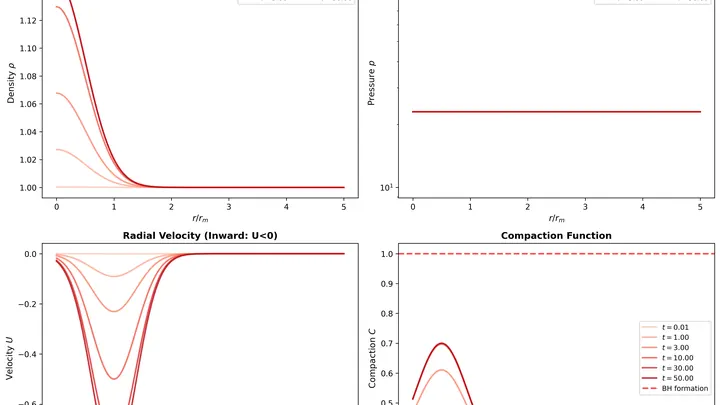
In the first moments after the Big Bang, the universe was filled with a hot, nearly uniform plasma. But in some places, the density could randomly be slightly higher. If such a clump gained critical mass, it collapsed into a black hole: this is how primordial black holes were born.
A figure skater spins on the ice, gradually spiraling inward. Similarly, a small star or black hole orbiting a massive black hole loses energy. It emits gravitational waves — ripples in spacetime that detectors on Earth pick up.
But the dance of this pair is more intricate than it seems. The small companion isn't just a point.
The light of a distant star briefly brightens when a massive invisible object passes between it and a telescope. This phenomenon, gravitational microlensing, acts as a natural telescope. Usually, the lens is a black hole, warping the spacetime around it.
The universe as painted in Einstein’s textbooks is a smooth four-dimensional canvas. But string theory adds a frame of extra dimensions — invisible, yet tangible to gravity. Imagine our universe as a membrane that trembles under the pressure of hidden layers.
A classical black hole has a temperature and other thermodynamic properties. When physicists began accounting for changes in the cosmological constant, the energy of empty space, a strange coupling emerged in the equations.
Einstein’s cosmological constant — a blunder or a boomerang insight? The universe’s acceleration caught physicists off guard: ΛCDM works, but why is the vacuum energy so absurdly tiny? Imagine an ocean heaving with quantum fluctuations, yet on the surface only a microscopic ripple.
Two magnets collide in a dark room, stick together into a clump, and a dull thud echoes. Black holes behave much the same way, except instead of magnets they carry electric charge, and instead of a thud, there's a burst of gravitational waves. But there's a third player in this story — an invisible field that physicists call scalar.
In the early 20th century, Einstein showed that gravity is the curvature of space and time. A bit earlier, Maxwell had unified electricity and magnetism into a single theory.
A black hole is like a perfect vacuum cleaner: anything that crosses its horizon vanishes without a trace. But this vacuum cleaner has a strange feature: its "dust bag" grows, and by the size of the bag you can tell how much has been sucked in. In black hole physics, this size is linked to entropy entropy — a measure of hidden information about what fell inside.
The ocean bulges a full meter under the Moon: that's a tide. If a massive body sits near a black hole, the hole feels a tidal pull too. In ordinary Einsteinian gravity, it doesn't respond to such a static tide: its "tidal numbers" (measures of deformability) are zero.
A black hole is a place where gravity is so strong that even light cannot escape. But around it there is a glowing ring of gas, and in the center a dark void known as the shadow. The size of this shadow depends on how spacetime is curved.
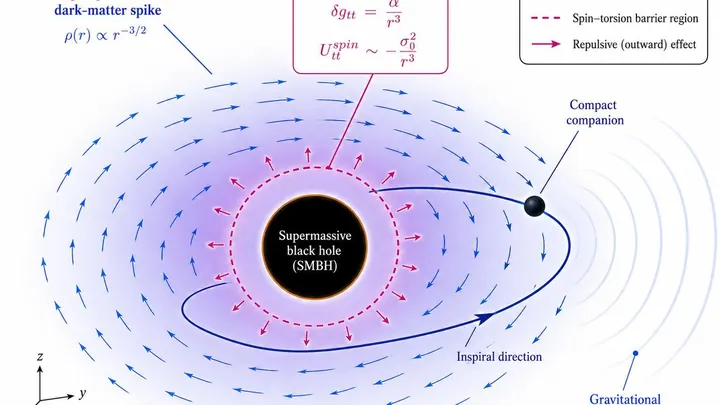
A supermassive black hole drifts through a cloud of dark matter. In the usual picture, this invisible substance just adds mass and barely interacts with ordinary matter. But dark matter particles could have intrinsic rotation — spin.
Drop a pebble into a pond — ripples spread across the water. In much the same way, a massive body circling a black hole perturbs the fabric of spacetime, generating gravitational waves. But what if the pond itself isn't flat, but has hidden folds — extra dimensions invisible to the eye?
A light ray skims along the horizon of a black hole: that invisible boundary from which nothing can escape. The closer the ray gets to the horizon, the slower its own 'time' stretches — a special measure of path called the affine parameter.
In the usual picture, a black hole is a featureless pit in spacetime. But if a shell of matter vibrates around it, the gap between the edge of the abyss and this shell becomes a resonant cavity.
A black hole is like a whirlpool in the ocean: anything that falls in disappears forever. But if the whirlpool spins and carries a slight electric charge, and invisible axion particles (dark matter candidates) are buzzing around it, its surface stops being smooth.
Around an invisible fire, glowing gas swirls. The fire itself is hidden, but its outline can be guessed from the way the flames dance. That's roughly how astronomers 'see' black holes — not the object itself, but the superheated matter that, before plunging into the abyss, accelerates to enormous speeds and shines.
Two electrically charged spheres attract each other with a certain force. If you replace their charges with magnetic poles, a spring scale shows exactly the same force. Black holes, it turns out, behave the same way — except instead of springs, the fabric of spacetime itself does the work.
A wormhole is a tunnel through the fabric of spacetime, an idea expanded by John Wheeler and Kip Thorne. Just as a mountain passage tends to cave in, the throat of a wormhole wants to snap shut.