Dust and Gas in Planetary Cradles: Taurus Reveals Early Disks ✛
Context
Protoplanetary disks are rings of gas and dust around young stars where planets are born. But the earliest stages of these disks, when the star is still embedded in a dense cloud (Classes 0 and I), remain poorly understood: the disk's emission is hard to separate from the surrounding envelope. Our work fills this gap by conducting the first systematic survey of all such objects in the nearest major star-forming region—Taurus. Surveys of disks in Perseus, Orion, and Ophiuchus exist, but Taurus is unique in its proximity and lack of massive stars, making it an ideal laboratory.
Methods
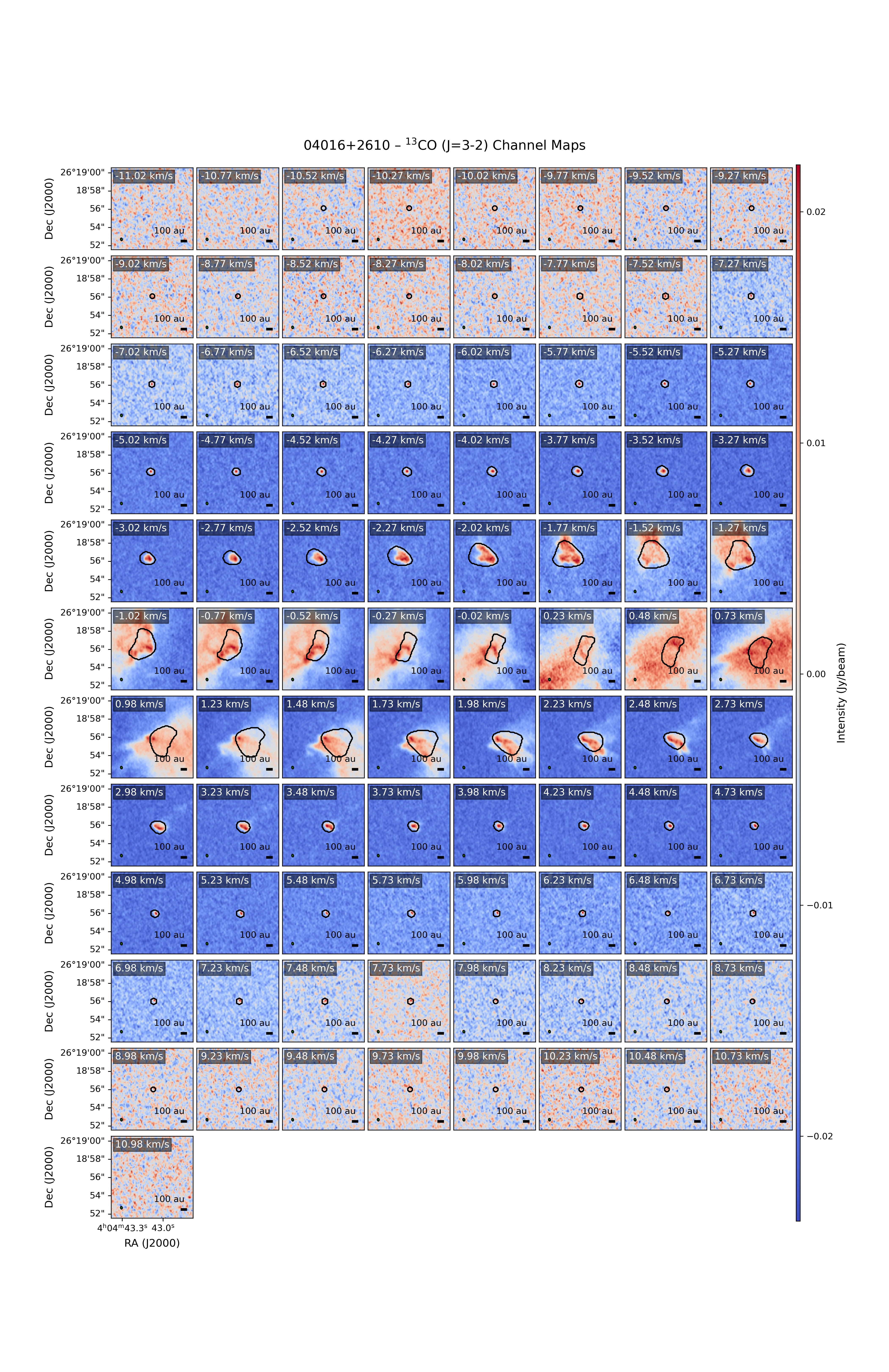
We observed 26 systems in Taurus at two wavelengths: 0.87 mm (ALMA) and 9 mm (VLA) to measure dust, and the carbon monoxide lines 13CO and C18O to estimate gas. To separate the disk from the envelope, we constructed Keplerian masks—three-dimensional templates that only pass emission moving in orbit around the star. We then compared the observed lines with a grid of 29,160 disk models to find the most likely gas mass. This approach has been applied for the first time to the entire Taurus population, not just individual objects.
Results
The median dust mass in Taurus disks was 5.5 Earth masses (from ALMA data) and 39 Earth masses (from VLA data), with a median radius of 28 AU. Taurus disks turned out to be brighter and more massive than those in Ophiuchus, but fainter than those in Orion. Within Taurus itself, Class 0/I disks are brighter than more evolved Class II disks, although their dust masses are comparable. The median gas mass is 6.7×10⁻⁴ solar masses, and the gas-to-dust ratio ranges from 8 to 147 (median 26). This indicates that some disks have already lost gas, while others retain the interstellar ratio.
Implications
This work provides the first complete census of dust and gas masses for all young disks in a single region, eliminating systematic errors in comparisons between different clouds. Unlike neighboring surveys, we combined ALMA and VLA data with CO lines, allowing independent estimates of gas and dust. This showed that Taurus disks are not a scaled-down version of disks in Orion or Ophiuchus, but have their own peculiarities, likely related to the mass of the parent cloud.
Future development
The topic will evolve toward detailed modeling of each disk, including radiative transfer and chemistry, to refine the masses. It is also important to extend surveys to other regions with different conditions, such as dense clusters, to understand the role of the environment. New instruments like ngVLA will allow measuring gas on larger scales and testing our assumptions about composition.
Impact
The results will impact theories of planet formation by refining the initial reservoir of material, and models of disk evolution by linking early stages to later ones.
Next steps
The next step is to perform radiation-hydrodynamic modeling for each disk to remove uncertainties in temperature and optical depth. We also need data on rarer CO isotopes, such as C17O, to independently verify gas masses.
Key open problems
Our work directly addresses the unresolved problem: why Class II disks often contain less dust than needed to form giant planets. We showed that at early stages, dust is abundant, but the gas-to-dust ratio already varies widely, which may indicate rapid evolution. This raises the question of where the dust goes and how fast planetesimals grow.
The knowledge machine's view
This section is addressed to the author of the paper and their colleagues. Neighbouring works were found by meaning-based search across our archive, not by word overlap. We do not review: we show the field around the work.
What the work does
We conducted a complete survey of 26 protostellar systems in Taurus with ALMA and VLA, measuring dust and gas masses using Keplerian masks and a grid of models. We obtained median dust masses of 5.5 and 39 Earth masses at 0.87 mm and 9 mm, a median radius of 28 AU, a median gas mass of 6.7×10⁻⁴ solar masses, and gas-to-dust ratios of 8–147.
Where its strength is
For the first time, we provide a full census of dust and gas masses for all young disks in a single region, with independent estimates from dust and molecular lines, eliminating systematic errors in inter-cloud comparisons.
Where it could go next
- It might be interesting to compare the measured gas-to-dust ratios with predictions from chemical evolution models where carbon and oxygen are redistributed between gas and ice; in our archive there is a nearby work on how this affects observed disk properties.based on: Cosmic Kitchen: How Carbon and Oxygen Shape the Look of Disks arXiv:2602.16030
- To interpret the wide spread in dust masses and disk brightness at different wavelengths, one could consider models of dust growth and migration, including the formation of icy pebbles that can change opacity and observed fluxes.based on: Icy Pebbles: Why Some Comets Are Rich in Carbon Monoxide arXiv:2603.26876
- Since your data indicate possible gas loss in some disks, it would be useful to compare them with observations of winds and outflows; the archive contains a work on dust halos around young stars that could provide additional context.based on: Dust Halos Around Young Stars arXiv:2604.18332
Worth trying
- Test whether the variation of gas-to-dust ratio with radius can be explained by carbon and oxygen transport models from work 2602.16030.
- Assess how the growth of icy pebbles (2603.26876) would affect the measured dust masses at 0.87 mm and 9 mm.
- Search for a correlation between gas loss and the presence of extended dust halos, as in 2604.18332.
Why this may matter
Such comparisons can clarify how initial conditions in different star-forming clouds determine the evolution of protoplanetary disks and, ultimately, the diversity of planetary systems.
Nearby works in our archive
- Icy Pebbles: Why Some Comets Are Rich in Carbon Monoxidesimilarity 0.65
- Weighing the Dust Around Young Starssimilarity 0.64
- Dust Halos Around Young Starssimilarity 0.62
- A Dust Ring Where Giants Are Bornsimilarity 0.62
- A Warm Pocket in a Cold Disksimilarity 0.62
- Baby Galaxy with Fuel to Sparesimilarity 0.61
- Cosmic Kitchen: How Carbon and Oxygen Shape the Look of Diskssimilarity 0.61
The closest work in the archive sits at 0.65 by meaning — the usual level for our corpus.
Original abstract
as written by the authors arXiv:2608.09896v1
Envelope-embedded protostellar disks represent the earliest stage of protoplanetary disk evolution, but their masses and sizes are difficult to measure because disk emission is entangled with the envelope. We analyze 26 protostellar disk systems in Taurus using ALMA Band 7 (345 GHz; ~0.3'') and VLA Ka-band (33 GHz; ~0.2'') continuum observations, together with molecular-line data to constrain disk gas masses. At 345 GHz, the median flux density, dust mass, and radius are 71 mJy, 5.5 M_Mearth, and 28 AU, with 68% ranges of 54-107 mJy, 3.9-9.4 M_Mearth, and 25-39 AU. At 33 GHz, the corresponding medians are 0.43 mJy, 39 M_Mearth, and 32 AU, with ranges of 0.41-0.80 mJy, 34-52 M_Mearth, and 29-33 AU. Taurus Class I disks are fainter and less massive than those in Orion, comparable to Perseus Class I disks but fainter than Perseus Class 0 disks, and brighter and more massive than those in Ophiuchus. Within Taurus, Class 0/I disks are brighter than Class II disks at both frequencies, although their inferred dust masses are comparable at 345 GHz and slightly higher at 33 GHz. Radiative-transfer modeling of CO isotopologue emission yields a median gas mass of 6.7 x 10^-4 M_Msun. The resulting CO-inferred gas-to-dust ratios span a broad range, with a mean of 147 +/- 75, a median of 26, and a 16th-84th percentile range of 8-147. This distribution overlaps the Taurus Class II population at the low end and ISM-like or higher values, including the AGE-PRO Ophiuchus Class 0/I population, at the high end.
The most massive disk in the sample contains dust equivalent to 97 Earth masses — enough to build three Neptunes. The smallest disk is only 8 astronomical units across — smaller than Saturn's orbit.
In Liu Cixin's novel 'The Three-Body Problem', the Trisolaran civilization exists in a system with chaotic orbits due to three stars. Our data on Taurus disks remind us that most stars are born in binary and multiple systems, and their disks can be distorted by the gravity of companions, affecting planet formation.
Key numbers
- median dust mass (ALMA): 5.5 Earth masses
- median dust mass (VLA): 39 Earth masses
- median disk radius: 28 AU
- median gas mass: 6.7×10⁻⁴ solar masses
- gas-to-dust ratio range: 8–147