Where Stars End and the Invisible Begins express
A galaxy is like a city: bright lights and dense buildings at the center, sparse lights and emptiness toward the outskirts. But if you watch how gas rotates in a galaxy's disk, you see that its speed barely drops at the edges. As if invisible neighborhoods keep the motion going. Astronomers have found a way to map this invisible city.
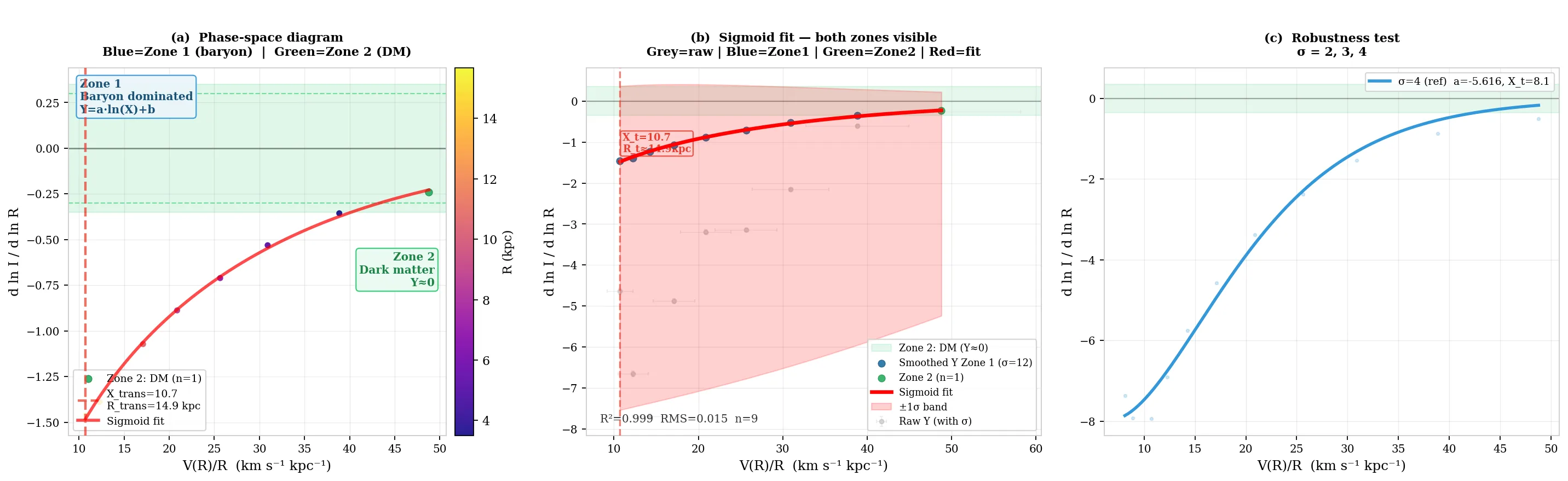
They compared two quantities at each distance from the center: how fast matter rotates (which tells you how much mass lies inside the orbit) and how sharply the stars' brightness falls off. Inside, where stars are plentiful, brightness drops steeply. Outside, where stars are scarce, brightness barely changes. The transition between these regimes turned out to be smooth, like a gentle slope, and is described by the same mathematical curve for all galaxies.
After checking 136 galaxies at various distances from us, the scientists saw that, on average, the boundary lies 5,4 thousand light-years from the center. Inside this boundary, stars rule; beyond it, invisible mass, called dark matter, takes over. It can't be seen through telescopes, but its gravity accelerates gas and stars at the outskirts.
Such a simple marker helps quickly estimate where ordinary matter ends in a galaxy. It's like telling where the private sector ends and the field begins by the color of the fence — without peeking over it.
In some galaxies, the transition zone spans less than a thousand light-years, like a sharp boundary between downtown and the suburbs, with no intermediate neighborhoods.
In Blake Crouch's novel Dark Matter, the protagonist enters a world where dark matter affects reality, and here, it truly determines where stars end.