Solar Wind: Why Protons and Alpha Particles Heat Differently express
The solar wind is a continuous stream of charged particles flowing from the Sun. It has two main components: protons (hydrogen nuclei) and alpha particles (helium nuclei, four times heavier). If particles simply collided with each other, heavy alpha particles would cool down, transferring energy to light protons, and eventually all would have the same temperature. But measurements show a different picture.
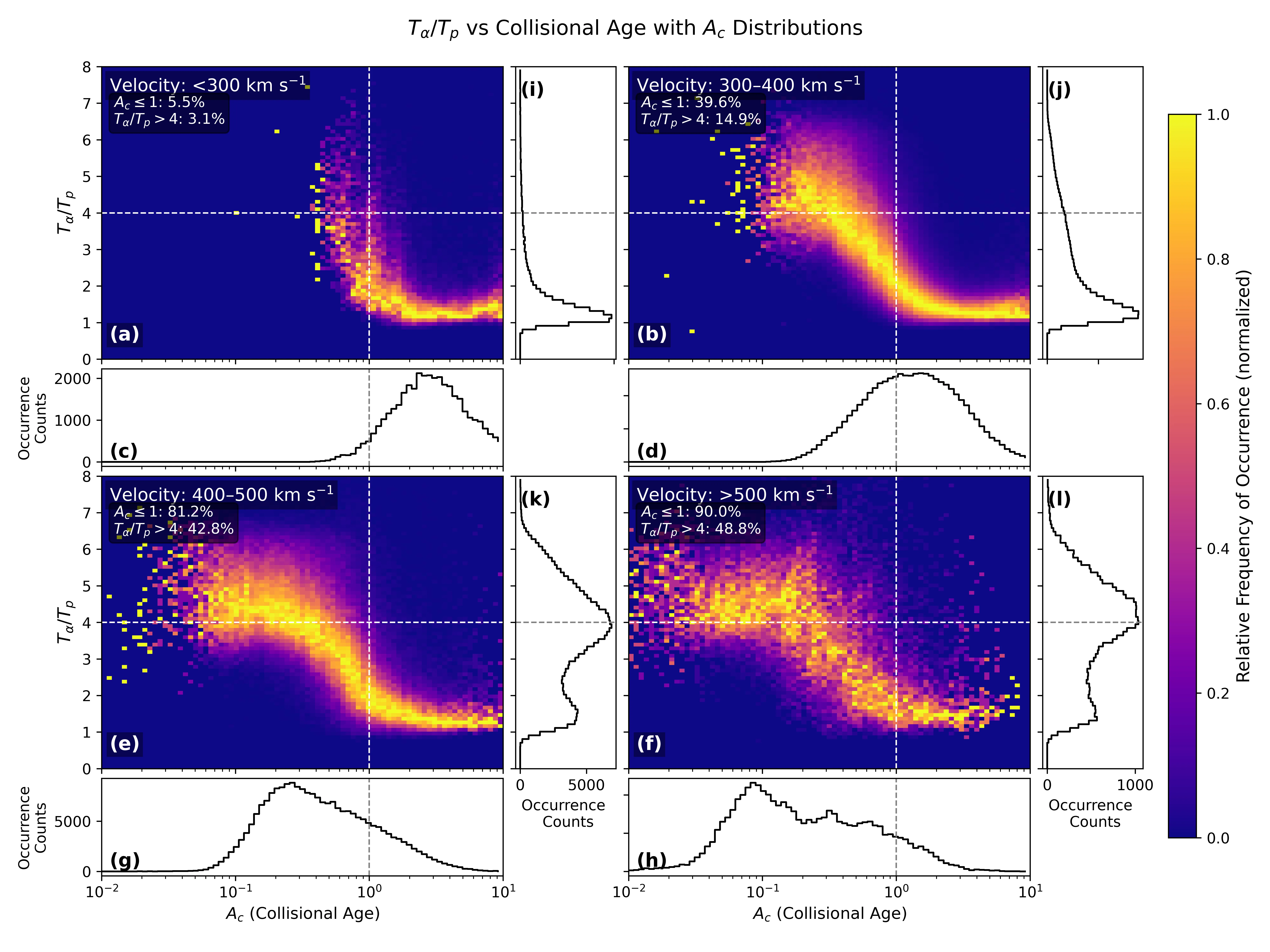
The Wind satellite, launched in 1994, has been recording the composition and temperature of the solar wind for three decades. Scientists divided all measurements by flow speed: slow wind (up to 400 km/s), fast wind (above 500 km/s), and intermediate. In the slow wind, where particle collisions are frequent, proton and alpha temperatures are indeed nearly equal, like water in a well-stirred teapot. In the fast wind, where particles are sparse and rarely collide, alpha particles turn out to be four times hotter than protons. It's as if in a crowd of runners, heavy athletes retain more energy because they are pushed less often.
The key surprise is the dependence on the solar cycle. During solar minimum, the Sun emits more fast wind from polar coronal holes (regions with open magnetic field lines). At maximum, a dense slow wind dominates. Therefore, the temperature ratio changes from cycle to cycle. This means that the heating of particles near Earth's orbit is determined not only by local collisions but also by where on the Sun the stream originated.
The solar wind is like a river that sometimes spreads into a slow, dense flow and sometimes rushes as a fast jet from mountain peaks. And the water temperature in this river depends not only on how molecules rub against each other but also on from what height and along which channel the water came. Three decades of Wind observations have allowed us to see how this cosmic stream changes its character with the Sun's breath.
Original abstract
as written by the authors arXiv:2608.10819v1
The influence of collisional age $$(A_c)$$ on the alpha-to-proton temperature ratio $$(T_\alpha/T_p)$$ has been explored in the past. However, the modulation of this ratio with respect to the solar cycle has remained unexplored so far. We show solar-cycle modulation of $$T_\alpha/T_p$$ and $$A_c$$ using nearly three decades of in-situ observations from Wind spacecraft across distinct solar wind speed regimes and solar activity phases. Our results reveal that in the slow solar wind with velocity $$<400$$ km s$$^{-1}$$, where $$A_c$$ happens to be typically $$>1$$, the ratio $$T_\alpha/T_p$$ stays close to unity. This suggests frequent Coulomb collisions efficiently iron out temperature differences. In contrast, the fast wind with velocity $$>500$$ km s$$^{-1}$$, where $$A_c$$ happens to be typically $$<1$$, mass-proportional heating is most pronounced, with $$T_\alpha/T_p$$ often exceeding 4. The intermediate speed regime ($$400$$-$$500$$ km s$$^{-1}$$) represents a gradual transition between the slow and fast wind populations in terms of their solar-cycle dependence. This behavior reflects the changing dominance of high-speed streams from polar coronal holes during minima to denser slow wind during maxima. These results suggest that mass-proportional ion heating at 1 AU is not solely governed by local collisional physics but is significantly modulated by the solar cycle dependent variations in the solar wind sources.
The Wind satellite was launched in 1994 and was initially planned for 3 years of operation, but it continues to transmit data to this day — already more than 30 years.
In the series 'Star Trek', the solar wind was repeatedly used for maneuvering ships with solar sails.