Shock Wave in Liquid Light express
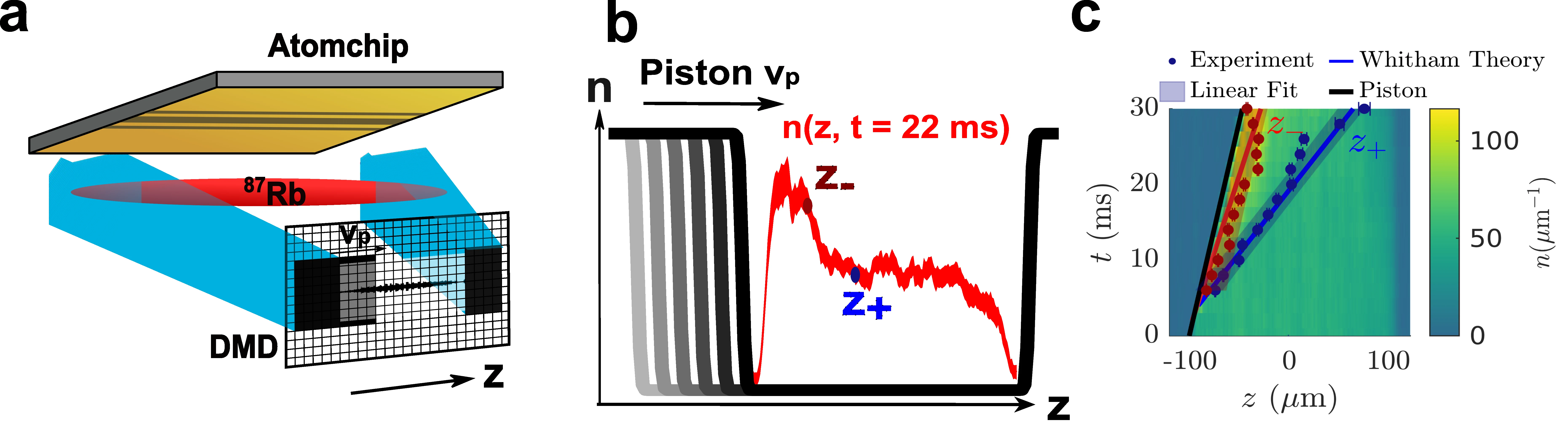
If you push water in a narrow channel too fast, a steep wave forms and breaks into foam. In the world of ultracold atoms, cooled to near absolute zero, quantum laws prevent such a wave from breaking. Physicists took a cloud of rubidium atoms stretched into a thin thread and sharply compressed it from one end with a movable wall of light. The compression speed reached up to three times the speed of sound in this gas — faster than any disturbance can propagate.
In an ordinary fluid, a supersonic push creates a sharp density jump. In a quantum fluid, instead of a jump, a wave with smooth but steep edges emerges — a shock wave smeared by the quantum jitter of atoms. The scientists measured the gas density along the thread, taking images with minimal disturbance to the cloud. They found that the front and back edges of the wave move at different speeds, and the wave itself gradually expands: its width grows linearly with time.
This behavior is the hallmark of dispersive shock waves, where steepness is limited not by viscosity but by quantum spreading. Comparison with calculations using the Whitham method and numerical simulations showed quantitative agreement. Even when the microscopic dynamics deviated from the ideal one-dimensional model, the large-scale wave pattern remained the same. This means that simple laws describe a complex quantum process, and they can be tested in the lab with high precision.
The speed of sound in a cloud of ultracold atoms is a few millimeters per second, like a snail's pace. A push three times faster is like a hurricane in a glass of water.