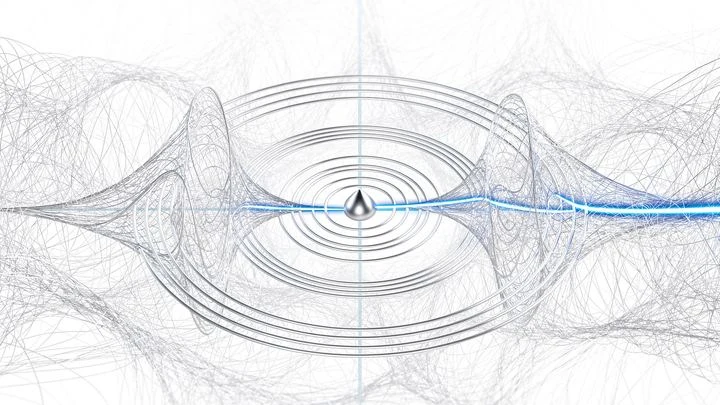
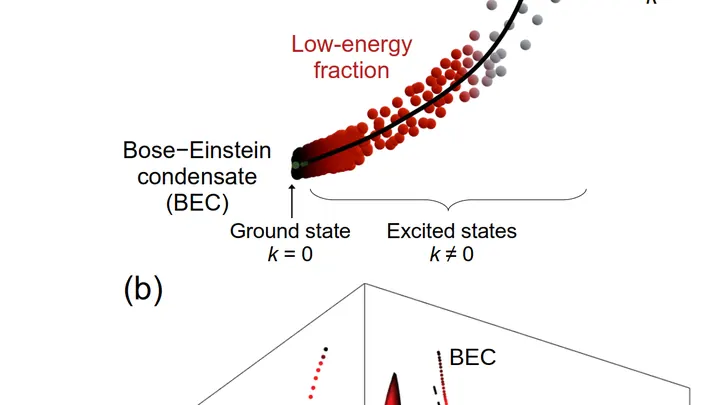
A quantum gas is a gas of atoms cooled to such low temperatures that their de Broglie wavelengths—the quantum wave-like spread of each particle—become comparable to or larger than the interparticle spacing. At this point, quantum statistics dominate the behavior of the gas, leading to phenomena that have no classical counterpart. The most famous example is a Bose-Einstein condensate (BEC), where a macroscopic number of bosonic atoms occupy the same quantum ground state, behaving as a single coherent matter wave.
History
The concept of Bose-Einstein condensation was predicted by Satyendra Nath Bose and Albert Einstein in 1924–25. The first atomic BEC was created in 1995 by Eric Cornell, Carl Wieman, and Wolfgang Ketterle, who shared the 2001 Nobel Prize in Physics.
How it works
Cooling atoms to microkelvin temperatures (using laser cooling and evaporative cooling) slows them down, increasing their de Broglie wavelength. For bosons, when the wavelength overlaps, the particles' wavefunctions merge, and they collectively 'condense' into the lowest energy state. For fermions, the Pauli exclusion principle prevents this, but they form a degenerate Fermi gas where the particles stack up in momentum states up to the Fermi energy. The behavior is described by quantum statistics (Bose-Einstein or Fermi-Dirac), not classical Maxwell-Boltzmann statistics.
In practice
Quantum gases are used as platforms for quantum simulation, studying phenomena like superfluidity, superconductivity analogs, and quantum magnetism, and for precision measurements in atom interferometry.
Fun fact
In a Bose-Einstein condensate, thousands of atoms can be described by a single wavefunction, making it a visible manifestation of quantum mechanics on a macroscopic scale.
If you push water in a narrow channel too fast, a steep wave forms and breaks into foam. In the world of ultracold atoms, cooled to near absolute zero, quantum laws prevent such a wave from breaking. Physicists took a cloud of rubidium atoms stretched into a thin thread and sharply compressed it from one end with a movable wall of light.
In an ultracold cloud of atoms cooled to near absolute zero, regions with different spin orientations emerge, like patches with different magnetization. The boundaries between them are called domain walls. Usually they are stationary, but in this experiment the walls started moving on their own.
A black hole isn't just a cosmic vacuum cleaner. If it rotates, it can amplify waves around it, much like a mountain echo repeats sound. For ultralight dark matter (particles billions of times lighter than an electron), this effect, called superradiance, can create a huge cloud.
Plasma is not just hot gas; it's an entire orchestra of charged particles, each group playing its own part. Heavy ions (atoms that have lost electrons) set the slow rhythm, while light electrons dart around ten thousand times faster.
At the center of many galaxies lurks an invisible cloud — a halo of dark matter. If this matter is cold and light enough, it behaves like a superfluid: it flows without friction, and any rotation in it twists into tiny quantum vortices — threads the size of an atomic nucleus.
At temperatures billionths of a degree above absolute zero, a Bose–Einstein condensate emerges — a state where thousands of atoms march in a single quantum key.
A lone potassium atom enters a dense cloud of sodium atoms cooled to near absolute zero. Such a medium is called a Bose–Einstein condensate — all particles merge into a single quantum wave. One might expect the impurity to simply pick up a single neighbor and form a pair. But the experiment showed something else.
In the quantum world, particles can merge into a single liquid that flows without friction. One of its most mysterious forms is the fractional quantum Hall liquid. In it, electrons or atoms move as a single vortex, and their charge splits into fractions, like a pie cut into perfectly equal slices.
At the center of many galaxies lurks an invisible halo of dark matter: it holds the stars at the edges, keeping them from flying apart. For a long time, it was described as a dilute gas of particles, but new work offers a different view: dark matter might gather into a quantum droplet.
A pot of water always boils the same way: hit 100 degrees and bubbles start. Quantum fluids are different. When a cloud of atoms is cooled to near absolute zero, it can turn into a single matter wave — a Bose–Einstein condensate. But the transition itself, it turns out, can happen in three different ways.
A time crystal resembles an eternal clock: its atoms spontaneously perform rhythmic movements. In ordinary clocks, a pendulum is driven by a spring or battery, but here the motion arises without an energy supply — the system simply returns to its initial state at regular intervals. This idea was proposed by Frank Wilczek in 2012.
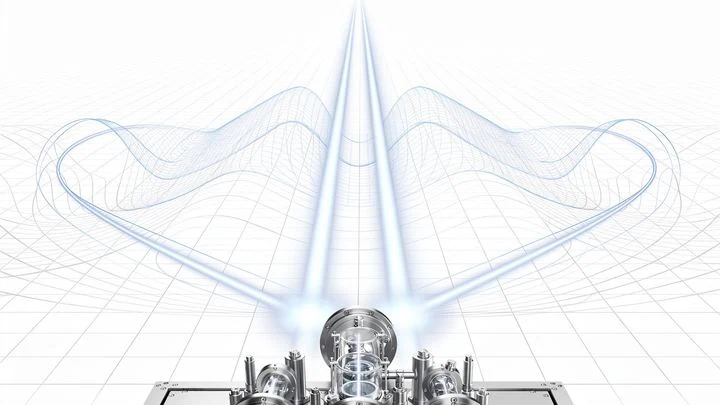
Two parallel streams of atoms, released from Bose condensates, begin their journey in free fall. In the classical picture, their separation remains unchanged — like two skiers gliding down a perfectly smooth slope. But if spacetime is not frozen snow, but a living, rippling membrane, then every tremble of it is transmitted to matter.
A pot of water has just been stirred: the whirlpools and eddies gradually calm down, and the liquid becomes smooth. A similar process, but in the quantum world, occurs in superfluid helium or in a cloud of ultracold atoms.
Picture two choirs in soundproof rooms on a wobbly stage. They sing, but can't hear each other — the air doesn't carry the tune. Yet if the stage trembles, its vibrations link their songs. That's the idea behind a new test for quantum gravity.
A cold cloud of atoms is like a swarm of fireflies drawn to one another. The attraction between atoms tries to pack them into a single dense ball. But quantum jitter, the unavoidable motion of particles, keeps the ball from collapsing. When the attraction is strong, the cloud breaks into separate clumps.
A thrown stone falls with acceleration, and from the fall time you can calculate the force of gravity. Scientists repeat this experiment with a cloud of atoms cooled to near absolute zero. Such a cloud falls in a vacuum chamber, and laser pulses split its waves, like light in an interferometer.
An ultracold cloud of atoms trapped in laser light can 'breathe': it rhythmically contracts and expands, much like lungs. Physicists have long been able to observe this breathing, but only now have they realized that its amplitude is not just a pretty picture: it is a precise measure of hidden energy jitters inside the cloud.
Water in a cup cools down in minutes. Gas in a room spreads evenly in seconds. But if you trap atoms in a tube as thin as a laser beam and give them a good kick, they will take several seconds to "cool" toward equilibrium — an eternity by atomic standards.
In an orchestra where every musician plays the same note, the sound merges into a powerful unison. This is how a Bose–Einstein condensate is born: many boson particles at extremely low temperatures behave as a single entity.
Fireflies flash in a dark forest: you see each flash, but not the flight. A quantum gas microscope can show individual cold atoms, like those fireflies. But until now, it couldn't tell you how fast they're moving.
Now scientists have found a way to fix that.
Atoms settled along a chain of traps, like a line of coastal forts. Nearby, a quantum sea: a Bose-Einstein condensate (a substance with zero resistance, where particles move as a single wave).
For a long time, cosmologists could not peer beyond the starting point — the infinitely dense singularity of the Big Bang, where the equations of general relativity by Einstein lose their predictive power.
A tiny cloud of 300,000 ytterbium atoms, cooled to near absolute zero, was shuttled along a light track 34 centimeters long, like transporting a fragile cargo over a bumpy road without shaking it apart.
In an ultracold cloud, potassium atoms behave like waves that can add up and amplify each other — much like sound waves in a musical instrument create a loud chord. Physicists have learned to control this process by tuning the strength of atomic interactions with a magnetic field.
Light and matter in the tiny world obey laws that are hard to compute even on a supercomputer. Physicists build special "quantum simulators"—setups where cold atoms play the roles of particles and fields. But until now, such simulators could only depict the field in its simplest form: as if it were either present or absent.
Cooling usually brings order: water freezes into ice. But in the quantum world, order takes unexpected forms. Experimenters cooled polaritons — particles that are both light and matter — to near absolute zero.
Dark matter is an invisible ocean that, as shown by observations by Vera Rubin, keeps stars in galaxies from flying apart. Physicists suspect that if dark matter consists of ultralight particles, in the cosmic cold it turns into a frictionless fluid — a so-called condensate.
In laboratories on Earth, Bose-Einstein condensates are created by cooling a cloud of atoms to billionths of a kelvin. The atoms lose their individuality and merge into a single quantum wave that behaves as one entity. But in space, such conditions are not needed: gravity itself creates deep wells where matter compresses and cools into a state of quantum fog.