A film that holds superconductivity for nearly a year express
Inside a diamond anvil cell, squeezing a sample with a force millions of times greater than atmospheric pressure, a thin film of lanthanum meets hydrogen. The hydrogen comes from ammonia borane — a powder that, when heated, releases its hydrogen like a sponge releasing water. Within minutes of laser heating, a film of lanthanum hydride is born — a material that conducts electricity without resistance at minus 26 degrees Celsius.
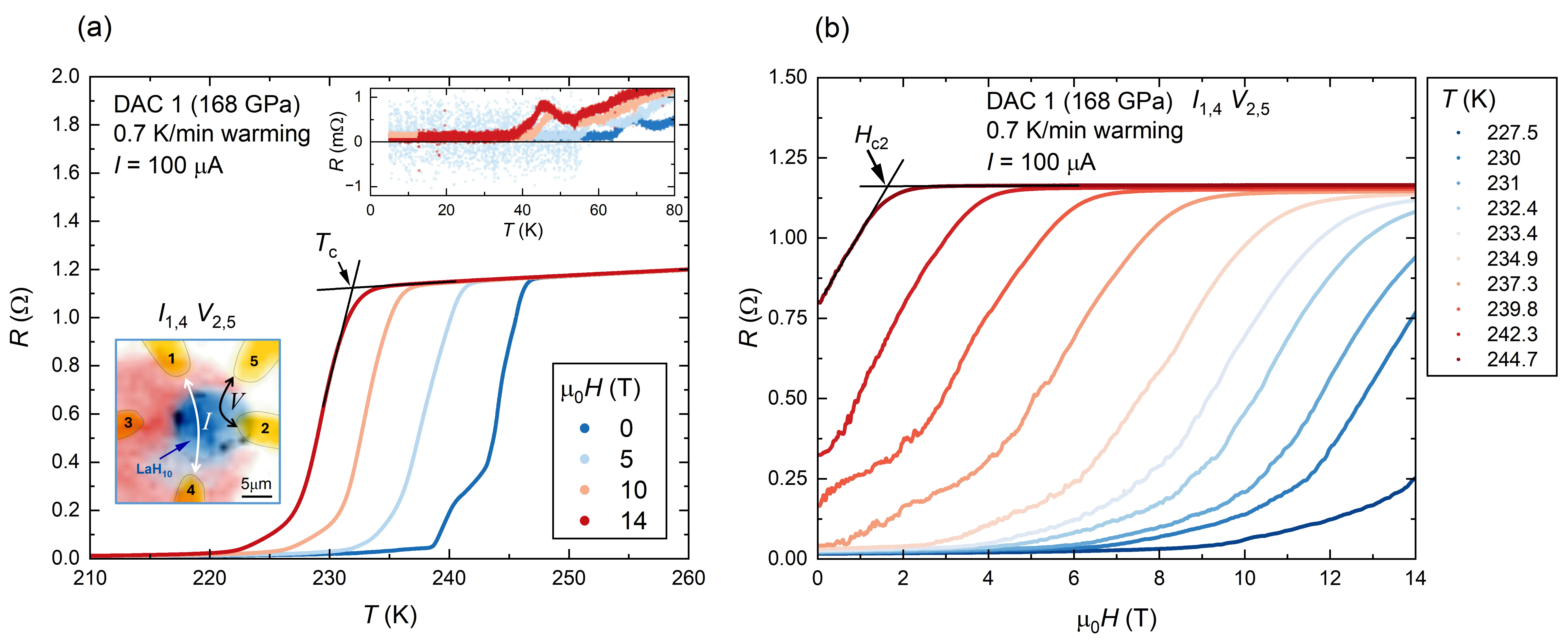
This result is a new step in the race for room-temperature superconductors. Conventional superconductors require cooling with liquid helium to minus 269 degrees, which is expensive and inconvenient. Lanthanum hydride, synthesized as a thin film rather than a bulky chunk, retains its properties for nearly a year—300 days. During that time, the crystal lattice did not degrade, and superconductivity did not vanish, even when a magnetic field was applied that usually 'quenches' a superconductor.
The thin-film technology opens the way to creating ternary hydrides — compounds of three elements where the properties of the superconductor can be tuned more precisely. Moreover, thin films are compatible with microelectronics: they can be used to make miniature sensors, quantum devices, and lossless power transmission lines. Previously, hydrides were only obtained as powders or tiny monoliths, unsuitable for circuits.
Returning to the sponge analogy: ammonia borane gave up its hydrogen, lanthanum absorbed it, and under the pressure of diamonds, a material was born that carries current without loss for nearly a year. Now the challenge is to make it work at ordinary pressure and room temperature. The sponge is squeezed to its limit, but the water hasn't leaked out.
Original abstract
as written by the authors arXiv:2608.18865v1
High-pressure hydrides hold the record for the highest superconducting critical temperatures across all classes of superconductors. Currently lanthanum decahydride, LaH$$_{10}$$, exhibits the highest critical temperature among binaries, with $$T_c \approx$$ 250 K at pressures between 140-180 GPa. Here, we report the synthesis of LaH$$_{10\pm\delta}$$ films in two DACs at pressures of 168 GPa and 176 GPa via in situ laser heating of elemental lanthanum films with ammonia borane (NH$$_3$$BH$$_3$$) as the hydrogen donor. The high-symmetry fcc lanthanum sublattice (space group $$Fm\bar3m$$) is resolved using synchrotron X-ray diffraction, with unit cell parameters in excellent agreement with previous studies on bulk samples. We provide confirmation of high-$$T_c$$ superconductivity in LaH$$_{10\pm\delta}$$ with highest $$T_c$$ of 247 K at 176 GPa evidenced in electrical measurements. The characteristic suppression of superconductivity is observed in magnetic fields. Furthermore, combined diffraction and electrical measurements reveal remarkable temporal stability of both the crystal structure and the high-$$T_c$$ superconductivity over the full measurement period of about 300 days post laser heating. Our work establishes film precursors using physical vapour deposition (PVD) techniques as a practical route to hydride formation, opening a pathway toward the controlled synthesis of promising ternary hydrides and the integration of micro-fabricated device geometries in diamond anvil cells.
Superconductivity in lanthanum hydride occurs at a temperature that is lower than that of a freezer (−18 °C) but higher than the coldest point in Antarctica (−89 °C).
In Arthur C. Clarke's novel 'Childhood's End', room-temperature superconductors allow cities to be built in the air and energy to be transmitted without wires.