A Diamond Compass That Learns on Its Own: Physics Inside a Neural Network ✛
Diamond is not just a gemstone. Hidden inside its crystal lattice are defects that sense magnetic fields better than many instruments. One such defect, the NV center, acts as a tiny compass, but its needle wavers from heat and noise. For the compass to point accurately, calibration is needed. Usually that is a long, manual process, but here the neural network learns on its own.
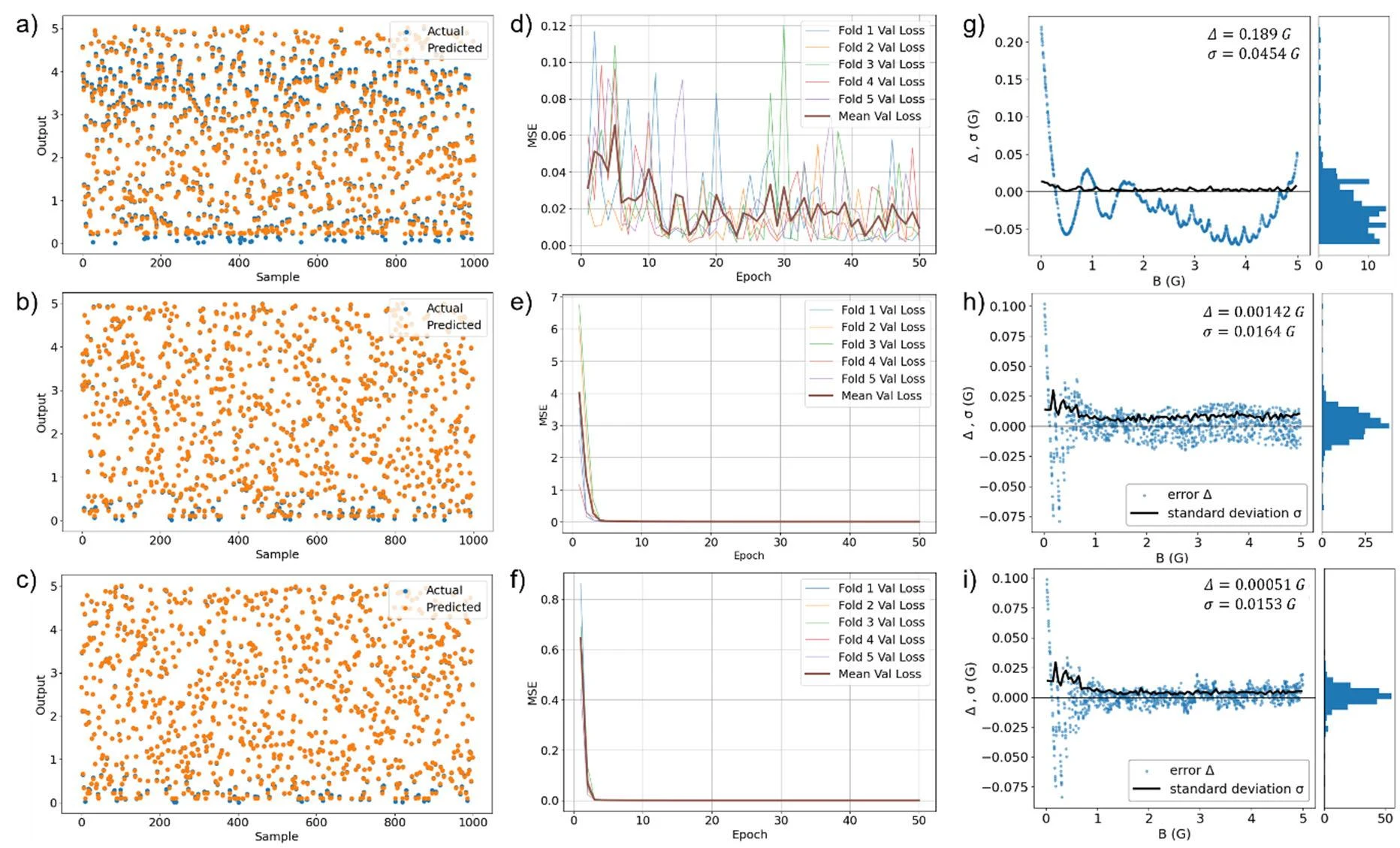
The key trick is to embed the physical law directly into the neural network. For an NV center, the frequency difference between resonances is proportional to the magnetic field: Δν = 2γ_NV B_∥. This is the Zeeman relation. Instead of just showing the network thousands of examples, they gave it this equation as a hint. The result is striking: on synthetic data, the error dropped from 0.189 G to 0.00051 G, a 372-fold improvement.
But how do you transfer that success from simulation to a real device? A hybrid approach helped here. They took just 36 raw experimental spectra, fed them into a parameterized simulator that pinned down the baseline parameters and generated 14,456 spectra over a field range from 0 to 120 G. On this data, the network learned to account for hardware noise and drifts. On 20 uncalibrated experimental spectra, the mean error was 7.97 G, with no external calibration.
This method is a step toward self-calibrating quantum sensors. Diamond magnetometers could work in GPS-free navigation, geological surveys, and medical diagnostics, where precision is needed in the field. Embedding other physical laws, such as temperature dependence, would allow simultaneous measurement of multiple quantities. A compass that has learned the laws of magnetism on its own is no longer science fiction but an engineering challenge.
An NV center is a nitrogen impurity next to a vacancy in the diamond crystal lattice. Its spin can be initialized and read out with laser light at room temperature, making it one of the few quantum objects that work without cryogenic cooling.