A diamond compass that learns on its own: physics inside a neural network ✛
Context
Quantum sensors based on nitrogen-vacancy (NV) centers in diamond promise high sensitivity and compactness, but outside the lab they face drift in temperature, microwave power, and noise. Traditional calibration requires external references or manual tuning, while purely statistical neural networks demand huge datasets and transfer poorly from simulation to reality. This work sits at the periphery: nearby research covers diamond sensors, optical microscopy, and quantum information, but no one has combined physics guidance with hybrid data generation for self-calibration.
Methods
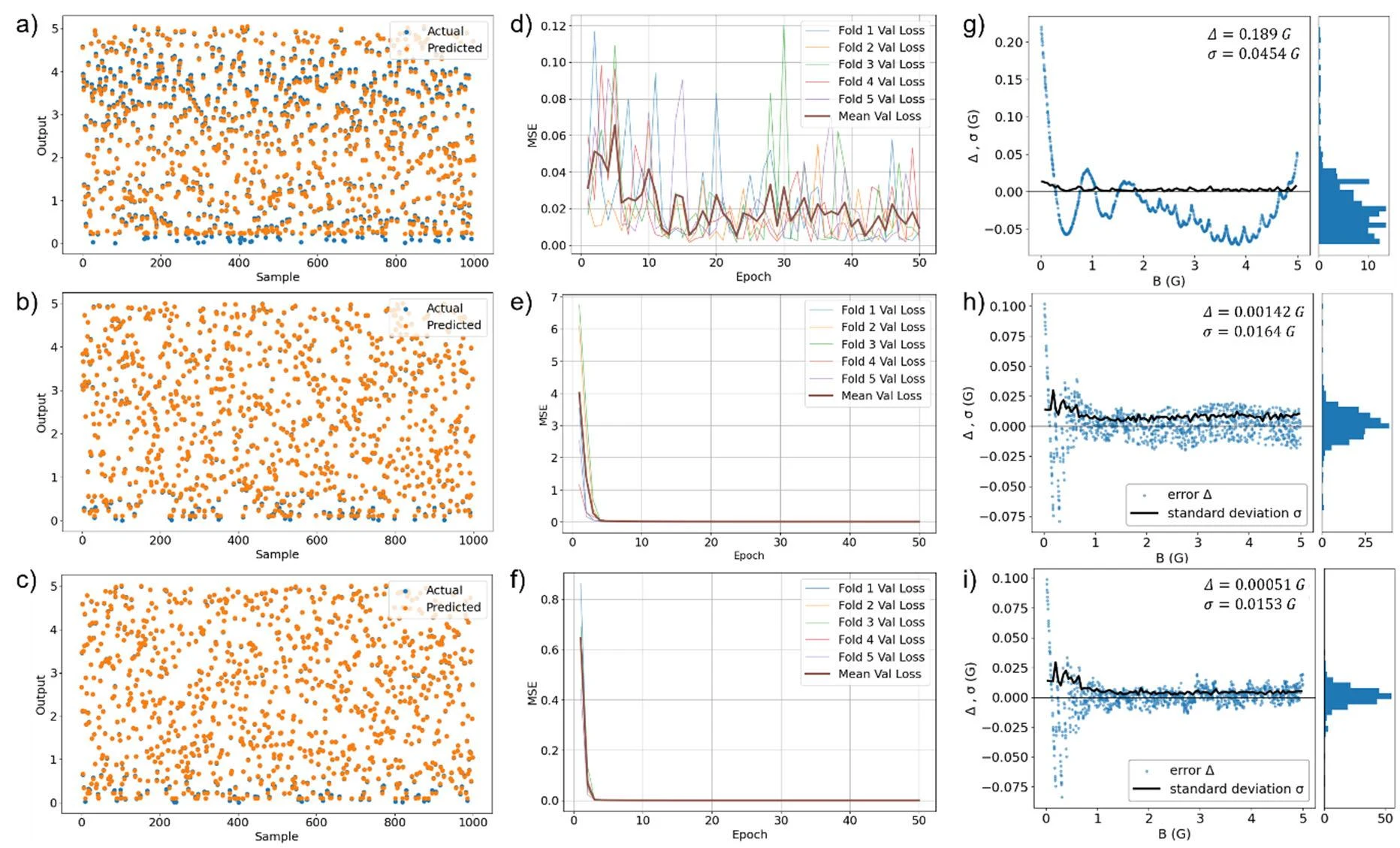
First, they generated a synthetic set of optically detected magnetic resonance (ODMR) spectra by solving the spin Hamiltonian of the NV center. Then they compared three strategies: a purely statistical neural network, a physics-guided model with the Zeeman relation embedded (the frequency difference between resonances is proportional to the longitudinal field), and an ensemble model combining the outputs of the first two. To bridge the simulation-to-reality gap, they used a hybrid approach: 36 raw experimental spectra were fed into a parameterized simulator, which fixed the baseline parameters and generated 14,456 spectra over a field range from 0 to 120 G.
Results
On synthetic validation, the purely statistical model gave a mean error of 0.189 G, the physics-guided model 0.00142 G, and the ensemble model 0.00051 G. This corresponds to accuracy improvements of 133 and 372 times, respectively. The physics-guided model also smoothed out catastrophic errors in the weak-field region (below 1 G), where the statistical model lost stability. On 20 uncalibrated experimental spectra, the hybrid model achieved a mean absolute error of 7.97 G and a root-mean-square error of 9.52 G, with almost zero systematic bias (−1.24 G).
Implications
Unlike neighboring works that either use purely statistical learning on large data or require careful pre-calibration, this work is the first to embed the deterministic Zeeman relation directly into the neural network's loss function. This allows fast convergence and robustness even with scarce data. The hybrid scheme of generating data from rare experimental spectra solves the simulation-to-reality gap without requiring massive physical measurements.
Future development
The approach can be extended to other physical systems where collecting dense, high-precision data is difficult. Embedding other physical laws (for example, the temperature dependence of the splitting) would allow the neural network to estimate multiple parameters simultaneously. It may be possible to create fully self-calibrating sensors that operate in real time on edge devices.
Impact
The method will accelerate the adoption of diamond magnetometers in GPS-free navigation, geophysical exploration, and biomedical diagnostics. It is also applicable to any quantum sensor suffering from a lack of labeled data.
Next steps
Test the approach on other types of NV ensembles and under varying temperature conditions. Extend the model to simultaneously estimate the magnetic field vector and temperature.
Key open problems
The key problem in quantum sensing is self-calibration in uncontrolled conditions. This work directly addresses it by showing how physical constraints can replace big data. It is also a step toward closing the simulation-to-reality gap common to all machine learning applications in physics.
The knowledge machine's view
This section is addressed to the author of the paper and their colleagues. Neighbouring works were found by meaning-based search across our archive, not by word overlap. We do not review: we show the field around the work.
What the work does
The authors embedded the Zeeman relation directly into the neural network architecture to analyze ODMR spectra from ensemble NV centers, using a hybrid scheme that generates data from scarce experimental spectra. On synthetic validation, they achieved up to a 372-fold improvement in accuracy over a statistical model, and on uncalibrated experimental data they obtained a mean error of 7.97 G.
Where its strength is
The strong point is a physics-informed model that remains stable in the weak-field regime and converges quickly with limited data, paving the way for self-calibrating sensors.
Where it could go next
- It might be interesting to see how the proposed physics-informed approach adapts to other noise-reduction scenarios in diamond sensors, for instance to improve sensitivity for weak signals, as in the work on neural-network analysis of noise.based on: Noise in Diamond: How a Neural Network Hears Magnetic Fields arXiv:2603.14144
- A related step is applying machine learning to calibration and error correction in quantum sensors, which could help further reduce error on experimental data.based on: Quantum sensor learns from its mistakes arXiv:2601.17465
- It would be interesting to consider transferring the hybrid data generation scheme to magnetic microscopy or biomagnetism tasks, where NV centers are used for field mapping, as in the work on magnetic signals from the heart.based on: Diamond sensor picks up the heart's magnetic signals arXiv:2601.18843
Worth trying
- Test the physics-informed model on data covering a wider range of temperatures and microwave powers to check its robustness.
- Use an ensemble approach that dynamically weights the outputs of the statistical and physics-based models depending on the field magnitude.
- Investigate whether the hybrid data generation can reduce the number of experimental spectra needed for calibration.
Why this may matter
This approach could lower the barrier to deploying quantum magnetometers outside the lab, bringing them closer to practical use in geophysics, medicine, and navigation.
Nearby works in our archive
- Noise in Diamond: How a Neural Network Hears Magnetic Fieldssimilarity 0.53
- A Magnetometer That Listens to Diamondssimilarity 0.53
- Microwaves in a Diamond Anvilsimilarity 0.50
- Diamond sensor picks up the heart's magnetic signalssimilarity 0.50
- Quantum Calculator Cuts Molecular Costs in Halfsimilarity 0.50
- Robot Tuner for Quantum Processorssimilarity 0.49
- Quantum sensor learns from its mistakessimilarity 0.49
The archive is sparse around this work: the closest review is only 0.53, against a usual 0.64. It looks like few have drilled nearby.
An NV center is a nitrogen impurity next to a vacancy in the diamond crystal lattice. Its spin can be initialized and read out with a laser at room temperature, making it one of the few quantum objects that work without cryogenic cooling.
Key numbers
- accuracy improvement: 372 times
- mean error of ensemble model: 0.00051 G
- mean error on experimental data: 7.97 G
- number of generated spectra: 14,456
- number of experimental spectra for initialization: 36