Diamond magnetometry is a technique that uses nitrogen-vacancy (NV) centers in diamond—atomic-scale defects where a nitrogen atom sits next to a vacancy in the carbon lattice—to measure magnetic fields with exceptional sensitivity and spatial resolution. These centers act as quantum sensors: their electron spin states are sensitive to external magnetic fields, and their optical properties allow readout of those states with visible light. The technique works at room temperature and can map fields at the nanoscale, making it a powerful tool for imaging magnetic structures in materials, biological systems, and even fundamental physics experiments.
History
The use of NV centers for magnetometry was proposed in the early 2000s, with key demonstrations by groups such as Jörg Wrachtrup and Fedor Jelezko in Stuttgart, and later by the group of Ronald Walsworth at Harvard.
How it works
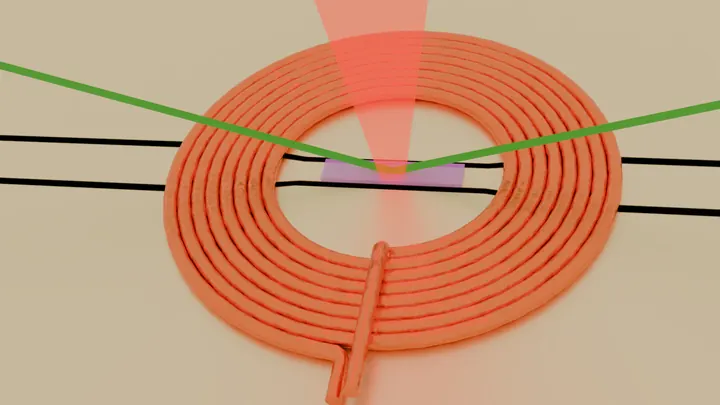
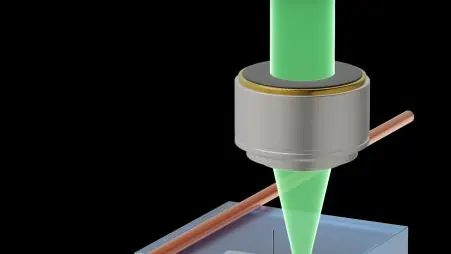
An NV center is excited with green light, and its fluorescence intensity depends on the spin state, which in turn is shifted by an external magnetic field via the Zeeman effect. By applying microwave pulses to manipulate the spin and measuring the fluorescence, one can determine the field strength and direction. Scanning the diamond tip over a sample yields a high-resolution magnetic map, while in bulk mode, ensembles of NV centers provide sensitive magnetometry over larger areas.
In practice
Diamond magnetometry is used to image magnetic fields in hard drives, map neural activity in living cells, and search for dark matter particles that would produce tiny magnetic signals.
Fun fact
Diamond magnetometers can detect a single electron spin, which is about 100,000 times weaker than the magnetic field of a typical fridge magnet.
Surf doesn't roll onto the shore as an even front. It comes in tongues of foam that merge and split apart. Magnetic fields inside materials behave much the same way: they breathe in waves, and until now nobody had seen them whole.
Diamond is not just a gemstone. Hidden inside its crystal lattice are defects that sense magnetic fields better than many instruments. One such defect, the NV center, acts as a tiny compass, but its needle wavers from heat and noise. For the compass to point accurately, calibration is needed.
An ordinary lamp shines steadily, while a lighthouse flashes. Scientists in London have made a tiny diamond work like a lighthouse, but not for light — for radio waves. To do this, they added a bit of nitrogen to the crystal and then shone a green laser on it.
In the layered crystal CrSBr, the magnetic moments of atoms are arranged like notes in a score: within each layer they point in the same direction, but between layers they point in opposite directions. This antiferromagnetic melody plays up to 132 kelvin, beyond which thermal motion destroys the order.
The magnetic framework of the EuMnSb2 crystal resembles scaffolding: manganese atoms form rigid vertical pillars, while europium atoms act as movable crossbars. Until now, there was no consensus on the angle at which these crossbars rest and how they rotate when a magnetic field presses on the scaffold.
Earth's magnetic field is not constant: it trembles from the solar wind, from distant thunderstorms, and from the subway running nearby. To notice these tremors, you need an instrument that doesn't tremble itself. Physicists have built such an instrument from ytterbium atoms cooled to nearly absolute zero.
A magnet weighing just a few grains of sand hovers in midair with no support. It doesn't touch the walls, doesn't rub against bearings — it just hangs in a magnetic trap like a speck of dust in a sunbeam. Researchers have turned this tiny object into an ultra-sensitive compass: the device detects changes in the magnetic field of 23 femtotesla.
A radio receiver the size of a palm can measure signal power more accurately than expensive lab benches. Inside, there are no coils or antennas, just a glass head and a cloud of rubidium atoms cooled to near absolute zero.
Deep underground, iron glows white-hot, and the pressure is so intense that an ordinary instrument would be crushed flat. To peer into this world, physicists built a special microscope based on tiny diamond defects (so-called NV centers).
Ordinary magnetic sensors lose sensitivity as they shrink. But scientists turned a tiny diamond into a light-based compass. Unlike jewelry diamonds, what matters here isn't purity but artificially created defects — these are what turn the crystal into a compass.
Trying to count people in a dark room by the sound of their breathing hits a wall of background noise — individual breaths are inaudible. Scientists working with quantum spins in solids face a similar challenge. Each spin (the electron's magnetic moment) has its own "voice," but it is drowned out by the technical noise of the instruments.
A tiny diamond with a defect — a nitrogen atom next to a vacancy in the crystal lattice. This defect, the NV center, acts like a magnetic needle: under green light, it glows red, and the brightness of that glow depends on the direction of its magnetic field.
A substance's spectrum is its fingerprint. Usually, to record one, you place the sample in a strong magnetic field, like in an MRI scanner. But there is a way to do without a magnet altogether: detect the signal from atomic nuclei at zero field. Until now, this method suffered from poor sensitivity, and its complex spectra were hard to predict.
A neutral-atom quantum computer is like a library where books not only need to be read but also quickly returned to the shelf. Slow readout of results is like a sluggish librarian holding up the entire queue. Scientists have found a way to speed up this process by adding helpers.
A white dwarf is what remains of a star like the Sun after it sheds its outer layers. What's left is a hot core the size of Earth but with a mass close to that of the Sun. A teaspoon of this material would weigh as much as a truck. Some of these stars have extremely strong magnetic fields — a billion times stronger than Earth's.
In laboratories where atoms are cooled to near absolute zero, even a tiny change in the magnetic field throws off all the settings. Conventional sensors, Hall plates or coils with ferrite cores, sit a few centimeters away from the vacuum chamber because they themselves create interference.
In a solid, atoms vibrate, transmitting sound. Sometimes this wave doesn't run straight but curls into a spiral, like a corkscrew entering a cork. In ordinary crystals, such 'sound vortices' are known, but in magnetic materials they had long eluded detection.
A tiny diamond hangs in the air, held by an electric field like a speck of dust in a beam of light. Hidden inside are defects — places where a carbon atom is replaced by nitrogen, with a vacancy nearby. These defects behave like little magnets that can be flipped with laser and microwaves.
Heat inside a cell is like traffic in a city: on some streets the lanes are wide and traffic flows fast, while in narrow alleys everything gets stuck. Scientists have found a way to map such 'traffic jams' for heat without opening the cell.
They took tiny diamonds, so small they are invisible to the naked eye, and placed them on a thin gold plate.
Turning light gases like hydrogen and nitrogen into metal is a long-standing dream of physicists. In a new experiment, nitrogen was compressed to 130–140 gigapascals (pressure equivalent to 14 million kilograms pressing on a fingernail) and heated to 3000°C.
A tiny defect in a diamond crystal works like a sensitive antenna. When a magnetic field oscillates nearby, this defect, a nitrogen vacancy, responds by glowing. Previously, to hear the signal, you had to accumulate many repeated measurements, like listening to a whisper with your ear pressed against a door. Now a single short "look" suffices.
A pinch of diamond dust dropped into a glass of liquid acts like hundreds of tiny magnetic compasses. When molecules with unpaired electrons, known as paramagnetic, appear nearby, the needles of these compasses start to quiver. From that quiver, you can tell what the molecule is and how much of it is there.
A spring scale in a geologist's backpack responds sensitively to every mountain and valley beneath their feet. But springs get tired, and their readings drift — the instrument needs frequent recalibration against a reference. An atomic gravimeter measures gravity flawlessly, but it's the size of a refrigerator and doesn't like being jostled.
Diamonds sometimes have a defect: instead of two adjacent carbon atoms, there is one nitrogen atom and an empty spot. This defect acts like a tiny antenna that responds to magnetic fields. Scientists aimed a laser and microwaves at such a diamond, and the defect started spitting out electrons.
A magnetic field is invisible, but you can make it 'glow' using tiny defects in diamond — nitrogen-vacancy centers. Each such defect acts as a miniature compass, telling you which way the field points. The problem is that there are many of these compasses, and reading them all in sequence is like transcribing every letter in a thick book by hand.
A tiny defect in diamond is like a microscopic ear, able to pick up the magnetic 'breath' of the heart. Such sensors work at room temperature and are no bigger than a grain of sand.
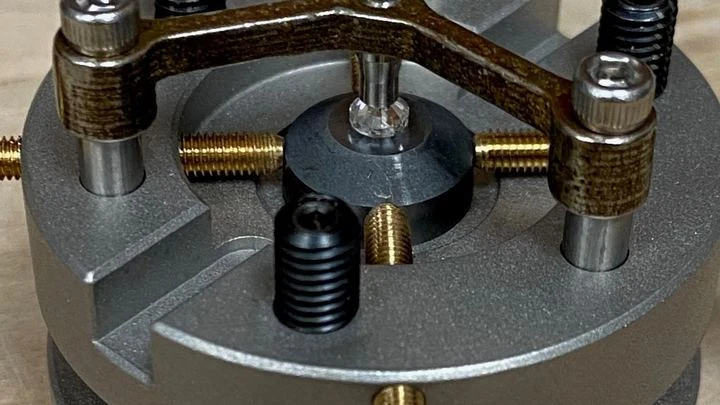
In a diamond anvil cell, pressure squeezes a material as if it were buried hundreds of kilometers deep inside the Earth. Inside this chamber, tiny diamond sensors, color centers, respond to microwaves and report on the magnetic fields and temperatures around them.
A magnetic field is invisible, but you can make it 'glow'. To do that, take a tiny diamond with defects — places where a carbon atom is replaced by nitrogen and a neighboring lattice site is vacant. These defects, like sensitive compass needles, respond to the slightest changes in the magnetic field and emit light of varying brightness.
An ordinary magnetic compass freezes when lightning strikes nearby. A sudden jump in the magnetic field throws the needle off. A similar problem has been hindering scientists trying to measure magnetism in strong pulsed fields: those that switch on for a thousandth of a second.
The new setup tackles this with a laser beam.
In a dark room, a tiny diamond glows red when a green laser hits it. This glow isn't just for show: it's a signal: its brightness changes when a magnetic field is nearby. Inside the diamond sit defects — nitrogen atoms with an empty neighboring site. They act like sensitive needles that rotate under the influence of a magnet.
A cell doesn't just lie on a surface: it probes it, pulls it, and pushes it. Until now, instruments could only detect direct forces: how hard a cell presses or stretches its support. But if you grab a cell by the "shoulders" and give it a slight twist, it responds by rotating, and until recently, no one could measure that rotation.
Diamond crystals harbor invisible cracks — dislocations. These are places where rows of atoms are shifted, like a sheet of paper pulled halfway out of a stack. Stress builds up around these spots, affecting how the material breaks, bends, or conducts electricity.
In the 1930s, Fritz Zwicky, observing the Coma cluster, noticed anomalously high galaxy velocities: their motion pointed to a huge hidden mass gravitationally binding the system.
Quantum computers demand reliable memory. In a diamond crystal — carbon — information is stored as the orientation of microscopic magnetic needles (spins) at special defects. Reading these arrows with light was inconvenient: optics are bulky for chips. The new method works like developing photographic film.
Inside a diamond anvil cell, a device where two diamonds squeeze a sample to hundreds of gigapascals, pressure is distributed unevenly. Some regions are compressed more, others less. This affects experimental results: the material may behave differently than under perfectly uniform compression.