Why Pulsars Can't Spin Faster Than a Blender ✛
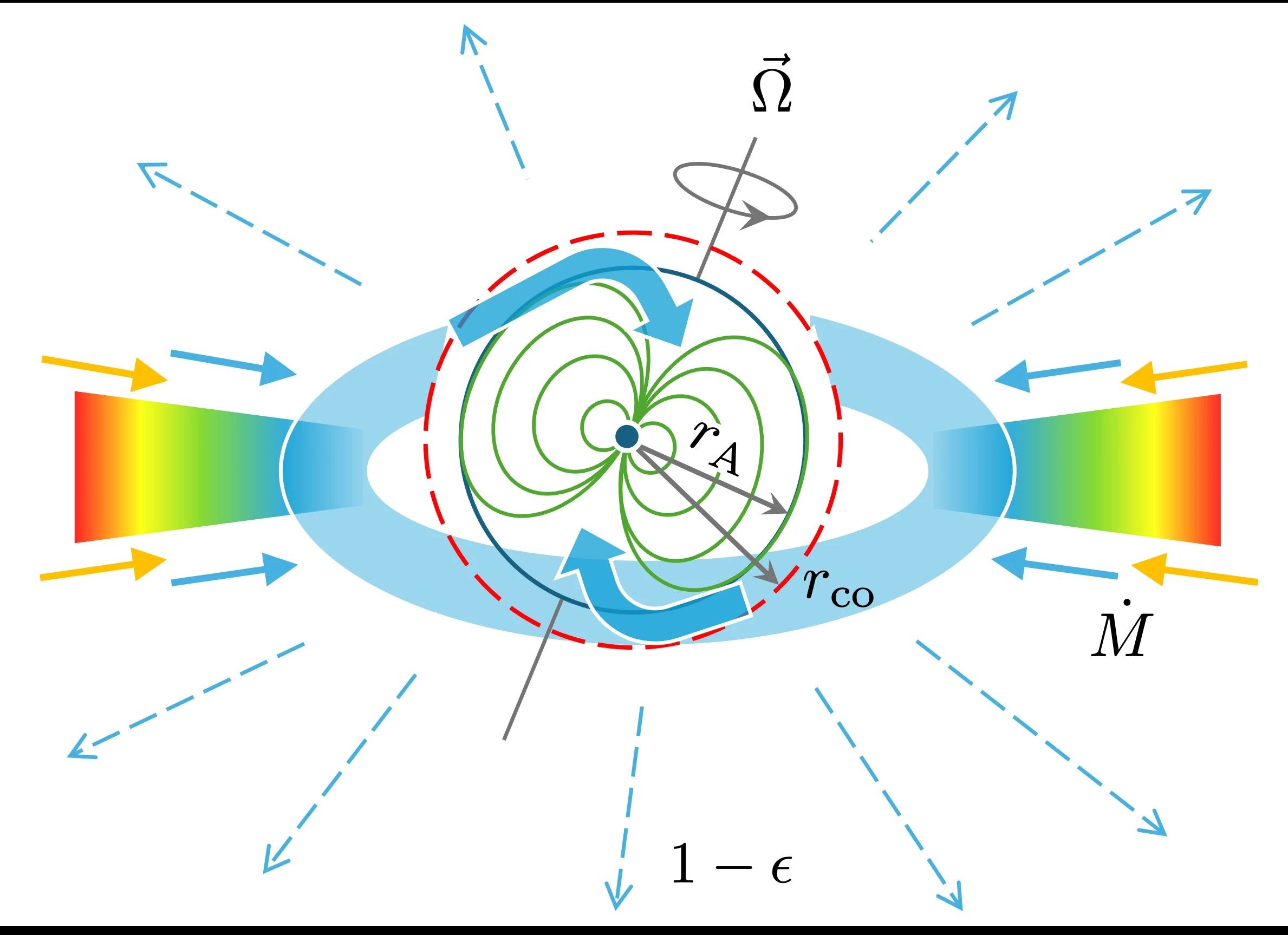
Imagine a spinning top that you spin up by pouring water on it. To make it spin very fast, you need a lot of water, but if you pour too hard, the water splashes and doesn't hit the top. The same goes for pulsars: they are superdense stars that spin up when matter falls onto them from a companion star. The fastest known pulsar spins 716 times per second — faster than a kitchen blender. But to spin even faster, it would need to accrete a mass equal to a quarter of the Sun. The companion star can't deliver that much matter slowly enough: it's either too light or lives too short.
Scientists checked: maybe such pulsars exist but we don't see them? They added thousands of artificial ultra-fast pulsars to telescope data and saw whether the programs would detect them. It turned out that bright ones would definitely be spotted. So they really don't exist, or they disappear too quickly. It's like looking for a record-holder who ran the 100-meter dash in 8 seconds, but finding that such a feat would require a runway longer than the stadium allows.
The fastest known pulsar, PSR J1748-2446ad, spins 716 times per second — faster than a kitchen blender. If it were the size of Earth, a point on its equator would move at about 0.24 times the speed of light.
In Robert Forward's novel "Dragon's Egg," a neutron star spins so fast that creatures live on its surface perceiving time differently. A submillisecond pulsar would be an even more extreme object, but physics shows such stars cannot exist for long.