A Record That Can't Be Broken Because the Run-Up Is Too Short ✛
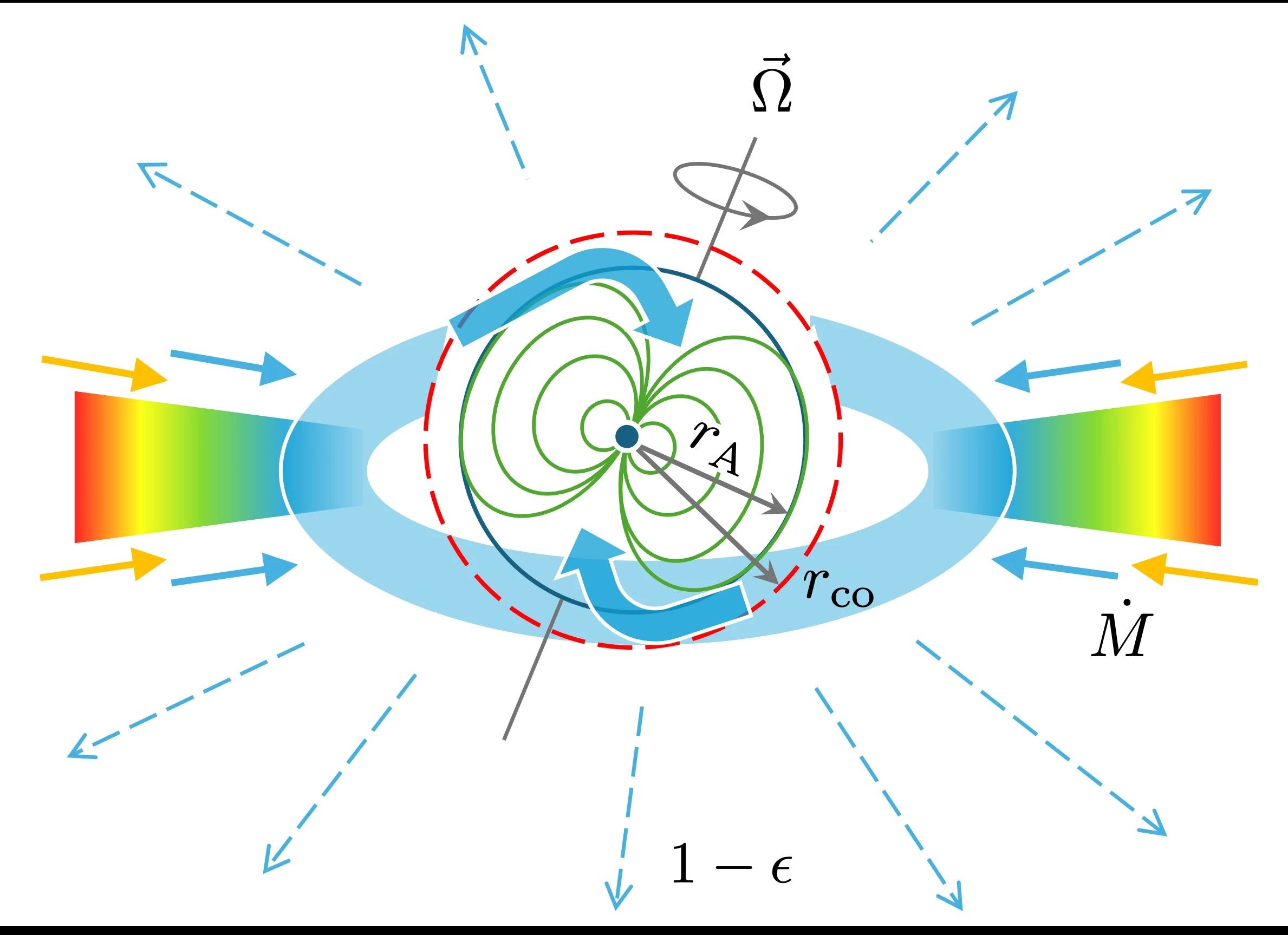
It's like a sprint record: to break it, you need a perfect run-up. But for sub-millisecond pulsars, the run-up is too short. The fastest known pulsar, PSR J1748-2446ad, spins 716 times per second — faster than a kitchen blender. If it were the size of Earth, a point on its equator would move at about 0.24 times the speed of light. But why doesn't any pulsar spin even faster? Physics doesn't forbid it: a neutron star can withstand higher speeds. The prohibition comes from astrophysics — from how pulsars get spun up.
A neutron star is born slow, and it becomes fast when a companion star transfers matter onto it (accretion). Each gram that falls adds rotational momentum, like a figure skater pulling in their arms. To spin up to a period of 1 millisecond, the star needs to accumulate at least 0.25 solar masses. That's a huge amount: with typical accretion efficiency of 20–30%, the donor star must lose 2–4 solar masses. But such massive stars live short lives and transfer matter too quickly, like trying to fill a glass from a fire hose: most of the water splashes past. As a result, the spin-up never reaches the sub-millisecond threshold.
But maybe sub-millisecond pulsars exist and we just don't see them? The authors checked that too. They inserted 40,000 artificial sub-millisecond pulsars into real MeerKAT telescope data and ran them through standard search pipelines. It turned out that at short periods, sensitivity indeed drops due to scattering of radio waves in the interstellar medium. But bright pulsars with strong signals could not have been missed. The statistics of observed periods show: the probability of finding a pulsar with a period shorter than 1 ms is practically zero.
So, the record isn't unbroken because the judges aren't looking carefully, but because the run-up is too short. Sub-millisecond pulsars are not forbidden by physics, but their formation is suppressed by astrophysical constraints. This shifts the focus from searching for exotic limits to more down-to-earth aspects of stellar evolution. Future gravitational-wave observatories, such as the Einstein Telescope and Cosmic Explorer, will be able to test whether gravitational radiation limits spin at the ~716 Hz limit. For now, the fastest pulsar remains the record holder, and its record may never be broken.
The fastest known pulsar, PSR J1748-2446ad, spins 716 times per second — faster than a kitchen blender. If it were the size of Earth, a point on its equator would move at about 0.24 times the speed of light.
In Robert Forward's novel "Dragon's Egg," a neutron star spins so fast that creatures live on its surface perceiving time differently. A submillisecond pulsar would be an even more extreme object, but physics shows such stars cannot exist for long.