Model comparison in physics is the process of using statistical evidence to decide which of several competing theoretical models best explains observational data. In the context of black hole versus boson star models, Bayesian evidence quantifies how well each model predicts the data, while automatically penalizing unnecessary complexity. This is crucial because different exotic objects can mimic the gravitational signatures of black holes, and distinguishing them tests fundamental physics.
History
The Bayesian approach to model comparison was formalized by Thomas Bayes in the 18th century and developed by Pierre-Simon Laplace. Its modern application to astrophysics, including black hole alternatives, grew in the 2000s with the advent of gravitational wave astronomy and computational methods for evidence calculation.
How it works
Bayesian evidence is computed by integrating the likelihood of the data over all possible parameter values of a model, weighted by the prior probability. This integral rewards models that fit the data well but penalizes those with many parameters that are not strongly constrained. The ratio of evidences for two models, called the Bayes factor, indicates the relative support: a factor greater than 10 is considered strong evidence for one model over the other. In practice, this is done numerically using algorithms like nested sampling or Markov chain Monte Carlo.
In practice
It is used in gravitational wave astronomy to test whether detected signals come from black holes or exotic alternatives, and in cosmology to compare dark energy models.
Fun fact
Bayesian evidence automatically implements Occam's razor: a simpler model can win even if it fits slightly worse, because it does not waste probability on unconstrained parameters.
In 2015, the LIGO detectors caught the first ripple of spacetime from a black hole merger. Since then, hundreds of such events have piled up, each carrying the imprint of its ancestry: whether the holes were born together from a single pair of stars or met by chance in a dense cluster. The difference shows in the direction of their spin axes.
An invisible scaffold holds galaxies together, keeping them from flying apart. This is dark matter — matter that doesn't shine and barely interacts with ordinary stuff. Astrophysicists have long debated what it's made of.
A rotating black hole is no calm whirlpool. Space around it shudders and rings at the slightest disturbance, like a guitar string after a pluck. These oscillations are described by the Teukolsky equation — a complex mathematical construct that physicists have studied for half a century.
Recently, a strange symmetry was noticed in this equation.
Two black holes circle in a cosmic dance, spiraling closer together. In the end, they merge into one, and that moment unleashes a powerful burst of gravitational waves, ripples in spacetime itself. But what remains after the merger?
A Dictyostelium amoeba crawls across glass. Its path is recorded — a chain of points on a plane. But what forces are pushing it? Inside the cell, a molecular motor works: proteins pull, the membrane springs, water presses.
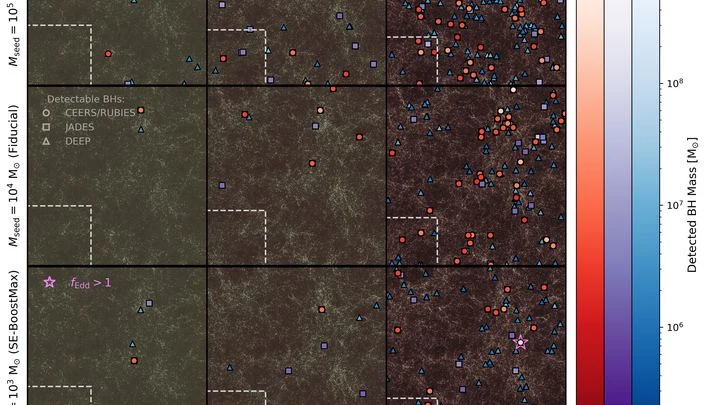
A marathon lasting 13 billion years started with different weights. A hundred solar masses — lighter than some gas clouds. A hundred thousand — gravitational dominance, comparable to an elephant among kittens. That's what black hole seeds looked like, ones that by our time should have turned into supermassive giants.
Two figure skaters on a lake frozen to the horizon. They are so far apart that their silhouettes turn into dots, and their mutual attraction becomes almost an article of faith. By Newton's law, they should circle in an unimaginably slow waltz. But telescopes see otherwise.
In 2019, the world saw the first image of a black hole's shadow — an orange doughnut on a black background, becoming a symbol of scientific progress. But this image wasn't captured by a camera: it was born from mathematical alchemy, where data from eight radio telescopes, which gathered only crumbs of signal, merged into a single picture.
At the heart of almost every galaxy slumbers a supermassive black hole — the invisible conductor of a stellar orchestra. When galaxies collide, their central monsters draw closer, entwining in a gravitational dance. Sometimes a third partner joins the duo, and then a triple waltz begins, its outcome unpredictable.
Ever since Einstein predicted gravitational lensing, and gravitational waves were first heard by LIGO detectors, physicists have dreamed of catching the lensed echo — a repeating signal from one merger, multiplied by the gravity of a massive body.
Boson stars are gravitational atoms. Only instead of electric charge, gravity itself serves as the nucleus, holding a cloud of scalar field in quantized clumps.
Statistical models are an attempt to stretch a perfect mathematical web over the uneven landscape of data. When a model resists, it emits tension, but we've grown accustomed to ignoring it. Researchers spend hours staring at residual plots, trying to guess where the model is 'coming apart at the seams.' Squealer translates this resistance into sound.
A black hole is not a frozen void, but a living magnetic engine. Its 'heart'—the accretion disk, pulsates: inhale, matter spirals into the funnel, exhale — magnetic reconnection tears the field lines, and plasma shoots away from the horizon.
The universe as painted in Einstein’s textbooks is a smooth four-dimensional canvas. But string theory adds a frame of extra dimensions — invisible, yet tangible to gravity. Imagine our universe as a membrane that trembles under the pressure of hidden layers.
Twenty-first-century astrophysics is deafening with triumphs: we’ve caught the tremor of spacetime from the merger of invisible giants; glimpsed the 'shadow' of a supermassive monster in a distant galaxy; traced the orbits of stars dancing around a compact something at the heart of the Milky Way.
The cosmos is full of mimicry. The clearwing moth wears a wasp's mask, a harmless fly buzzes like a bee. And in the world of gravity, the role of impersonator is perhaps played by boson stars — colossal clumps of scalar field, indistinguishable from black holes.
Two heavy balls orbit on the surface of a pond. Ripples spread from them: these are gravitational waves. As the balls spiral closer, the waves carry away energy, and the ripples become more frequent.
At the center of the Milky Way lurks something invisible but extremely massive — about four million times heavier than the Sun. It is usually called a black hole and designated Sagittarius A*. But astronomers are not letting their guard down: what if it is not a hole but something more exotic, like a giant ball of ultralight particles — a boson star?
Comparing two scents is easy even without knowing their ingredients, just tell if they're alike. This everyday principle became the foundation for a new class of Bell inequalities, reimagining tests of the spooky connection between particles. Previously, you had to measure precise properties, like spin direction, but the authors showed that simply comparing outcomes is enough.
Imagine the hum of a crowded square (that's what the gravitational wave background of the Universe sounds like, as detected by a network of pulsars) neutron stars that emit regular radio pulses with the precision of atomic clocks.
Black holes are among the most mysterious objects in the universe. Their gravity is so strong that even light cannot escape their vicinity. But studying them directly is extremely difficult: the nearest black hole is thousands of light-years away, and mergers of two black holes take millions of years.
In the 19th century, James Clerk Maxwell imagined a tiny demon. It knows the speed of every gas molecule and opens a door: fast ones to the left, slow ones to the right. This creates a temperature difference without expending energy, seemingly violating the laws of physics.
Two black holes circle each other, and their dance isn't always a smooth waltz. If the holes spin on their own axes, their orbit can start to tumble, like a top that's been pushed and wobbles on its side while still spinning.
Inside a neutron star, matter is compressed to unimaginable densities. Previously, scientists speculated about its exact makeup, cycling through possible equations linking pressure and density. The new method tosses out guesswork: it directly ties the measurable mass and radius to the internal structure.
The James Webb Space Telescope spotted galaxy Abell 2744-QSO1, which has almost no heavy elements (astronomers call them metals), and its central black hole weighs hundreds of times more than all its stars combined. Standard scenarios can't explain this imbalance.
Every evening, in the city archive, the attendant places new folders on the shelves. If too many arrive during the day, the shelves sag, and the next morning the archive responds to requests more slowly. A black hole's memory works in much the same way: it doesn't just store information, it physically feels its weight.
A gravitational-wave detector catches not only the roar of mergers but also the quiet splash when a star or gas cloud dives into a supermassive black hole. Such a dive, like a stone falling into a well, generates waves at all frequencies at once—and in that spectrum lies encoded the nature of the well itself.
An ordinary black hole is the perfect devourer: everything that crosses its horizon disappears forever. But in recent decades, this picture has been cracking at the seams. The information paradox, singularities, firewalls: theorists are looking for a way out, and one candidate replacement is the black mirror.
In the quantum world, particles do not have precise properties until they are measured. The official model refuses to explain what lies behind this uncertainty. But the idea that invisible 'pilots' control particles has been around since the 1920s.