Degeneracy in physics refers to a situation where different parameters or configurations produce the same observable outcome. This concept appears in many areas, from quantum mechanics where multiple quantum states share the same energy level, to astrophysics where different combinations of stellar properties yield the same observed spectrum. Degeneracy is a fundamental challenge in inverse problems, where scientists must infer underlying parameters from measurements, because it means that multiple explanations are consistent with the data.
History
The concept of degeneracy has roots in quantum mechanics, where it was formalized in the 1920s by physicists like Erwin Schrödinger and Werner Heisenberg, who recognized that degenerate energy levels arise from symmetries of the system.
How it works
Degeneracy arises when the mapping from parameter space to observable space is not one-to-one. In quantum mechanics, it occurs when a Hamiltonian has symmetries that make different eigenstates have the same eigenvalue. In astrophysics, it can occur because different physical processes produce similar observationalsignatures, such as when the effects of temperature and density on a spectrum are partially interchangeable. Breaking degeneracy requires additional information, such as multi-wavelength observations, time-dependent measurements, or theoretical priors.
In practice
Degeneracy is a central issue in data analysis across physics, from determining the properties of exoplanets from transit and radialvelocity data, to interpreting the cosmic microwave background, where different cosmological parameters can produce similar power spectra.
Fun fact
In black hole physics, the 'no-hair theorem' states that black holes are characterized by only three parameters (mass, charge, and angular momentum), meaning that all other details of the collapsing matter are completely degenerate and unobservable.
The universe is like a vast warehouse where a strict inventory was taken long ago. The cosmic microwave background is an ancient record of everything in stock 380,000 years after the big bang. According to it, the fraction of matter in the cosmic 'budget' (the parameter Omega_m) is known with high precision.
An atomic nucleus is like a crowded bus. To free up space, a group of two protons and two neutrons — a helium nucleus, an alpha particle — exits through the front door: this is alpha decay, described by George Gamow as tunneling under an energy barrier.
A squad of soldiers marches across a parade ground. As long as everyone keeps in step, the movement remains sharp and coordinated. But if someone falls out of line, the order is lost. In the microworld, electrons play the role of such a squad: when their oscillations are synchronized, the substance emits a narrow, sharp line.
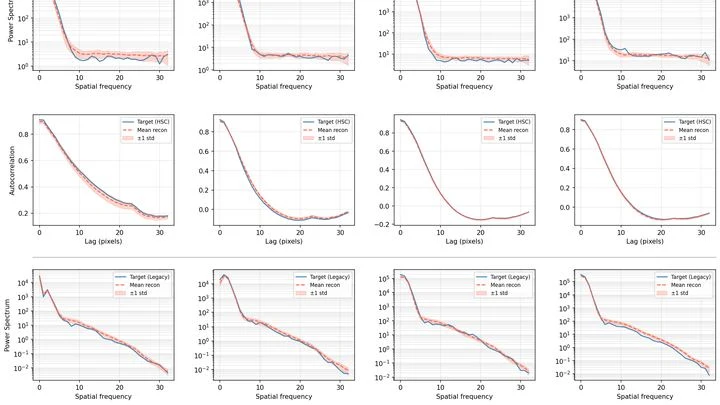
If you photograph the same mountain with a film camera and a modern smartphone, you get different images: colors are brighter in one, details are blurrier in the other. The same goes for telescopes: each instrument sees the sky in its own way, adding its own distortions to the true light of galaxies, like a filter through which we look.
Classical black holes, regions of spacetime with gravity so strong that even light cannot escape, according to general relativity, hide a singularity at their center: a point of infinite density and curvature where the known laws of physics break down.
The early universe was an extremely hot and dense medium. In this medium, like bubbles of steam in boiling water, bubbles of a new state of space spontaneously emerged — regions where physical properties changed abruptly.
A quantum system, once born, does not forget it. Even after dozens of lifetimes, a trace of the initial state remains in its decay: a slowly decreasing power-law tail. For two fluorescent dyes, erythrosine B and eosin Y, this tail has been observed for the first time in two spectral channels simultaneously.