Why does a magnetic string sound lower than it should? ✛
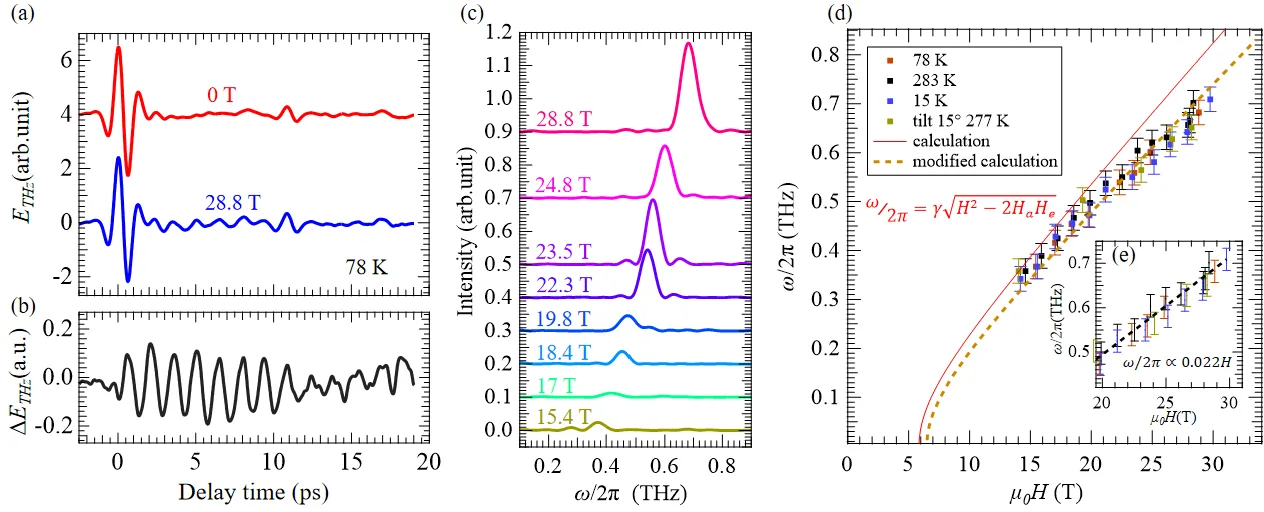
If you pull a string tighter, it sounds higher. Magnetic materials behave similarly: the stronger the magnetic field, the faster their magnetization oscillates. But in a chromium oxide crystal, the frequency grew more slowly than expected.
Scientists at the University of Tokyo used a pulsed magnet that created a field of up to 30 teslas in a thousandth of a second. They sent a short burst of terahertz radiation through the crystal and observed which frequency it absorbed. That frequency is the oscillation frequency of the magnetization.
The discrepancy did not depend on temperature or on the tilt of the sample. So it was not a random error. It seems that the strong field slightly compresses or stretches the crystal lattice, and the lattice in turn changes the magnetic stiffness. When the physicists took this coupling into account, the calculation matched the experiment. Previously, the behavior of chromium oxide in such strong fields had not been studied, because combining a pulsed magnet with ultrafast spectroscopy is very difficult. Now it is clear that accurate calculations must account for how the field deforms the crystal.
Chromium oxide Cr₂O₃ is one of the few materials where the linear magnetoelectric effect was predicted and confirmed as early as the 1960s. In this work, a 30 T field is generated by a pulse lasting only 1 ms, while the terahertz pulse lasts about 1 ps, meaning the time resolution is a billion times better than the field duration.
Arthur C. Clarke's novel 'Childhood's End' mentions materials with unusual magnetic properties, but there is no direct analogy to magnetoelastic resonance. Rather, the theme resonates with the idea of 'smart' materials that change their properties under external influence, as in science fiction about self-healing structures.