method

radio pulse

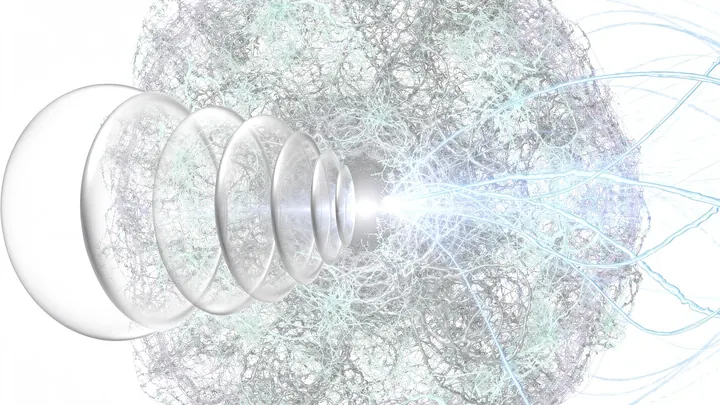
A burst of radio-frequency electromagnetic radiation used to manipulate spins.
44 related articles

Description

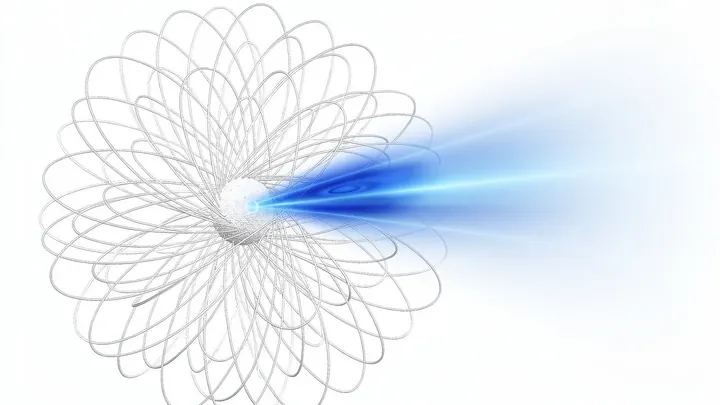
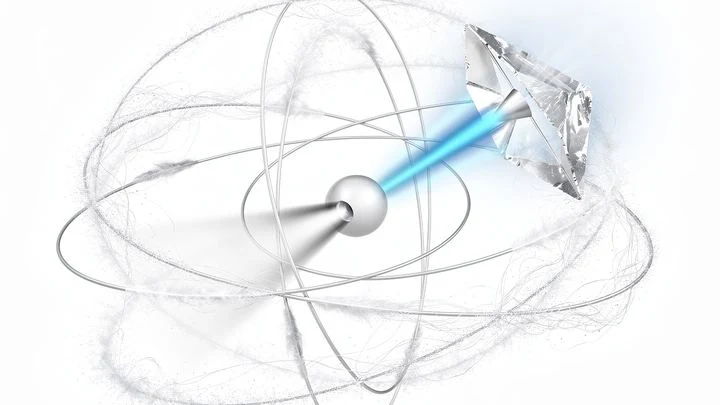
A radio pulse is a short, intense burst of radio-frequency electromagnetic radiation. In physics, it is most commonly used to manipulate the spins of atomic nuclei or electrons in techniques like nuclear magnetic resonance (NMR) and magnetic resonance imaging (MRI). By applying a carefully timed radio pulse, researchers can tip the magnetization of spins away from equilibrium, then observe how they precess and relax back. In astrophysics, radio pulses are also natural phenomena, such as the periodic emissions from pulsars or the enigmatic fast radio bursts (FRBs).

History

The technique of using radio pulses to manipulate nuclear spins was developed in the 1940s and 1950s, with key contributions from Felix Bloch and Edward Purcell, who independently demonstrated nuclear magnetic resonance in 1946. The concept of the pulse sequence was later refined by Erwin Hahn, who introduced the spin echo in 1950.

How it works

In a magnetic field, spins align either parallel or antiparallel to the field, creating a net magnetization. A radio pulse at the Larmor frequency (the natural precession frequency of the spins) delivers energy that flips or rotates the magnetization vector. The pulse duration and power determine the flip angle. After the pulse, the spins precess and emit a radio signal that is detected. The timing and shape of the pulse can be tailored to selectively excite specific spins or to refocus signals, enabling detailed imaging or spectroscopy.

In practice

Radio pulses are the foundation of MRI scanners in hospitals, where they generate the signals used to create detailed images of soft tissues. They are also used in quantum computing to control qubits and in NMR spectroscopy to determine molecular structures.

Fun fact

Pulsars, which emit regular radio pulses, are so precise that their timing rivals atomic clocks — the first exoplanets were discovered around a pulsar by measuring tiny variations in its pulse arrival times.
Concept graph →

Related articles · 44

Pulsar's Radio Spectrum Breathes in Time with Its Orbit
A radio receiver tuned to one station suddenly starts picking up another because someone invisible is turning the tuning knob.
Materials2026-08-302 minarXiv:2608.29712
A String That Changes Stiffness: Magnetic Resonance in Chromium Oxide
A taut string sounds higher when you pull it tighter. Magnetization in an antiferromagnet behaves similarly: the stronger the external field, the faster it oscillates. But in chromium oxide crystals, something goes awry. In fields from 20 to 30 tesla, the resonance frequency grows more slowly than it should.
Magnetic Flip-Flops on an Astronomical Unit Scale
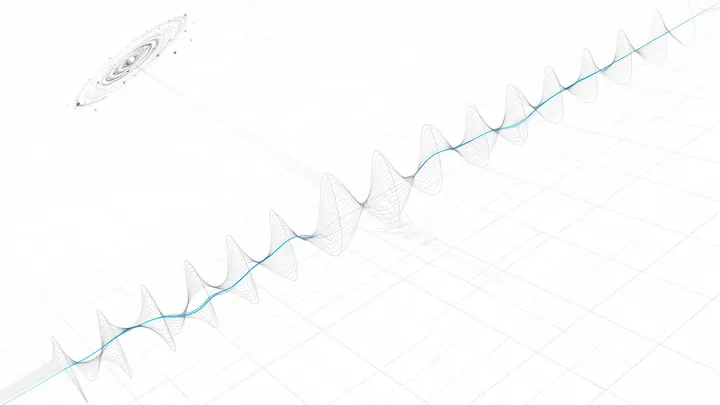
Radio waves from a distant pulsar travel through the interstellar medium, encountering invisible magnetic structures the size of the distance from the Sun to Earth. One such structure is a current sheet, where the magnetic field abruptly changes direction, like a compass needle flipping from north to south.
High Energy2026-08-141 minarXiv:2608.14010express
A Neutron Star's Pulse in X-Ray Bursts
A lighthouse doesn't flash steadily but in short, bright pulses. The neutron star in the system 4U 1323-62 is such a lighthouse in the X-ray range. It pulls gas from a companion star, and when enough material accumulates on its surface, a thermonuclear explosion occurs — an X-ray burst.
High Energy2026-08-091 minarXiv:2608.08754express
Lone Radio Pulsars: The Mystery of Rare Bursts
Pulsars are rapidly spinning neutron stars that emit radio pulses like a lighthouse. But some of them stay silent almost all the time, occasionally emitting a single pulse. Such objects are called rotating radio transients (RRATs). They were discovered nearly twenty years ago, but they remain a mystery.
HEP Phenomenology2026-08-061 minarXiv:2608.05698express
How Light Twists an Electron's Spin
A laser beam is like a swift vortex that briefly captures a passing electron. As the particle moves through the pulse, its spin (the intrinsic rotation, like a tiny top) experiences a weak kick. After leaving the beam, the top no longer points in the same direction; it has turned a little.
Cosmology2026-08-042 minarXiv:2608.03235express
Radio Bursts to Map the Invisible Universe
A flashlight beam cuts through fog. The denser the fog, the more the light scatters and the later it reaches your eye. A similar principle works with fast radio bursts — mysterious, super-powerful pulses from distant galaxies. As their radio waves travel through space, they interact with free electrons — particles stripped from atoms.
High Energy2026-07-301 minarXiv:2607.27622express
Medical Physics2026-07-202 minarXiv:2607.17974express
Oxygen Decides Whether Ultrafast Radiation Saves Tissues
A camera flash that fires in a thousandth of a second doesn't heat the subject — unlike a regular flash that lasts a full second. A similar trick has been found in radiotherapy: when a radiation dose is delivered in milliseconds instead of minutes, healthy tissues suffer less. This is called the FLASH effect.
Space Physics2026-07-091 minarXiv:2607.08464express
Cosmic Mirage: How Radio Bursts Kick Light into Overdrive
The flash lasts a thousandth of a second, but in that instant it releases as much energy as the Sun emits in a day. Such signals, fast radio bursts, have been caught by telescopes since 2007, and their source remains a mystery. A new study offers an elegant answer: it's all about a cosmic amplifier.
Magnetic Echolocation: Measuring the Cosmic Cocoons of Fast Radio Bursts
Fast radio bursts — millisecond radio pulses arriving from distant galaxies — long remained a puzzle. Their colossal energy, compressed into instants, pointed to cataclysms on neutron stars, perhaps pulsars or magnetars.
Kinetic Dead End of Fast Radio Bursts: Where Models Break Down
The enigma of fast radio bursts (FRBs) is not just a question of 'what exploded?' It’s a drama of energy transfer under extreme conditions, where the slightest stumble leads to collapse.
Cosmology2026-06-213 minarXiv:2606.22390
In the Rhythm of the Universe: Radio Bursts vs. Hubble Tension
The universe is a vast orchestra playing the score of expansion. Galaxies race apart to the beat of inaudible music of dark energy. But here's the trouble: the conductor's baton held by Edwin Hubble, Adam Riess, and Vera Rubin sets two incompatible tempos.
High Energy2026-06-172 minarXiv:2606.19448express
Radio Signals from the Depths: Why Magnetars Muffle Their Bursts
A lighthouse sends its beam through a storm of its own mirrors: that's roughly how fast radio bursts behave when trying to leave a magnetar's vicinity. A magnetar is a neutron star with a magnetic field a quadrillion times stronger than Earth's.
Broken Prism: How a Pulsar Became a Cosmic Ghost
A radio telescope is not just an antenna, but a computing machine that builds an image from millions of equations. This mathematical prism is as fragile as glass: one wrong digit in the calibration, and the real sky splits, spawning phantom sources.
A Polygraph for Flashes: How the Pincus–Lyapunov Diagram Uncovers FRBs
Since their discovery in 2007, fast radio bursts (FRBs) have teased astrophysicists with their elusive nature. These millisecond signals arrive from distant galaxies and carry colossal energy: for an instant, they radiate as much as the Sun does in a month.
physics.ed-ph2026-05-201 minarXiv:2605.21626express
A Magnetic Remote for Atoms
In the orchestra of atoms, each instrument has its own score. But sometimes two musicians start playing in unison, and the sound amplifies many times over. In the quantum world, this 'harmony' is called a Feshbach resonance. It allows you to control atomic interactions with jeweler-like precision.
Atomic Physics2026-05-121 minarXiv:2605.12767express
Radioactive Molecules — Hunters for Unknown Particles
The Standard Model is a set of rules for all known particles. But it says nothing about dark matter, which makes up a quarter of the Universe. To find it, you don't need to build city-sized colliders. Radioactive molecules act like sniffer dogs: their incredible 'scent' picks up the faintest traces of unknown forces that slip past giant machines.
High Energy2026-04-282 minarXiv:2604.25469express
Cosmic Radio Burst and Sculpting Waves
A distant lighthouse flashes for an instant brighter than an entire galaxy. This is a fast radio burst — a mysterious signal from deep space. Some repeat, and astronomers have noticed a peculiarity: these bursts show rapid changes in polarization — a property indicating how the radio wave is twisted in space.
General Relativity2026-04-282 minarXiv:2604.26011express
The Gravitational Orchestra Loses Its Rhythm
A figure skater glides across the ice, gradually moving toward the center. Their trajectory isn't a perfect spiral: sometimes they catch the rhythm of the music and add an extra turn, slightly changing their speed. That's roughly how a small black hole behaves when it falls into a supermassive one.
High Energy2026-04-102 minarXiv:2604.09080express
The Sky Is Noisy: Radio Burst Hunters Catch a New Signal
The night sky looks calm, but if you listen in on the radio band, it's full of short clicks and rustles. Astronomers are combing the sky for solitary radio pulses — bursts lasting milliseconds that come from various corners of the Galaxy and beyond. One such search is underway at the 100-meter radio telescope in Effelsberg, Germany.
Plasma Physics2026-04-052 minarXiv:2604.04276express
What a Cosmic Hurricane Sounds Like
When water boils in a kettle, waves of steam ripple through the kitchen. A similar process happens in space, in plasma — gas so hot that electrons are stripped from atoms. Around black holes and neutron stars, this plasma isn't just hot: its particles zip around at nearly the speed of light.
High Energy2026-03-251 minarXiv:2603.24001express
A radio pulsar that is almost always silent
Radio pulsar J1574+4703 behaves like a finicky lighthouse. Instead of shining steadily, it turns its radio beam on in short flashes and then falls silent for long stretches. Objects like this are called 'rotating radio transients', or RRATs for short.
Quantum Physics2026-03-221 minarXiv:2603.21057express
Quantum Sensor: Noise-Proof Performance
A quantum magnetometer based on hydrogen nuclei works like noise-canceling headphones. It alternately "listens" to the field in two different ways: the noise is the same for both, but the desired signal is different. By subtracting one from the other, the device extracts the signal, reducing interference by more than 1000 times.
Nuclear Experiment2026-03-202 minarXiv:2603.20090express
Magnetic Portrait of a Potassium Nucleus
The atomic nucleus is not just a ball of protons and neutrons. Inside it, like a tiny magnet, there is its own distribution of magnetization. Until now, it has been difficult to see: nuclei live for tiny fractions of a second, and their magnetic field is weak. Now physicists at CERN have found a way to look inside.
Neutrons Leave a Trace
A dark matter detector is like a super-sensitive microphone listening for silence. It picks up tiny heat jolts, phonons, that occur when a particle grazes a crystal. But instead of silence, the instruments have been hearing noise for years: a slew of weak signals below a few hundred electronvolts.
HEP Phenomenology2026-03-101 minarXiv:2603.10189express
A Pulsar as a Beacon for Invisible Particles
A neutron star the size of a city spins thirty times per second. Its magnetic field is trillions of times stronger than Earth's. Such conditions could spawn a cloud of axions around the star — light particles that no detector has caught yet, but which neatly explain the hidden mass of the Universe.
High Energy2026-03-101 minarXiv:2603.10226express
How Neutron Stars Forge Their Light
A neutron star is a city the size of a metropolis squeezed into a small asteroid. Around it, plasma, a gas of charged particles, seethes, and waves ripple through it like ripples on a pond. There are three kinds of waves: Alfvén (A), ordinary (O), and extraordinary (X).
High Energy2026-02-271 minarXiv:2603.00295express
Magnetar Radio Pulse: Giant Flares
The lighthouse stays silent most of the time, but occasionally it emits a flare so bright it can be seen from hundreds of thousands of kilometers away. That's exactly how the magnetar XTE J1810-197 behaves — an ultra-dense star with a monstrous magnetic field.
High Energy2026-02-251 minarXiv:2602.22309express
Radio Burst Reveals the Secret of a Newborn Supernova
Fast radio bursts are instantaneous radio flashes from deep space. In a thousandth of a second they release as much energy as the Sun emits in a month. One such burst, repeating, allowed scientists to peer into the epicenter of a recent stellar explosion.
High Energy2026-02-211 minarXiv:2602.18783express
A Pulsar That Shudders with Flares
A kitchen timer ticks once a second. The neutron star SRGA J144459.2-604207 ticks 448 times a second: that's its own rotation, and it shows up in X-ray bursts. In 2024, the star woke up and started throwing thermonuclear explosions on its surface, like a bubbling pot of boiling water.
High Energy2026-02-181 minarXiv:2602.16955express
The Zebra in the Heart of the Crab
A radio telescope picks up a signal from the Crab Nebula, and instead of a smooth line, the screen shows bright and dark bands, like on a zebra's hide. This is the emission from the pulsar, a rapidly spinning neutron star left over from a supernova explosion.
Quantum Physics2026-01-291 minarXiv:2601.21499express
Controlling Nuclear Spin Without Radio Waves
A quantum computer is like an orchestra where electrons and nuclei play different instruments. Usually, the conductor needs two batons: microwaves for electrons and radio waves for nuclei.
High Energy2026-01-282 minarXiv:2601.20143express
Night Watchman for Cosmic Flashes
At night, while most people sleep, the giant dish of the Green Bank radio telescope in West Virginia keeps listening to the sky. Over 24,186 hours, that's nearly three years of continuous observation, it caught 50 pulsars and three fast radio bursts.
Stellar2026-01-181 minarXiv:2601.12476express
Waves Spinning in Opposite Directions Found Inside a Solar Eruption
The Sun constantly emits a stream of charged particles, mostly hydrogen — the solar wind. Sometimes the Sun ejects dense blobs of magnetized gas, inside which calm usually reigns. But in 2000, scientists noticed two regions inside one such cloud where the gas was churning.
High Energy2026-01-171 minarXiv:2601.12108express
A newborn neutron star's pulse heard in a 90s gamma-ray burst
Short gamma-ray bursts — instantaneous, but most powerful explosions — are born from the mergers of neutron stars (the superdense remnants of dead stars).
High Energy2026-01-082 minarXiv:2601.04953express
Wobbling Magnetars: The Key to Fast Radio Bursts
Astronomers have been wrestling for years with the mystery of fast radio bursts — ultra-short yet incredibly powerful radio signals from distant galaxies. Some flash repeatedly, like beacons with an irregular rhythm, while others are detected only once, leaving behind nothing but questions.