A String That Changes Stiffness: Magnetic Resonance in Chromium Oxide ✛
A taut string sounds higher when you pull it tighter. Magnetization in an antiferromagnet behaves similarly: the stronger the external field, the faster it oscillates. But in chromium oxide crystals, something goes awry.
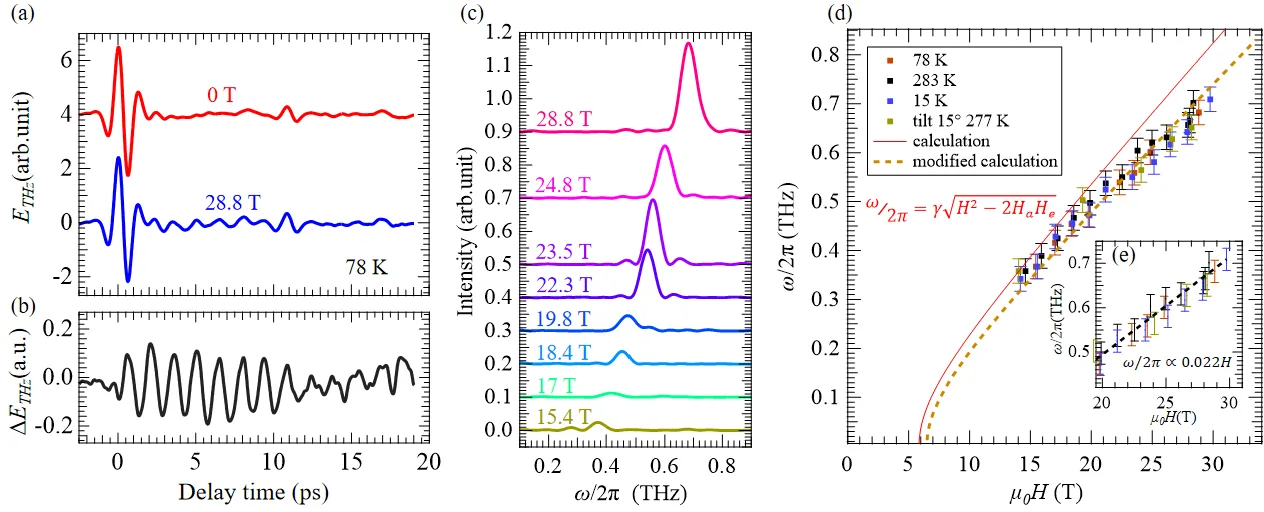
The experiment was conducted at the University of Tokyo: a single crystal of Cr₂O₃, half a millimeter thick, was placed in a pulsed magnet that generated fields up to 30 tesla in a thousandth of a second. Simultaneously, a terahertz pulse—a flash of radiation with a frequency of about a trillion oscillations per second—was sent through the sample. By measuring how the crystal absorbed this flash, the team could deduce the oscillation frequency of its magnetization.
It turned out that above 15 tesla, a clear resonance peak emerges. As the field increases, the peak shifts toward higher frequencies, but not as fast as expected. The slope was about 22 GHz/T, while a simple model predicted 28 GHz/T. The difference did not depend on temperature (from 13 to 283 K) or on whether the sample was tilted by 15 degrees. This suggests the effect is not due to random error but is intrinsic to the material.
It seems that a strong field slightly deforms the crystal lattice. The deformation, in turn, alters the magnetic anisotropy—how hard it is for the magnetization to rotate in a given direction. The physicists added a correction term proportional to the square of the field to their formula, and it fit the data perfectly. This implies that at 30 tesla, the anisotropy changes by about a third of a tesla—comparable to the fields at which magnetic domains align in other antiferromagnets.
Until now, the behavior of Cr₂O₃ in fields above 10 tesla had remained unexplored: combining a pulsed magnet with ultrafast spectroscopy is extremely challenging. Now it is clear that simple models fail there, and one must account for how the magnetic field tugs at the lattice. This is important for future spintronic and magnonic devices, where antiferromagnets are considered as a basis for information storage and transmission.
Chromium oxide Cr₂O₃ is one of the few materials where the linear magnetoelectric effect was predicted and confirmed as early as the 1960s. In this work, a 30 T field is generated by a pulse lasting only 1 ms, while the terahertz pulse lasts about 1 ps, meaning the time resolution is a billion times better than the field duration.
Arthur C. Clarke's novel 'Childhood's End' mentions materials with unusual magnetic properties, but there is no direct analogy to magnetoelastic resonance. Rather, the theme resonates with the idea of 'smart' materials that change their properties under external influence, as in science fiction about self-healing structures.