Magnetic Pulse of Cr₂O₃: How Terahertz Resonance Reveals Hidden Strain ✛
Context
Antiferromagnets with a linear magnetoelectric effect, such as Cr₂O₃, are attracting attention as candidates for spintronic and magnonic devices. Their dynamics in strong magnetic fields, especially above the spin-flop transition, remain poorly studied due to technical challenges: one needs simultaneously pulsed fields of tens of tesla and time-resolved terahertz spectroscopy. This work stands apart from neighboring studies in the archive: those deal with superconductivity, quantum models, and collective behavior, while here the focus is on magnetoelastic dynamics of an insulator. The closest related works explore magnetic phases and resonances in other materials, but no one has ventured into the 20–30 T range for Cr₂O₃ with such time resolution.
Methods
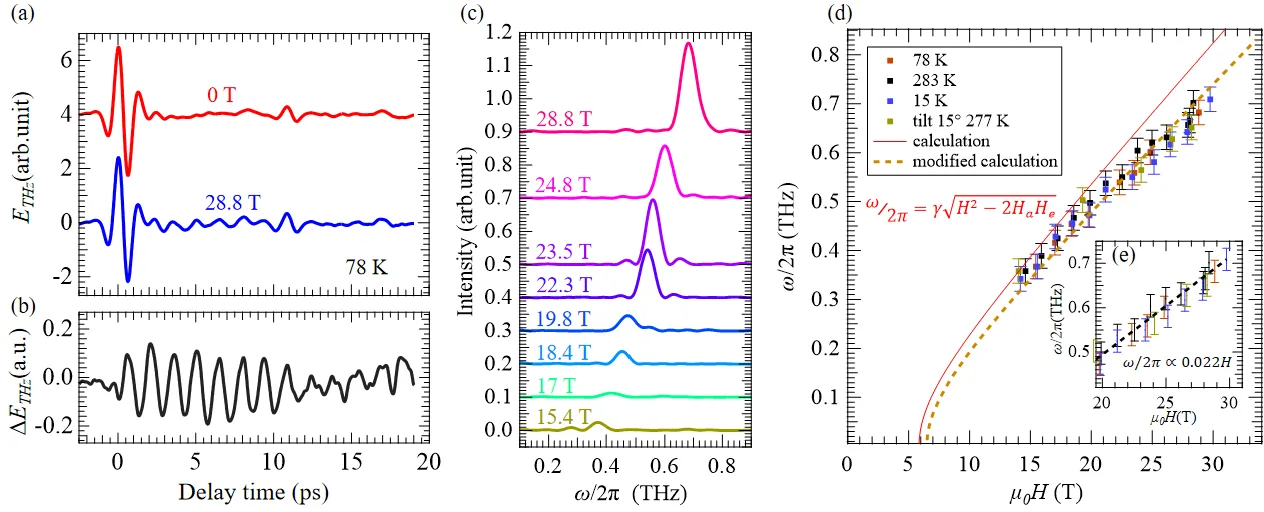
The experiment was performed on a single-shot terahertz time-domain spectroscopy (THz-TDS) setup combined with a 30-tesla mini-solenoid. The pulsed field is generated by discharging a capacitor bank with a capacitance of 1.2 mF at a voltage of 1900 V, with a pulse duration of about 1 ms. The terahertz pulse is generated in a LiNbO₃ crystal via tilted-pulse-front pumping and detected by electro-optic sampling in a ZnTe crystal. A single-channel scheme with an echelon mirror and a CMOS camera records the pulse waveform in a single shot within a 20 ps window. The sample is a Cr₂O₃ single crystal, 0.5 mm thick, grown by the Verneuil method, with the c-axis parallel to the field. Measurements were performed at 13–283 K and with the sample tilted by 15°. The signal with the field was subtracted from the signal without the field, and the difference was Fourier-transformed to obtain the resonance spectrum.
Results
Above 15.4 T, a clear resonance peak appears and shifts to higher frequencies with increasing field. In the 20–30 T range, the frequency versus field dependence is nearly linear, but the slope is about 22 GHz/T, noticeably smaller than the gyromagnetic ratio of 28 GHz/T expected for a g-factor of 2.00. This discrepancy is independent of temperature (13–283 K) and of a 15° field tilt, meaning it is an intrinsic property of the high-field phase. The resonance intensity sharply increases above 20 T, which is attributed to the growth of magnetization along the field. A simple quasi-ferromagnetic resonance model with fixed anisotropy does not describe the data. Introducing a phenomenological correction to the anisotropy field of the form $H_a$,eff = $H_{a0}$ + bH² with b = 3.8×10⁻⁴ T⁻¹ reproduces the observed slope well. The estimated change in anisotropy ΔH_a = bH² gives 0.15–0.34 T in the 20–30 T range, which matches in order of magnitude the monodomainization fields in other antiferromagnets.
Implications
This work demonstrates for the first time that in the high-field spin-flop phase of Cr₂O₃, the gyromagnetic ratio extracted from the resonance slope is effectively reduced. This points to magnetoelastic feedback: the field deforms the lattice, and the strain changes the anisotropy, which shifts the resonance. Unlike neighboring studies that examined low-field regimes or other materials, here direct terahertz spectra in fields of 20–30 T are obtained for this classic magnetoelectric for the first time. This expands the understanding of high-field dynamics of antiferromagnets and highlights the need to account for magnetoelastic effects when interpreting resonance data.
Future development
The topic could develop toward direct measurements of magnetostriction in the same pulsed fields to independently confirm the proposed mechanism. It would also be interesting to investigate other antiferromagnets with a spin-flop transition, such as α-Fe₂O₃ or MnCl₂, and compare the magnitude of the magnetoelastic correction. Theoretical models linking magnetoelasticity to high-field dynamics will gain an experimental basis for testing. Time-resolved experiments might emerge to track the dynamics of strain directly during the field pulse.
Impact
The results will impact the physics of antiferromagnetic materials for spintronics and magnonics, where resonance frequencies in strong fields are important. They are also useful for calibrating terahertz magnetometers and for understanding magnetoelastic phenomena in transition-metal oxides.
Next steps
The immediate next step is to measure the magnetostriction of Cr₂O₃ in pulsed fields up to 30 T on the same sample. Then one should check whether the reduced slope persists in other crystallographic orientations and at even higher fields, if the setup allows.
Key open problems
In the physics of antiferromagnets, the role of magnetoelastic interaction in high-field phases remains an open question. This work links the observed discrepancy in the gyromagnetic ratio to the field dependence of anisotropy, which is a step toward solving this problem. It also touches on the long-standing issue of precisely determining exchange and anisotropy parameters from resonance experiments in strong fields.
The knowledge machine's view
This section is addressed to the author of the paper and their colleagues. Neighbouring works were found by meaning-based search across our archive, not by word overlap. We do not review: we show the field around the work.
What the work does
The study measures the terahertz response of the antiferromagnet Cr₂O₃ in pulsed magnetic fields up to 30 T. Above the spin-flop transition, the quasi-ferromagnetic resonance frequency depends linearly on the field, but with a slope of about 22 GHz/T instead of the expected 28 GHz/T. The effect is independent of temperature and sample tilt, pointing to a magnetoelastic renormalization of the anisotropy.
Where its strength is
For the first time, it is shown that in the high-field spin-flop phase of Cr₂O₃ the effective gyromagnetic ratio decreases, which is attributed to magnetoelastic feedback. This opens a path to incorporating magnetoelastic effects into the dynamics of antiferromagnets.
Where it could go next
- It might be interesting to compare the observed magnetoelastic renormalization with lattice strain/compression effects, which were studied in a related work through changes in the crystal's acoustic properties.based on: Stretching a crystal changes its sound arXiv:2602.13924
- A nearby paper investigated magnetic phases and transitions via transport measurements that reveal angular dependencies. A similar approach could help map the anisotropy of the high-field phase of Cr₂O₃.based on: Resistance Paints the Secret Angles of a Magnetic Dance arXiv:2510.15091
- There is a preprint on lattice reconstruction and the emergence of magnetism. It may be useful to consider how field-induced strains affect the magnetic structure in Cr₂O₃.based on: Waves of Tilts: How to Rebuild a Crystal and Get Magnetism arXiv:2603.21120
Worth trying
- Test a magnetoelastic coupling model that includes the strain dependence of anisotropy to quantitatively describe the resonance slope.
- Check the model's predictions for other field orientations relative to the c-axis to separate contributions from different magnetoelastic constants.
- Investigate the temperature dependence of the magnetoelastic correction near the Néel temperature, where the effect may be enhanced.
Why this may matter
Understanding magnetoelastic effects in high fields is important for designing spintronic and magnonic devices based on antiferromagnets, where controlling resonance frequencies via strain could be practical.
Nearby works in our archive
- The Quantum Garden of UTe2: How a Magnetic Field Cultivates Three Superconducting Phasessimilarity 0.55
- Stretching a crystal changes its soundsimilarity 0.52
- Resistance Paints the Secret Angles of a Magnetic Dancesimilarity 0.52
- Waves of Tilts: How to Rebuild a Crystal and Get Magnetismsimilarity 0.50
- Cosmic Kneading: Turbulent Amplification of Magnetic Fields in Newborn Neutron Starssimilarity 0.50
- Heavy seed in a magnetic cocoonsimilarity 0.49
The archive is sparse around this work: the closest review is only 0.55, against a usual 0.64. It looks like few have drilled nearby.
Chromium oxide Cr₂O₃ is one of the few materials where the linear magnetoelectric effect was predicted and confirmed as early as the 1960s. In this work, a 30 T field is generated by a pulse lasting only 1 ms, while the terahertz pulse lasts about 1 ps, meaning the time resolution is a billion times better than the field duration.
Arthur C. Clarke's novel 'Childhood's End' mentions materials with unusual magnetic properties, but there is no direct analogy to magnetoelastic resonance. Rather, the theme resonates with the idea of 'smart' materials that change their properties under external influence, as in science fiction about self-healing structures.
Key numbers
- resonance slope at high field: 22 GHz/T
- expected slope (g=2.00): 28 GHz/T
- magnetoelastic correction coefficient b: 3.8×10⁻⁴ T⁻¹
- anisotropy change ΔH_a at 20–30 T: 0.15–0.34 T
- maximum field: 30 T