A nanohertz is a unit of frequency equal to one billionth of a hertz, corresponding to oscillations with a period of about 31.7 years. Such extremely low frequencies are used to describe phenomena that change on timescales of decades or longer, particularly in astrophysics where gravitational waves from supermassive black hole binaries are expected to have frequencies in this range.
History
The concept of using pulsar timing arrays to detect nanohertz gravitational waves was proposed in the 1980s by several researchers, including Sazhin and Detweiler. The first strong evidence for such a background was announced in 2023 by multiple collaborations.
How it works
Nanohertz frequencies arise when the characteristic timescale of a process is extremely long. In the context of gravitational waves, these signals are produced by pairs of supermassive black holes orbiting each other with periods of years to decades. Detecting them requires monitoring pulsars over many years, looking for tiny variations in their pulse arrival times caused by passing gravitational waves.
In practice
Nanohertz frequencies are used in pulsar timing arrays to detect gravitational waves from supermassive black hole mergers, providing a unique probe of the universe's largest black holes.
Fun fact
A nanohertz signal corresponds to a gravitational wave with a wavelength of about 10 light-years, making it one of the largest coherent structures ever sought in the universe.
Systems:SInanohertz is 10^-9 hertz, where hertz is the SI unit of frequency defined as one cycle per second.
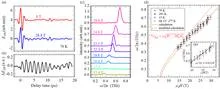
A taut string sounds higher when you pull it tighter. Magnetization in an antiferromagnet behaves similarly: the stronger the external field, the faster it oscillates. But in chromium oxide crystals, something goes awry.
In fields from 20 to 30 tesla, the resonance frequency grows more slowly than it should.
A pendulum weighing a few grains of sand swings on a hair-thin glass fiber. Its motions are so faint that the thermal jostling of air molecules seems like a hurricane. Yet such a pendulum is the key to witnessing quantum wonders in the world of large objects.
A tiny defect in a diamond crystal is like a sensitive microphone picking up the faintest magnetic fields. That's how sensors based on nitrogen-vacancy centers work (where a nitrogen atom and a neighboring vacancy form a quantum system). To hear the whispers of individual molecules, the sensor is placed right at the surface.
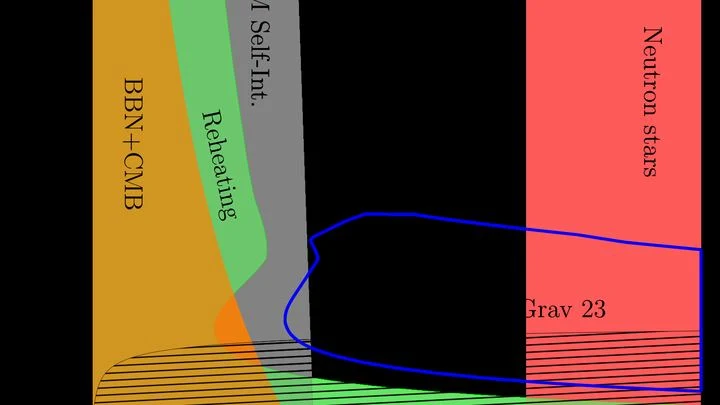
A bell rings not from the strike but from a fleeting shudder of space. A gravitational wave, like ripples on a pond, passes through a massive magnet, and it deforms ever so slightly. That deformation can be turned into an electrical signal.
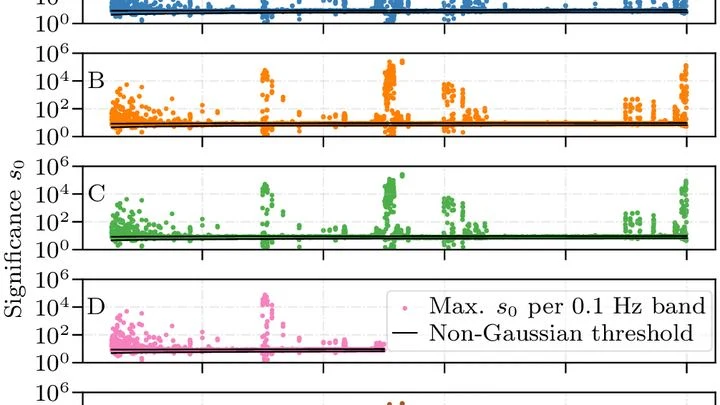
A low rumble coming from underground could be the noise of a distant construction site, or it could be the echo of an ancient earthquake. Astronomers faced a similar puzzle in 2023 when they detected ultra-low-frequency gravitational waves — the trembling of spacetime itself, rippling across the universe.
A spinning top whirls at great speed and, instead of a steady hum, emits a quiet buzz — because it is slightly dented. Neutron stars work much the same way: city-sized spheres compressed to such density that a teaspoon of their material weighs as much as a mountain.
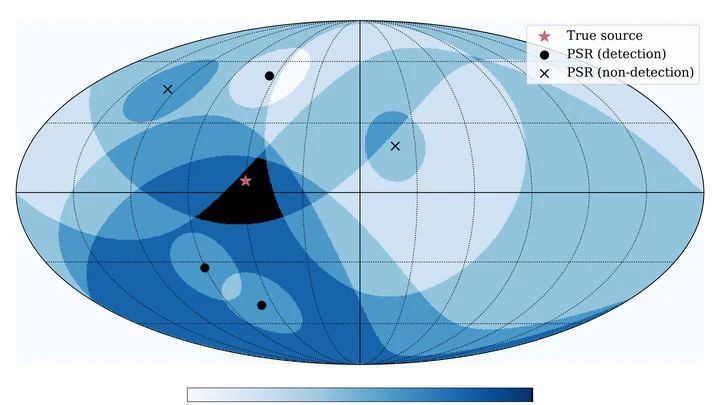
In a vast hall, a hundred tuning forks are set out. Each one is a pulsar — an ultra-dense stellar remnant spinning at a furious rate, sending out radio pulses more precisely than any clock. When a low-frequency sound wave sweeps through the hall, all the tuning forks start to go slightly out of tune at the same moment.
An ordinary laser emits narrow lines, like a string that sounds only one note. For spectroscopy, this is inconvenient: if a substance absorbs light between the lines, you might miss it.
When two supermassive black holes circle each other before merging, they shake spacetime itself, like a speedboat racing across a lake leaves waves in its wake. These waves are called gravitational waves. They travel through the Universe and pass through everything, even the Earth.
Imagine the hum of a crowded square (that's what the gravitational wave background of the Universe sounds like, as detected by a network of pulsars) neutron stars that emit regular radio pulses with the precision of atomic clocks.
You can squeeze light between two mirrors like a spring in a vise. It bounces back and forth, growing denser: that's how you get ultra-bright beams. But there's a limit: at too high a brightness, the mirrors start to shake. The light rocks them the way wind rocks a swing, and some energy leaks into that jitter.
At the center of the galaxy Ton S180 lurks a black hole that occasionally flares in X-rays. These flares are like a flashlight beam shining onto a swirling disk of superheated gas. Part of the light heads straight toward us, while another part first hits the disk, bounces off, and only then reaches the telescope.
For twelve years, astronomers at the LPA radio telescope in Pushchino have been listening to the same patch of sky — the direction of the galaxy 3C 33. In that time, they caught just six short radio signals, each lasting from one to four minutes.
The electron is a tiny particle, but inside a crystal it behaves as if it had a different mass. Physicists call this the effective mass. To measure it, they make electrons run in circles in a magnetic field, like a speed skater on an ice rink who is kept from leaving the orbit.
There is a region of light that has long remained a blind spot: from 5 to 15 terahertz. It is not radio waves, nor infrared heat, but something in between, where molecules vibrate in particularly characteristic ways. Scientists from Germany have built a setup that finally peers into this 'new terahertz gap' and even beyond — past 25 terahertz.
The secret lies in a crystal with the long name BNA.
Short, powerful bursts of radio static from deep space have long puzzled scientists. Their source is believed to be the ultra-dense cores of dead stars, where magnetic fields are unimaginably strong.