The Invisible Anchor: How a Cascade of Coalescence Holds a Bubble at the Electrode ✛
A hydrogen bubble on a platinum electrode behaves like a swimmer trying to surface, but every time it almost breaks free, something below grabs its legs. In the lab, high-speed cameras captured this behavior: a millimeter-sized bubble hangs near the surface, even though buoyancy pulls it upward with a force thousands of times stronger than surface tension can hold.
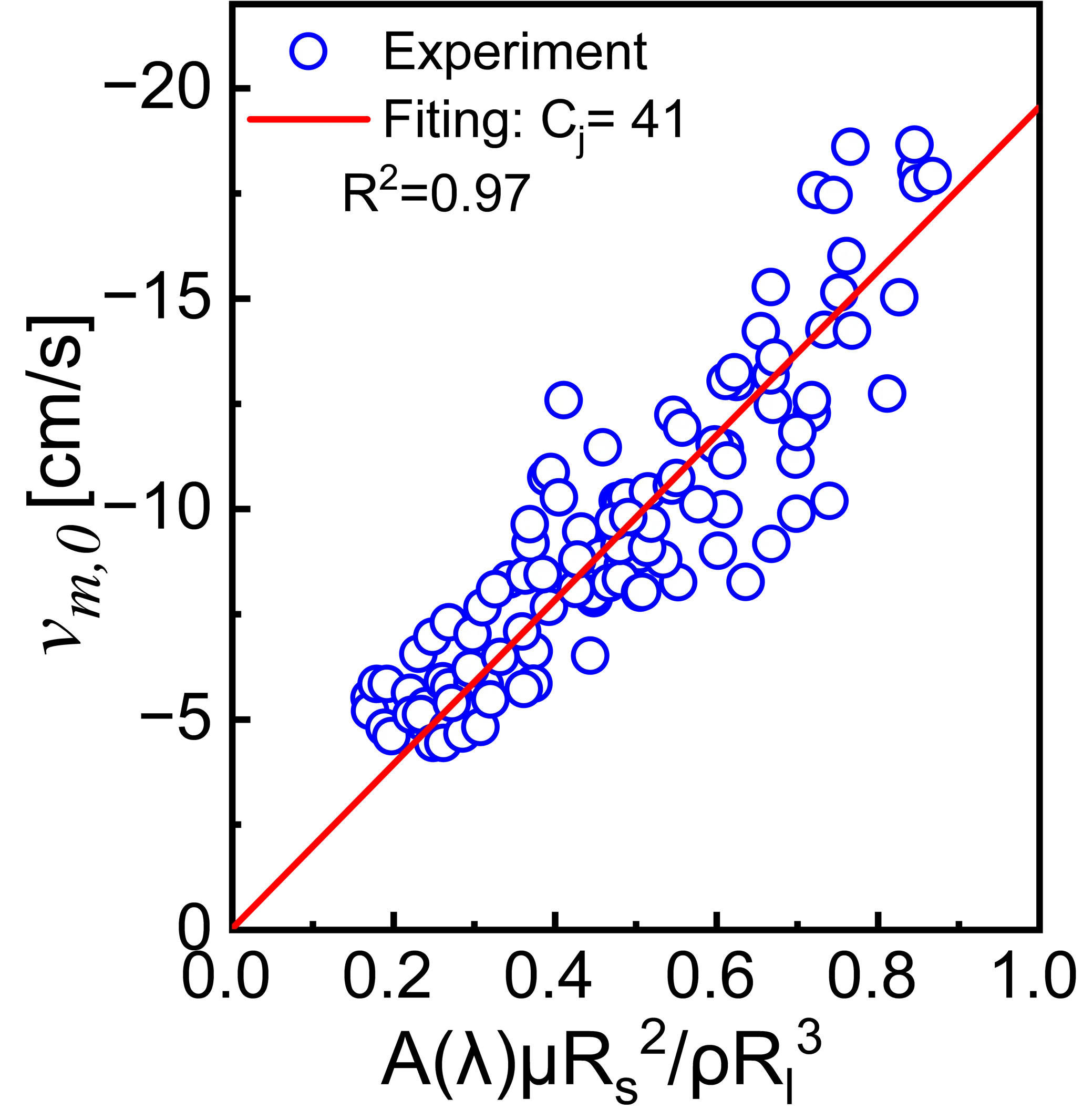
The secret lies in the tiny bubbles continuously born on the electrode. As the large bubble rises, it collides with these little ones and merges with them. After each merger, the combined bubble abruptly flips and moves downward at speeds up to 13 centimeters per second. That's a hundred times faster than its upward motion before the collision.
To understand the origin of the jolt, the authors built a computer model of the coalescence. They found that when two bubbles of different sizes merge, the interface contracts unevenly: most of the energy goes into decelerating the liquid near the smaller bubble. This asymmetry creates a viscous impulse directed toward the electrode. The impulse magnitude grows with the size difference between the bubbles.
With repeated mergers, the impulses add up like strikes from many tiny hammers. The total force reaches about one millionth of a newton, comparable to the buoyancy force on a bubble with a radius of half a millimeter. Electrostatic forces and Marangoni effects, previously considered possible candidates, turned out to be an order of magnitude weaker.
This discovery changes the game for electrolyzers, where bubbles shield electrodes and reduce efficiency. If engineers can control the coalescence frequency, they could make bubbles detach earlier or, conversely, hold them longer. That can be done simply by adjusting the current, surface texture, or electrolyte composition. Thus, an invisible anchor made of thousands of tiny jolts becomes a tool in the hands of engineers.
A millimeter-sized bubble held at the electrode can result from up to one hundred thousand coalescence events with microbubbles, each lasting less than a millisecond.
Controlling bubbles through cascade coalescence resembles science-fiction technologies where microscopic robots collectively hold macroscopic objects, though here the bubbles themselves play the role of the robots.