Cascade Bubble Coalescence as a Dynamic Anchor ✛
Context
In clean-energy technologies such as water electrolysis and boiling cooling of microelectronics, bubble detachment from surfaces dictates heat, mass, and charge transfer. At high current densities, bubbles unexpectedly remain attached to the surface, shielding active sites and increasing energy losses. Classical theory, based on the balance between buoyancy and capillary pinning at the three-phase contact line, predicts detachment at sizes of tens of micrometers, yet real bubbles grow to millimeters. This work stands alongside studies of bubbles in superfluid helium, in ice traps, and during cosmological phase transitions, but it differs in its focus on coalescence dynamics at a solid surface under continuous gas evolution.
Methods
Experiments were conducted on platinum microelectrodes with diameters of 50 and 500 μm in a solution of sulfuric acid and sodium sulfate. Hydrogen evolution was controlled galvanostatically, and bubble dynamics were recorded with a high-speed camera. To resolve individual coalescence events, small currents (0.01–0.015 mA) were used to obtain a sparse population of microbubbles. Bubble trajectories were tracked automatically using a neural-network algorithm based on Cellpose. To uncover the mechanism, direct numerical simulations of two-bubble coalescence were performed using the volume-of-fluid method in the open-source code Basilisk. Additionally, the effect was verified in pure water without electrochemistry by injecting bubbles through a capillary.
Results
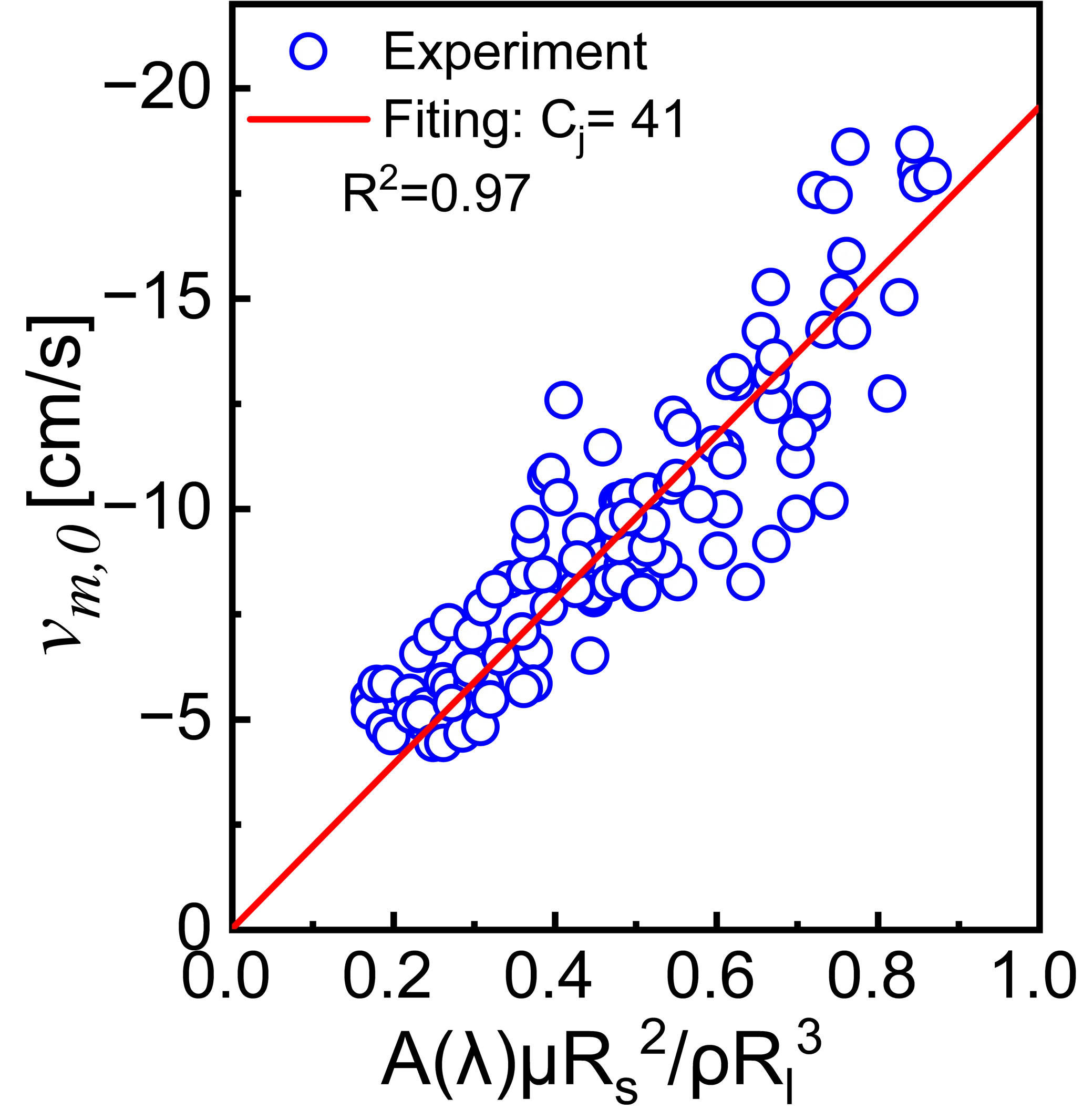
When a rising bubble with a radius of about 30 μm coalesces with a surface bubble of radius 12.5 μm, the merged bubble sharply turns and moves toward the electrode at speeds up to 13 cm/s, two orders of magnitude faster than its rise velocity before coalescence. The measured downward displacement was 6.5 μm over 0.3 ms, whereas the classical capillary-inertial model predicts only 2.5 μm. Direct simulation showed that the asymmetric contraction of the interface creates an unbalanced viscous impulse directed toward the smaller bubble. The magnitude of the impulse scales with the square of the smaller bubble's radius and the asymmetry factor (1 − λ²). With repeated coalescence events at a rate set by Faraday's law, these impulses sum to a retaining force on the order of 10⁻⁶ N, comparable to the buoyancy force on a bubble with a radius of 500 μm. Estimates of Marangoni and electrostatic forces were an order of magnitude smaller.
Implications
This work introduces a new bubble retention mechanism that does not depend on static surface properties such as contact angle or roughness. Unlike neighboring studies that consider single bubbles or quasi-static regimes, here it is shown that cascade coalescence at high gas evolution rates creates a dynamic anchor. This explains the long-observed but poorly understood retention of large bubbles during intense electrolysis and boiling. The result underscores the need to account for collective coalescence effects in models of multiphase flows near surfaces.
Future development
The topic could develop toward controlling the retaining force by modulating the coalescence frequency. For example, by altering the electrolyte rheology, surface microtexture, or nucleation rate, one could regulate bubble detachment. It would be promising to study the influence of cascade coalescence on local mixing and mass transfer near the surface, as well as on electrode durability due to high-frequency mechanical loading. The question of the exact momentum transfer efficiency under turbulent conditions remains open.
Impact
The results will influence the design of electrolyzers for green hydrogen production, boiling cooling systems for microelectronics, catalytic reactors with gas evolution, and gas–liquid contactors.
Next steps
Test the model predictions on electrodes with controlled roughness and in flow cells. Measure local velocity and concentration fields near the retained bubble using micro-PIV and confocal microscopy.
Key open problems
This work links the microscopic dynamics of coalescence to the macroscopic behavior of gas-evolving surfaces, filling the gap between single-bubble models and empirical correlations for dense bubble layers. It raises the question of the role of collective hydrodynamic interactions in transport processes, which remains open in multiphase mechanics.
The knowledge machine's view
This section is addressed to the author of the paper and their colleagues. Neighbouring works were found by meaning-based search across our archive, not by word overlap. We do not review: we show the field around the work.
What the work does
This study investigates the phenomenon of bubble retention at an electrode during intense gas evolution. The authors show that the cause is a cascade of bubble coalescence events, where the asymmetric contraction of the interface generates a momentum directed toward the electrode. Experiments on platinum microelectrodes with high-speed imaging and numerical simulations using the volume-of-fluid method confirmed the mechanism, and force estimates showed that the total retaining force is comparable to the buoyancy force for millimeter-sized bubbles.
Where its strength is
The work introduces a new dynamic mechanism for bubble retention that does not depend on static surface properties. This mechanism explains the long-observed but poorly understood phenomenon of large bubble retention at high current densities.
Where it could go next
- It might be interesting to see how similar dynamic effects during bubble coalescence manifest in conditions where bubbles are trapped, for example, in ice: there, too, there is confined geometry and interaction with a solid phase, which could provide new ideas for controlling retention.based on: Bubbles Trapped in Ice arXiv:2601.15045
- Closely related is work on making hydrogen cheaper, which examines bubble behavior under pressure. One could study how external pressure affects cascade coalescence and the retaining force, which might be useful for optimizing electrolyzers.based on: Bubbles vs. Pressure: Making Hydrogen Cheaper arXiv:2603.26855
- In the archive, there is a study of early Universe bubbles that do not pop. Although the context is completely different, it may contain interesting mathematical tools for describing bubble stability under continuous growth and coalescence, which could be adapted to analyze cascade processes at the electrode.based on: Bubbles in the Early Universe: Why They Don't Pop arXiv:2606.30740
Worth trying
- Test how the addition of surfactants affects the asymmetry of interface contraction during coalescence and, consequently, the retaining force.
- Perform simulations of a cascade of many bubbles to assess collective effects and possible saturation of the retaining force.
- Investigate the dependence of the retaining force on coalescence frequency by varying current and electrolyte concentration, aiming to find optimal regimes for controlling bubble detachment.
Why this may matter
Understanding this dynamic anchoring could lead to new ways of controlling bubbles in electrolyzers and cooling systems, reducing surface shielding and improving process efficiency.
Nearby works in our archive
- How Bacteria Stick to Surfacessimilarity 0.55
- Viscosity Awakens Hidden Energysimilarity 0.53
- Bubbles Trapped in Icesimilarity 0.52
- Bubbles vs. Pressure: Making Hydrogen Cheapersimilarity 0.52
- Charged Particles in Water: Why Like Attracts Likesimilarity 0.52
- Invisible Superconductivity in Twisted Layerssimilarity 0.52
- Bubbles in the Early Universe: Why They Don't Popsimilarity 0.50
The archive is sparse around this work: the closest review is only 0.55, against a usual 0.64. It looks like few have drilled nearby.
A millimeter-sized bubble held at the electrode can result from up to one hundred thousand coalescence events with microbubbles, each lasting less than a millisecond.
Controlling bubbles through cascade coalescence resembles science-fiction technologies where microscopic robots collectively hold macroscopic objects, though here the bubbles themselves play the role of the robots.
Key numbers
- downward velocity after coalescence: up to 13 cm/s
- excess over rise velocity: 100 times
- retaining force: on the order of 10⁻⁶ N
- radius of retained bubble: up to 510 μm
- number of coalescence events for a millimeter bubble: up to 10⁵