A Quiet Quasar Jet: An X-Ray Portrait of the Inner Jet ✛
Context
Quasar jets remain among the most energetic objects in the universe, but the mechanism behind their X-ray glow is debated. For the bright outer knots of the PKS 0637-752 jet, gamma-ray limits effectively ruled out inverse Compton scattering of the cosmic microwave background, forcing a synchrotron explanation. The inner part of the jet, from 3.4 to 7 arcseconds from the core, remained without a detailed model, even though it is precisely there that one can test whether the Compton mechanism works in a fainter and possibly faster flow. This work stands alongside studies of blazars, fast radio bursts, and magnetic fields in galaxy clusters, where the kinematics of relativistic jets also matter.
Methods
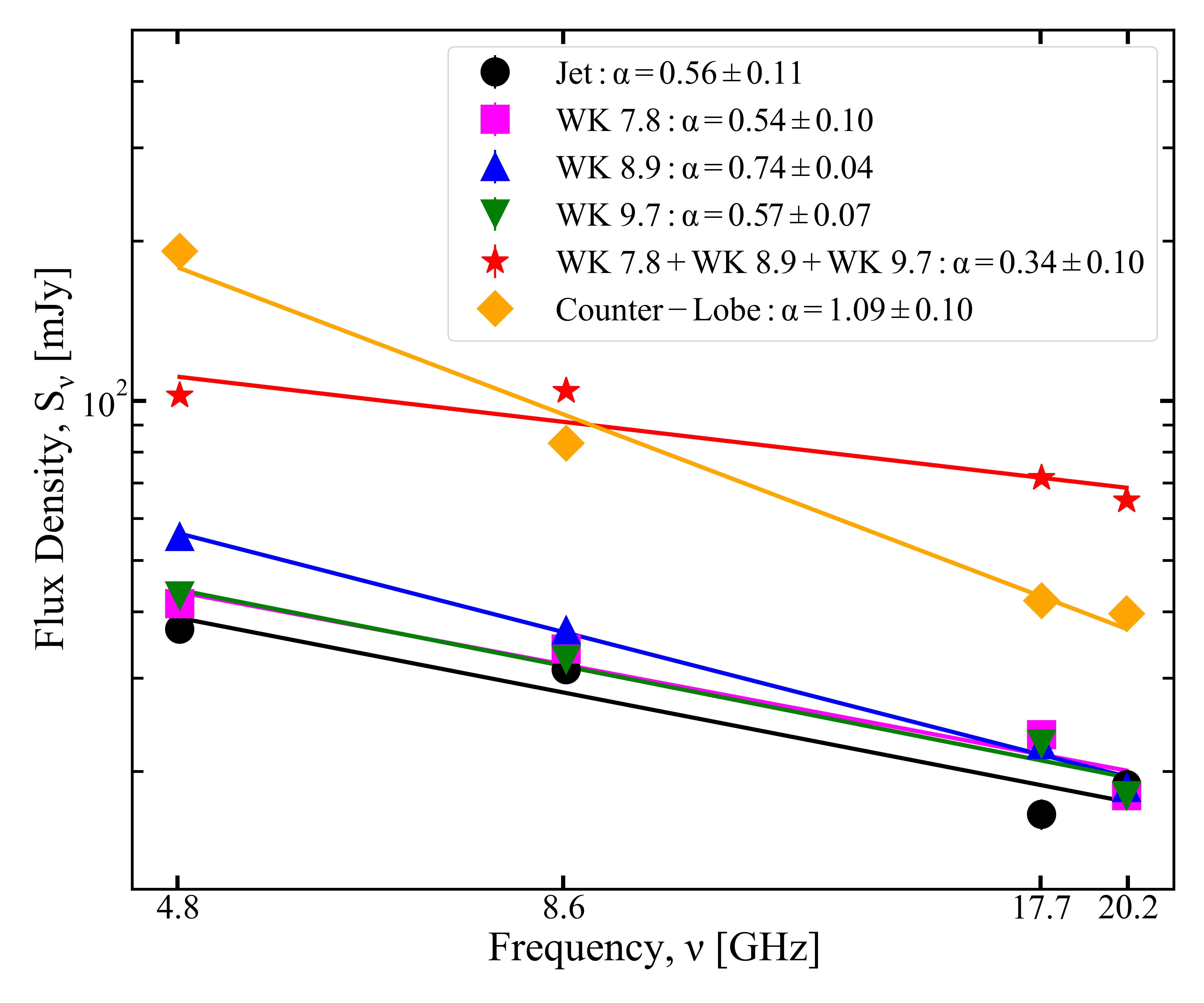
The authors used two sets of archival Chandra observations: calibration data from 1999 (34.1 kiloseconds) and deep targeted observations from 2017 (113.2 kiloseconds). To isolate the faint inner jet, they compared the actual photon distribution with simulations of the point spread function, allowing them to subtract the contribution of the bright core. Radio data came from the ATCA archive at four frequencies from 4.8 to 20.2 GHz, and millimeter fluxes from the ALMACAL survey at 100 and 320 GHz. They built a semi-analytical model of a homogeneous cylinder with relativistic electrons emitting synchrotron in radio and Compton in X-rays. For each possible viewing angle, they calculated the magnetic field from the minimum energy condition and from the ratio of radio to X-ray fluxes; their equality set the Lorentz factor. The viewing angle was then chosen from a Bayesian prior distribution that accounts for Doppler boosting.
Results
The inner jet was detected in X-rays with high significance: 348 counts versus 101 predicted from the core scattering. Its photon index is 1.92±0.14, and the flux in the 0.5–7 keV band is about 2.5×10⁻¹⁴ erg s⁻¹ cm⁻². The inverse Compton scattering model of the cosmic microwave background yields three scenarios depending on the maximum electron energy. Scenario I ($γ_{max}$=2.5×10⁴) fits the radio and X-ray data well but requires a separate population for the millimeter emission. Scenario II ($γ_{max}$=5×10⁴) reproduces the radio, millimeter, and X-ray fluxes but exceeds the Fermi gamma-ray upper limits. Scenario III ($γ_{max}$=5×10⁴) agrees with all data if only about 22% of the X-ray flux comes from inverse Compton scattering, with the rest from synchrotron radiation of another electron population. The median viewing angle for acceptable scenarios is 4–6 degrees, the Lorentz factor is 6–10, and the magnetic field is 9–15 microgauss.
Implications
This work stands out from neighboring studies because it models in detail the faint inner jet, not the bright outer knots, and combines X-ray data with millimeter observations to test the uniformity of the electron population. Neighboring studies of bright knots have already shown that a purely Compton explanation fails, while here it is shown that in the inner part a hybrid mechanism is possible. This strengthens the view that jets have a complex structure, where different zones can emit differently. The Bayesian method for determining the viewing angle with Doppler selection can be applied to other quasars.
Future development
Future observations with higher angular resolution in X-rays (for example, with the proposed Lynx mission) will allow separating the Compton and synchrotron contributions by morphology. Monitoring the X-ray variability of the inner jet would help distinguish slowly varying Compton emission from fast synchrotron emission. Developing models with radial velocity stratification (spine and sheath) could resolve the discrepancy between Lorentz factors inferred from parsec and kiloparsec scales.
Impact
The results will influence models of particle acceleration in relativistic jets and estimates of their kinetic power, which are important for understanding feedback between active galactic nuclei and the intergalactic medium.
Next steps
The next step is to build a full two-zone model that simultaneously describes the Compton and synchrotron components of the inner jet's X-ray emission, and to test it against new deep observations.
Key open problems
This work directly addresses the unresolved problem of the origin of X-ray emission from kiloparsec-scale quasar jets: whether it results from Compton scattering of the cosmic microwave background or from synchrotron radiation of a separate particle population. For the inner jet of PKS 0637-752, it shows that both mechanisms can coexist, complicating the picture and requiring a revision of simplified models.
The knowledge machine's view
This section is addressed to the author of the paper and their colleagues. Neighbouring works were found by meaning-based search across our archive, not by word overlap. We do not review: we show the field around the work.
What the work does
This work presents the first quantitative model of the inner jet emission of the quasar PKS 0637-752, based on archival Chandra X-ray data from 1999 and 2017. The authors isolated the faint jet by subtracting the core's contribution using PSF simulations, and built a semi-analytical model of a uniform cylinder that explains the radio, millimeter, and X-ray emission through inverse Compton scattering of cosmic microwave background photons. Three scenarios with different maximum electron energies are considered, leading to the conclusion that the X-ray emission is hybrid in nature.
Where its strength is
The strength of this work lies in the fact that it is the first to model in detail the faint inner jet, where the Compton mechanism can still operate, and to quantitatively constrain its parameters, including the viewing angle, Lorentz factor, and magnetic field, by matching the radio and X-ray fluxes.
Where it could go next
- It might be interesting to compare the derived parameters of the inner jet with estimates for blazars, where relativistic jets are seen at small angles and exhibit similar Compton processes.based on: Hidden Ultrarelativistic Spine in a Blazar Jet arXiv:2606.27430
- A related line of research concerns gamma-ray bursts, where the shape of the jet and its visibility depend on the viewing angle; a similar approach to analyzing the possible structure of the jet in PKS 0637-752 could refine the interpretation of its emission.based on: A Lighthouse Seen from the Side: How Two Gamma-Ray Bursts Revealed the Shape of an Invisible Jet arXiv:2609.04776v1
- The archive also contains an analysis of a red quasar emerging from a dust shell; comparing it with this case could help us understand how the environment of the core influences the observed properties of the jet in its early stages.based on: A Chick in a Dust Shell: How a Red Quasar Emerges arXiv:2607.22966v1
Worth trying
- Test whether the model with hybrid X-ray emission can explain data from other quasars with known inner jets.
- Apply a Bayesian approach to estimating the viewing angle across a sample of jets, in order to test the universality of Doppler boosting.
- Use future deep observations from Chandra or XMM-Newton to search for variability in the X-ray flux of the inner jet, which could separate the synchrotron and Compton components.
Nearby works in our archive
- A Chick in a Dust Shell: How a Red Quasar Emergessimilarity 0.53
- A Lighthouse Seen from the Side: How Two Gamma-Ray Bursts Revealed the Shape of an Invisible Jetsimilarity 0.52
- Breath of a Quasar: How a Black Hole Controls a Clustersimilarity 0.51
- Hidden Ultrarelativistic Spine in a Blazar Jetsimilarity 0.51
- Gamma-Ray Burst Wings: What Lies Beyond the Edge of the Beamsimilarity 0.51
- Hidden Accelerator in the SS 433 Jetsimilarity 0.51
The archive is sparse around this work: the closest review is only 0.53, against a usual 0.64. It looks like few have drilled nearby.
PKS 0637-752 was the very first object aimed at by the Chandra X-ray telescope in 1999 for focus calibration, and it immediately surprised astronomers with a bright extended jet.
Key numbers
- distance from the core to the inner jet: 3.4–7 arcseconds
- jet Lorentz factor: 6–10
- magnetic field: 9–15 microgauss
- fraction of Compton emission in X-rays: about 22%
- viewing angle: 4–6 degrees