Inverse Compton scattering is a process in which a high-energyelectron collides with a low-energy photon and transfers a significant portion of its kinetic energy to the photon, boosting the photon to much higher energies (e.g., from radio to X-ray or gamma-ray). This is the inverse of the more familiar Compton scattering, where a high-energy photon loses energy to a stationary electron. It is a fundamental mechanism for producing high-energy radiation throughout the universe and in laboratory accelerators.
History
The theoretical basis was developed in the 1940s and 1950s, with important contributions from Hans Bethe, Felix Bloch, and others. The term 'inverse Compton scattering' was coined by George R. Burbidge in 1956 to explain the high-energyemission from radio galaxies.
How it works
When a fast-moving electron encounters a photon, the photon can 'bounce' off the electron and gain energy, much like a tennis ball hitting a moving racket. The energy gain is proportional to the square of the electron's Lorentz factor (γ²), so even modest electron energies can produce dramatic photon boosts. In astrophysical settings, this happens when relativistic electrons in supernova remnants, pulsar wind nebulae, or active galactic nuclei scatter the ambient radiation field (e.g., cosmic microwave background photons) up to X-ray and gamma-ray energies.
In practice
Inverse Compton scattering is the operating principle of modern synchrotronlight sources and X-ray free-electron lasers, where intense laser pulses are scattered off relativistic electron beams to produce brilliant, tunable X-rays for materials science and biology. It also explains the diffuse gamma-ray background and the X-ray emission from many cosmic sources.
Fun fact
The cosmic microwave background radiation, left over from the Big Bang, is constantly being 'up-scattered' by fast electrons in galaxy clusters, producing a distortion known as the Sunyaev-Zel'dovich effect, which allows astronomers to map the hot gas in clusters.
A laser hits an atom, and tears out an electron. The brighter the light, the stronger the kick, and the faster the electron flies away. That's how the familiar picture works, where light is a smooth wave. But what if the light isn't smooth but 'squeezed,' with quantum fluctuations, like the trembling of a string?
The antiproton is the mirror twin of the proton: same mass, but negative charge. When it hits matter, it usually annihilates instantly — disappearing in a burst of energy upon colliding with an atomic nucleus.
Deep inside molecular clouds hide natural amplifiers — cosmic masers. They work like lasers but in the radio band: excited molecules collectively emit waves of a single frequency, creating a bright beam. The catch is that these molecules often have several ways to shed energy.
The mystery of antimatter in space has long puzzled astrophysicists: where do positrons come from, settling like snowflakes into our detectors? The answer might lurk in the most ubiquitous gamma-ray background. The Universe is soaked in diffuse light — the cosmic photon background (CPB).
Two guitar strings are stretched on the same neck. They are almost identical, but one is slightly shorter — and they sound different. That's roughly how the two isomers of ethanimine work: molecules with the same set of atoms but rotated differently in space. Astronomers spotted this molecule in the dense clouds near the center of our Galaxy.
When an orchestra is just tuning up, disjointed sounds drift through the hall, but as soon as the conductor raises the baton, chaos turns into a symphony. Much the same can be said for the beginning of our Universe. In its first moments, it expanded at an unimaginable speed — faster than light could cross it.
A swing only gets going if you push it in rhythm. Miss the beat, and your effort is wasted. Light interacts with an atomic nucleus in much the same way: a photon is usually absorbed only when its energy exactly matches the gap between nuclear levels. But what if the photon's energy doesn't fit? The authors of a new study have found a workaround.
A gamma-ray burst is a brief but extremely powerful flash of light, born from the merger of neutron stars or the collapse of a massive star. Inside such a flash, plasma flows race at enormous speeds and collide with each other.
In a particle accelerator, electrons race around a ring at nearly the speed of light. When such an electron collides with a photon, a particle of light, the photon bounces off like a ball hitting a moving truck and flies away with much greater energy.
In giant particle accelerators, particles fly at nearly the speed of light and smash head-on. But sometimes one beam is slightly denser than the other, like someone stepping onto a packed escalator the wrong way. Then collisions become uneven, and detectors start 'flickering,' throwing off measurements.
In a ring accelerator, particles race around in circles like cars on a roundabout. Normally, when new particles are injected, they take random spots on that roundabout — the beam becomes 'fluffy.' In a new experiment at the SNS accelerator, the eigenpainting method was applied: particles were injected so that they only entered one 'lane'—a single oscillation mode…
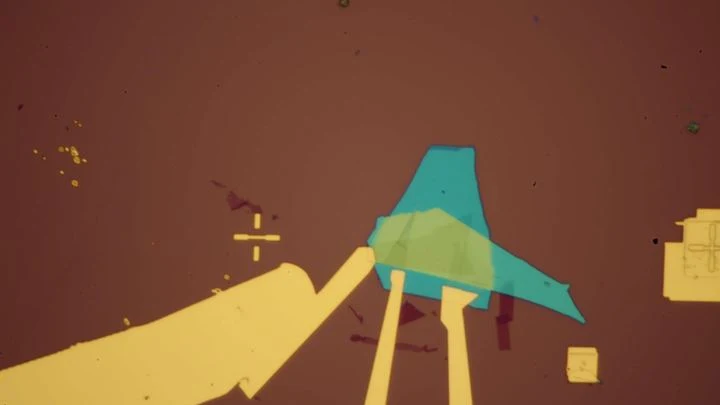
A material just one atom thick and of record purity — only one foreign atom per million — becomes the setting for a remarkable phenomenon. When cooled to near absolute zero, the electrons inside, like musicians in an orchestra, freeze into a strict order, forming a crystal. This state, predicted by Eugene Wigner nearly a century ago, has now been observed in detail.
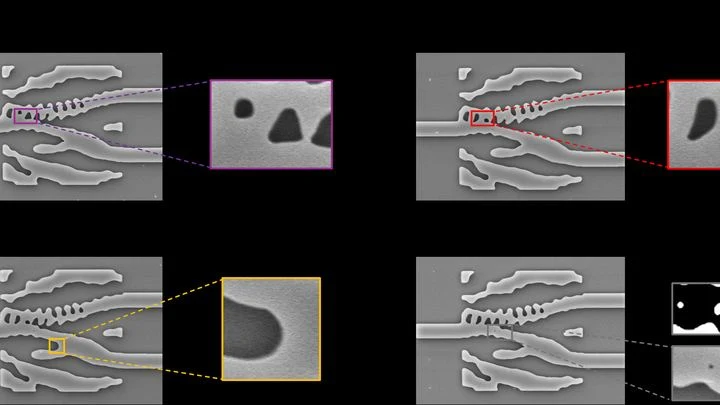
Modern computer algorithms design photonic integrated circuits — light chips capable of separating signals by frequency (color) for spectroscopy. Unlike traditional engineering, light paths in these chips are not straight waveguides but chaotic, almost organic mazes.
In 1976, Canadian physicist Bill Unruh asked a simple question: what does an observer see when accelerating through empty space? The answer turned out to be strange: emptiness ceases to be empty. An accelerating observer bathes in thermal radiation with a temperature proportional to the acceleration.