Viewing angle refers to the orientation of an observer's line of sight relative to an astronomical object's axis or jet. This angle critically affects what is observed: a jet pointed toward the observer appears much brighter and more variable than one viewed from the side, due to relativistic beaming. For example, blazars are active galactic nuclei with jets aligned nearly along our line of sight, making them appear extremely luminous and rapidly variable. In contrast, the same object viewed at a large angle would appear as a radio galaxy with distinct lobes.
History
The importance of viewing angle was recognized in the 1960s and 1970s with the unification of active galactic nuclei, notably through the work of Martin Rees and later the unified scheme proposed by Antonucci and Miller in 1985.
How it works
When a relativistic jet moves at speeds close to the speed of light, the emission is beamed into a narrow cone in the direction of motion. If the observer lies within this cone, the apparent brightness is enhanced by a factor that depends on the Lorentz factor and the viewing angle. Additionally, the apparent speed of features in the jet can appear superluminal due to projection effects. The viewing angle also affects the observed polarization and spectral energy distribution, as different emission regions become visible.
In practice
Determining viewing angles is essential for interpreting observations of jets from supermassive black holes, and for estimating the intrinsic power of these sources.
Fun fact
For a jet moving at 99.9% the speed of light, the beaming cone has an opening angle of only about 2 degrees, so the same object can look completely different depending on whether we are inside or outside that cone.
A light ray passing by a massive body slightly changes its direction, like a stream of water bending around a rock in a creek. In the solar system, there are many such "rocks": planets, their moons, asteroids. And each one, with its own gravity, bends the path of light coming from distant stars.
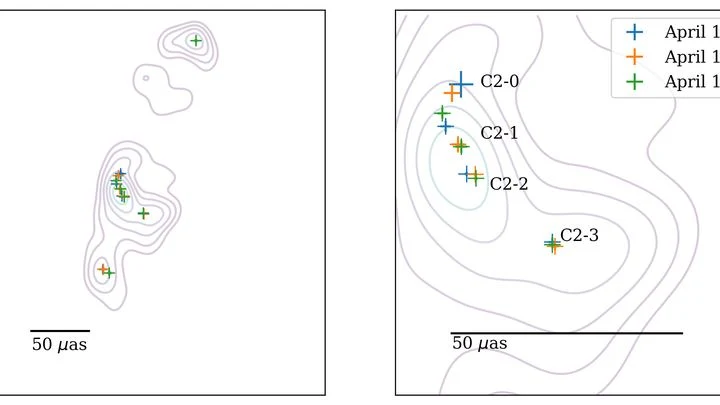
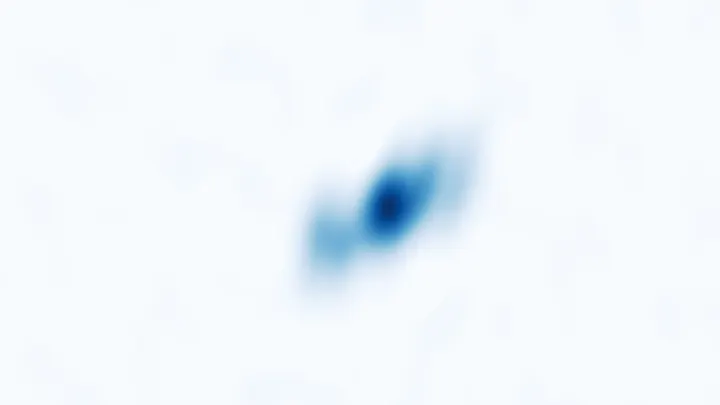
In April 2021, the antennas of the Event Horizon Telescope (EHT)—a global network of millimeter-wave radio telescopes — zeroed in on a tiny spot in the constellation Virgo.
For decades astrophysicists painted a neat picture: a galaxy, like a giant carousel, spins in a unified rhythm, and the supermassive black hole at its center inherits that dance.
A cosmic ray approaches a black hole almost tangentially. Instead of falling straight in, it lingers on an unstable orbit, like an acrobat balancing on a tightrope over an abyss. After a few loops, the light finally escapes toward a distant observer. Such rays produce multiple images of the same source, known as higher-order images.
Two sensitive microphones are listening to the Universe. One hears a low hum, the other hears almost nothing. It's not a malfunction: it's about how they are oriented.
Gravitational-wave observatories like LIGO don't just catch loud bursts from black hole mergers.
The black hole in GRS 1915+105 behaves like a lighthouse with a shaky foundation: its jet, normally aimed in one direction, suddenly veered off by 34 degrees in just a month. Astronomers spotted this during a radio burst in 2025. It turns out that since 2023, the "beam" had been wandering within a 70-degree range, but the abrupt jump in 37 days set a record.
The plasma jet from the center of a distant galaxy is like a river that flows from its source and gradually becomes clear. Near the black hole, the flow is dense and opaque to radio waves, like muddy water.
The Fermi telescope spent 17 years recording gamma rays from the active nuclei of galaxies with giant black holes at their centers. The glow of their jets resembles a chaotic cacophony: it constantly changes.
Throw pebbles along a tight row of posts: they ricochet into a dense spray. Throw at an angle, and they scatter. Gamma rays in a crystal do the same: they spawn particle cascades that spread out unless the crystal’s atomic rows are perfectly aligned. Align them within a hair’s width, and the cascade sharpens into a tight beam. A small crystal then outperforms a large one.
The galaxy NGC 1560 is a modest island of stars and gas ten million light-years away. Its rotation curve, first measured in 1991, became an icon for those seeking an alternative to dark matter. The plot of rotation speed versus radius shows bends that seem to exactly mirror the bends in the distribution of ordinary matter.