Dark Matter as an Invisible Conductor: Explaining a Rare Signal in the LZ Detector ✛
In an underground laboratory in South Dakota, the LUX-ZEPLIN detector, filled with liquid xenon, waits for rare collisions. Usually, dark matter particles pass through it without a trace, but one day a xenon nucleus was displaced with an energy of 248 keV. That is too strong a kick for conventional models where dark matter only gently nudges nuclei. Physicists began searching for an explanation that would not contradict everything else known about the Universe.
The answer came in a model with a particle that acts like a conductor: it is invisible but orchestrates interactions through a spin-dependent weak charge. Imagine a conductor raising a baton, and the musicians respond only if their instruments are oriented in a certain way. So here: dark matter interacts with xenon nuclei via the Z boson, and the strength of this interaction depends on the relative orientation of spins. To avoid unwanted weak signals, the authors tuned the coupling to the Higgs boson so that it vanishes, as if the conductor lowered their hands at a certain moment.
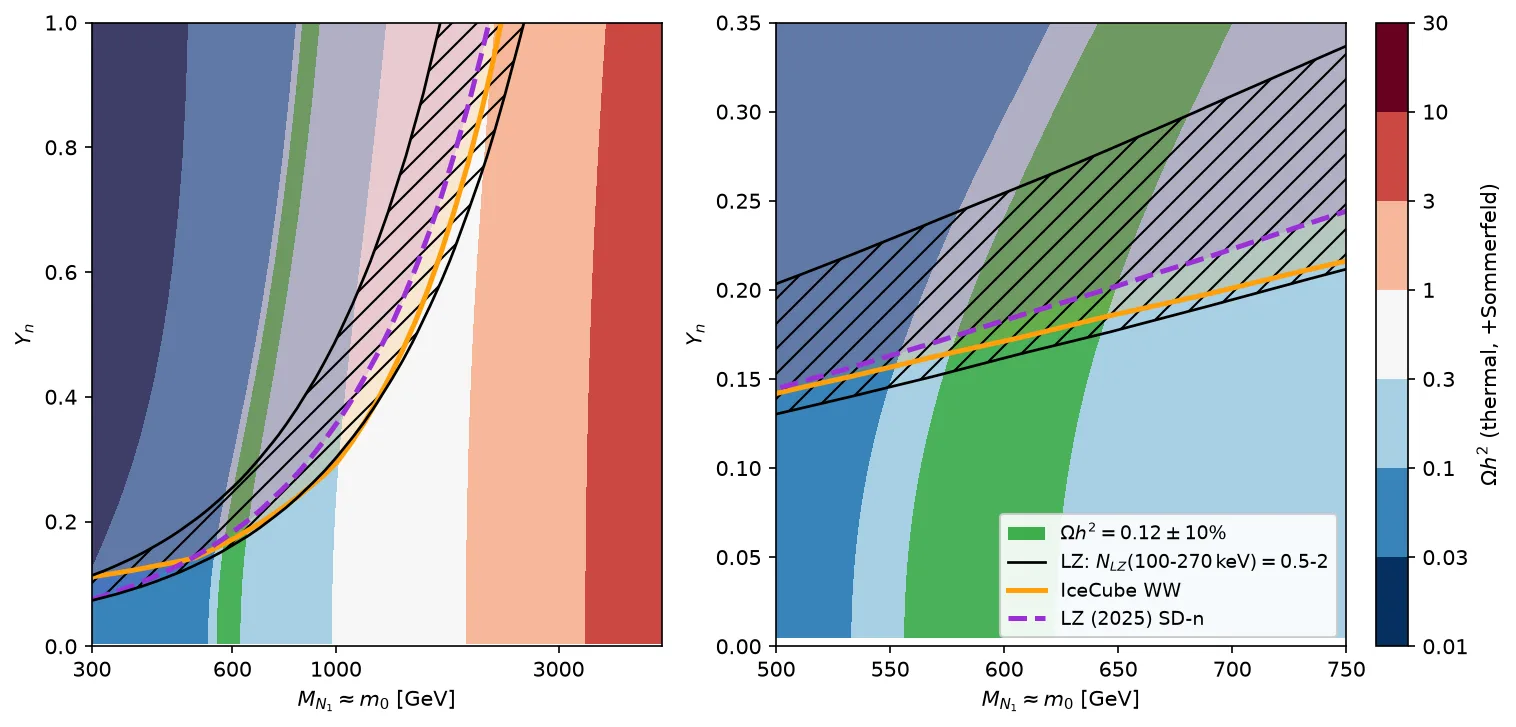
This model not only explains the rare recoil. It ties together three observable things: the recoil spectrum in xenon, the amount of dark matter left from the Big Bang, and the neutrino flux from the Sun. Like a conductor setting the tempo for the whole orchestra, the model's parameters determine the detector signal, the cosmological density, and the solar capture. The scientists calculated that for a particle mass of about 0.5 TeV and a coupling strength of order 0.1, one expects between 0.5 and 2 events in the energy window from 100 to 270 keV, which agrees with observation. At the same time, the relic density falls into the right range, and solar neutrinos produced by dark matter annihilation are already partially constrained by IceCube.
The conductor continues its work: the invisible hand of dark matter may leave traces not only in xenon detectors but also in neutrino telescopes. Improved searches at IceCube and future facilities will narrow the allowed parameter space, while colliders such as FCC-hh or a muon collider could search for charged partners of dark matter through events with soft leptons and missing energy. Thus, a rare recoil in one detector becomes a key to testing a unified theory linking dark matter, the Sun, and the early Universe.
The LZ event has a local significance of 3.4σ, but a global significance of only 2.6σ, which is insufficient for a discovery, yet enough to stimulate theoretical models.
The idea of dark matter interacting through weak forces and leaving rare traces in detectors echoes Blake Crouch's novel 'Dark Matter', where the protagonist confronts an invisible substance that alters reality.