The Higgs boson is a quantum manifestation of the Higgs field, a fundamental scalar field (its value is given by a single number rather than a vector) that permeates the entire Universe. In the Standard Model, the mass of elementary particles arises from their interaction with this field: the stronger the coupling, the greater the mass. The boson itself is a localized excitation of the field, detected in 2012 at the Large Hadron Collider at an energy of about 125 GeV.
History
The Higgs mechanism was independently proposed in 1964 by Peter Higgs, Robert Brout, and François Englert; similar ideas were expressed by Philip Anderson in the context of superconductivity. Years of searching required the construction of the most powerful accelerator — the Large Hadron Collider at CERN. In 2012, the ATLAS and CMS collaborations reported a particle with the expected properties; in 2013, Englert and Higgs were awarded the Nobel Prize.
How it works
The Higgs field has a non-zero vacuum expectation value (v ≈ 246 GeV). Its potential takes the shape of a 'Mexican hat' due to a negative mass term, leading to spontaneous symmetry breaking. The strength of a particle's interaction with the field (coupling constant) determines its inertial mass. Gauge bosons absorb components of the Higgs field as longitudinal degrees of freedom, becoming massive. Quantum fluctuations around the vacuum state manifest as the Higgs boson. The masses of W and Z bosons are expressed in terms of gauge couplings and v, while fermion masses are expressed through Yukawa couplings and v.
In practice
Understanding the Higgs mechanism is the foundation of the Standard Model, used in medical technologies (PET scanning, proton therapy) and in the construction of new accelerators.
Fun fact
Due to a popular science book, the Higgs boson is sometimes called the 'God particle', but physicists avoid this term: it creates a false impression of the particle's role and evokes inappropriate religious associations.
A black hole is like a spinning top that never stops on its own. But if a cloud of ultra-light particles, bosons, forms around it, the picture changes. This "fog" acts like an invisible brake: the particles drain the hole's spin, slowing it down.
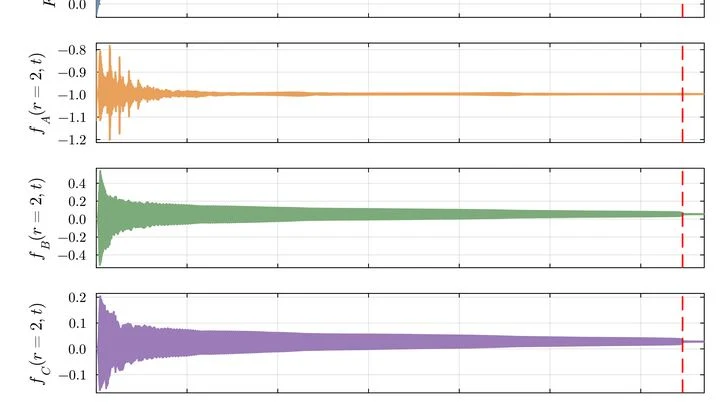
Every pulsating object has a moment when its rhythm falters. For boson stars, hypothetical clumps of ultralight particles, that moment turns out to be the point where mass stops growing. The authors calculated the lowest radial mode (the fundamental 'breathing' tone) for a whole family of such stars, including models with self-interaction.
In proton collisions at the Large Hadron Collider, sometimes not one but two Higgs bosons are produced. The rate of such events is a direct imprint of how the Higgs field interacts with itself. In the Standard Model, this coupling is rigidly fixed, but extended theories allow deviations.
In the first moments after the Big Bang, the universe expanded at an incredible rate — a phase known as inflation. Even the vacuum was restless back then: quantum jitters shook the fields like wind rustling through a wheat field.
In the first moments, the Universe expanded at an enormous rate. This process is called inflation, and its driving force is the inflaton field. Its energy pushed space apart, like yeast raising dough. But physicists suspect that the dough might have left 'bubbles'—superheavy particles born from the expansion itself.
The ocean bulges toward the Moon in a tidal hump. But some objects do the opposite — instead of stretching matter, the tide presses a dent into it. These are boson stars: invisible clumps of boson particles that can all collapse into a single quantum state. Normal matter is propped up by heat; boson stars are held together by quantum pressure.
At the center of nearly every galaxy lurks a supermassive black hole. Its gravity is so strong that it warps space itself. But few stop to wonder: what does it do to the very fabric of reality — the fields that permeate the cosmos?
One such field is the Higgs field.
A tightly stretched string keeps vibrating after being plucked. In particle physics, there is a similar object — the oscillon. It is a clump of energy that pulses like a heart without spreading out in space. Such structures arise in the Higgs field — the very field responsible for particle masses.
The Higgs boson is like a tuning fork that rings at a strictly defined note. But physicists have learned to hear it even when the note is off — in the so-called 'off-shell' region. It was there, in the data from the CMS detector, that answers were hiding about what the Higgs mechanism is really made of.
When a particle carries a large amount of internal energy, like a massive spinning top, its motion can be split into a fast part and a slow part. The fast part is a jitter that barely affects the big picture. Physicists have developed a method to discard this jitter and keep only the slow, meaningful motion. It's like skimming the foam off boiling soup to see the clear broth underneath.
Boson stars are gravitational atoms. Only instead of electric charge, gravity itself serves as the nucleus, holding a cloud of scalar field in quantized clumps.
Imagine: superfluid helium-3 in a thin film receives a sudden heat shock. In that instant, a whole orchestra of collective oscillations awakens within it — like striking an invisible drum produces a multi-voiced chord. The Kibble–Zurek mechanism, familiar from the cracking of ice during rapid freezing, here acquires a quantum elegance.
In the late 1990s, the night sky delivered a surprise: Saul Perlmutter and Adam Riess found that the expansion of the Universe is accelerating. Ever since, the greatest riddle has been dark energy — a substance making up nearly 70% of the cosmos, yet evading laboratory study.
In very dim light, photons arrive one by one, like drops from a leaky faucet — never in pairs. This effect, predicted by Roy Glauber and confirmed by Leonard Mandel, directly proves that light is made of particles.
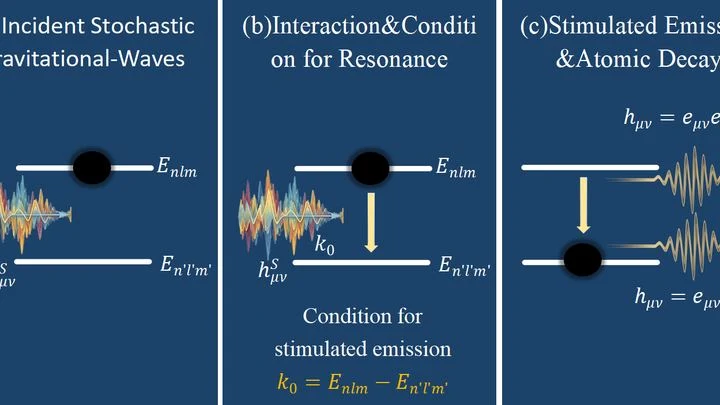
Gravitational waves — the cosmic tremors from distant cataclysms — are so faint that detecting them is like trying to hear a whisper in a hurricane. But a black hole can amplify that whisper many times over.
Deep inside the detector at the Large Hadron Collider, protons collide, and for a fleeting moment something heavy is born. It instantly shatters into two Higgs bosons — particles that, like nesting dolls, each hide two pairs of b-quarks.
Tiny invisible bullets pass straight through the Sun, barely noticing its matter. These are axions — hypothetical particles so light and elusive that they are often compared to ghosts.
An orchestra without a conductor. Each musician hears not only their neighbor but also echoes from across the stage. That's roughly how the idea of a nonlocal Higgs field works: a particle 'feels' what's happening not at a single point but across an entire region of space.
Two blindingly bright beams smash head-on. At the point of impact, a particle is born for an instant — the very one responsible for the mass of everything in the universe. That's the Higgs boson. Usually, it's produced by accelerating protons or electrons, but here the projectiles are particles of light themselves — photons.
Dark matter is the great cosmic invisible. It neither emits, absorbs, nor reflects light, yet its gravitational grip is felt in every motion of galaxies. Seventy years ago Vera Rubin showed that the outskirts of galaxies rotate too fast — as if spurred on by an unseen shepherd.
The cosmos is full of mimicry. The clearwing moth wears a wasp's mask, a harmless fly buzzes like a bee. And in the world of gravity, the role of impersonator is perhaps played by boson stars — colossal clumps of scalar field, indistinguishable from black holes.
Throw a stone into a pond — ripples spread out, changing the scale of the wave. The new theory works much the same way: it gives each particle its own "scale ripple," and it's this curvature of an invisible space that turns out to be the source of mass.
At the Large Hadron Collider, protons collide billions of times per second, and only once in a trillion collisions does a pair of Standard Model Higgs bosons (the particles responsible for the mass of everything) emerge. In the CMS experiment, physicists hunted for exactly such events.
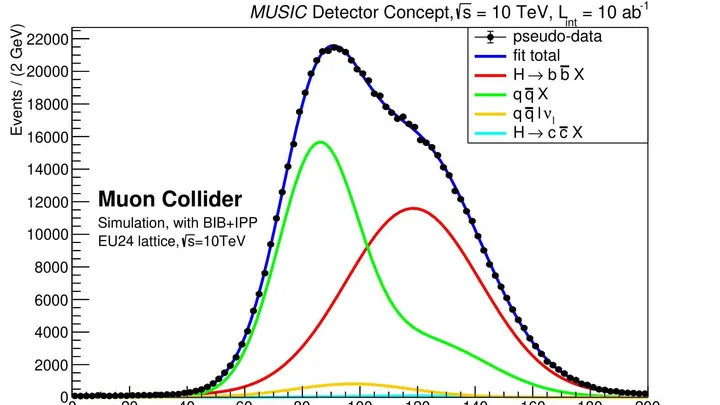
The Higgs boson is like a conductor that gives mass to all other particles. Without it, electrons would be massless and atoms would fall apart. But how does the conductor interact with itself? That is the key question a future muon collider aims to answer.
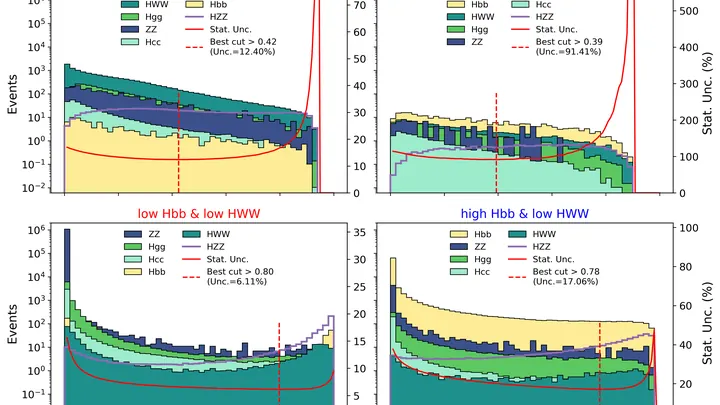
At the Large Hadron Collider, protons collide, and from the flash dozens of particles are born. Among them may be traces of rare processes — for example, the decay of a Standard Model Higgs boson into two W bosons. But these particles fly apart so quickly that their tracks merge into a single wide jet.
In an orchestra where every musician plays the same note, the sound merges into a powerful unison. This is how a Bose–Einstein condensate is born: many boson particles at extremely low temperatures behave as a single entity.
Two particles flying apart in opposite directions behave as a single whole: measuring one instantly determines the state of the other. Such quantum entanglement has long been known for light particles, but now it has been observed for the first time in heavy Z bosons — the carriers of the weak force.
At the Large Hadron Collider, protons collide at nearly the speed of light. Sometimes they don't smash apart but exchange photons — particles of light. These photons can produce a pair: one particle the detector sees, and another that flies off unnoticed.
In the ATLAS detector at the Large Hadron Collider, protons collide with enormous energy, and among the debris, a Higgs boson is sometimes born — the particle that gives mass to other particles.
The Higgs boson lives an unimaginably short life — less than a billionth of a second. It cannot be caught directly, so physicists look at what remains after its decay: jets of particles, muons, neutrinos. But some information is lost if you consider only the explicit decay traces rather than the whole event.
At the Large Hadron Collider, physicists accelerate protons to nearly the speed of light and smash them together. Usually, the protons themselves take part in such collisions, but sometimes they pass close by without touching, and it is their electric fields that interact.
Tiny black holes, the size of an atom but heavier than an asteroid, were born right after the Big Bang. Now, they are probably the dark matter — the invisible mass that keeps galaxies from flying apart. You can't catch them directly: they emit almost nothing.
The void is deceptive. William Unruh showed that an accelerating observer perceives the vacuum as hot. The effect resembles the particle birth near black holes, predicted by Stephen Hawking, but instead of spacetime curvature, acceleration is at work.
Fresh after the Big Bang, the Universe fizzed like a freshly poured soda. All of space was filled with bubbles — regions of new vacuum, the kind governed by the Standard Model, pushing out the old unstable state. The walls of these bubbles accelerated to near light speed, and in head-on collisions they crumpled and burst, unleashing monstrous energy.
Scientists have described a new type of invisible star that behaves like a breathing lens. Such a star is made of ultralight boson particles (not yet discovered). Its gravity causes spacetime curvature — this is the lens, which rhythmically expands and contracts, as if breathing.