A Vectorlike Lepton Explanation for the High-Energy LZ Event ✛
Context
In the particle physics archive, this study sits alongside other interpretations of the same LZ event: inelastic higgsino, axion portal, seasonal variations. Neighboring works seek explanations for the high-energy recoil through exotic mechanisms, but this paper stands out by using a minimal extension of the Standard Model with vectorlike leptons. This approach connects direct detection with cosmology and solar physics, offering testable predictions.
Methods
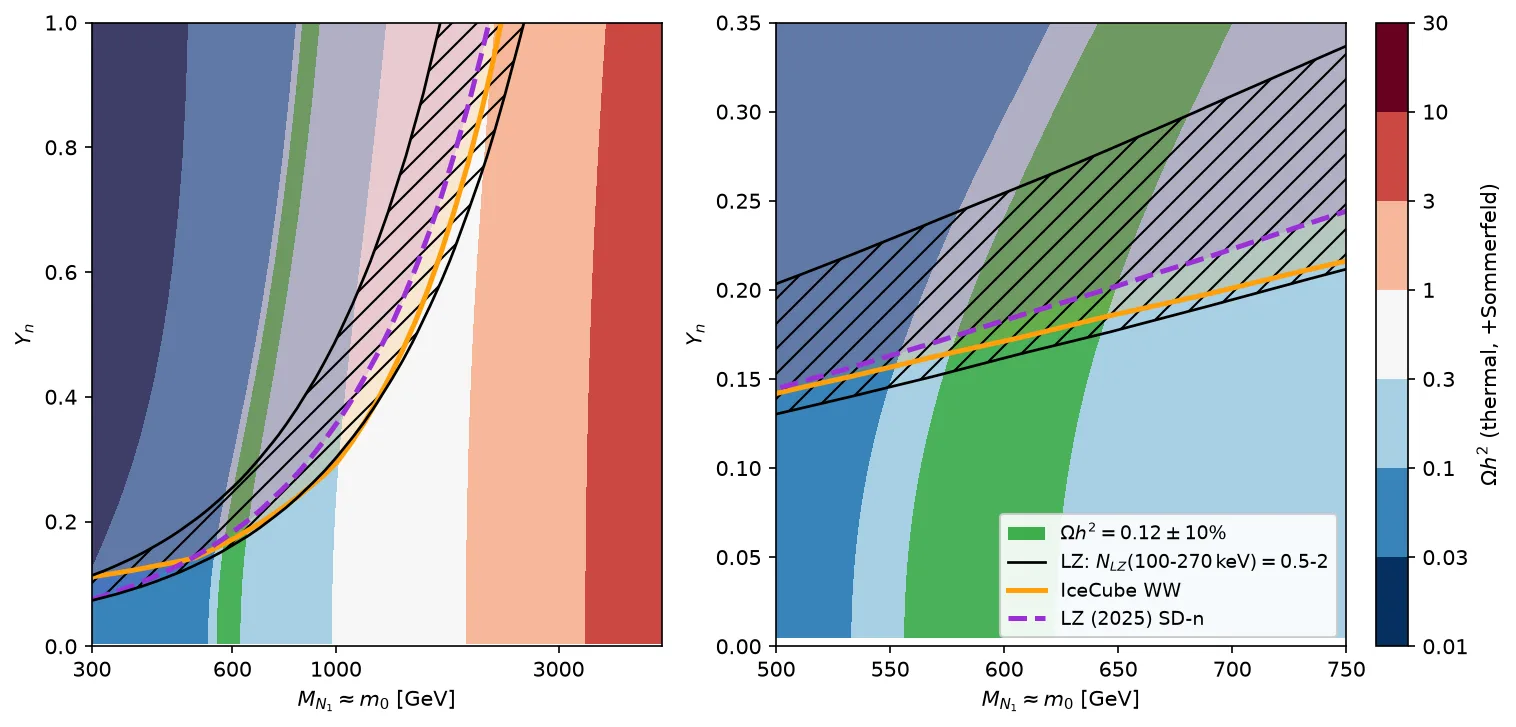
The authors constructed a model with a vectorlike lepton doublet and a Majorana singlet, whose mixing gives dark matter. The signal in a xenon detector was calculated using the micrOMEGAs program, which accounts for nuclear form factors and the isotopic composition of xenon. To suppress unwanted spin-independent scattering, they imposed a Higgs 'blind spot' condition, where the coupling to the Higgs boson vanishes at tree level. The relic density was computed including coannihilation with charged partners and the Sommerfeld effect.
Results
They found a parameter region where, in the recoil window of 100–270 keV, 0.5 to 2 events are expected, consistent with the LZ observation. The relic density falls in the range Ωh² = 0.12 ± 10%, and the dark matter mass lies in the sub-TeV region with a Yukawa coupling of order 0.1. Solar capture via the same spin-dependent interaction leads to annihilation into W+W−, and current IceCube limits exclude part of this region but leave a viable area. LZ's own spin-dependent limits also impose an upper bound, creating tension for the upper part of the signal region.
Implications
The work shows that a simple extension of the Standard Model can naturally explain the rare LZ event without invoking inelastic transitions as in higgsino models. The connection between direct detection, relic density, and solar neutrinos provides three independent tests of a single model. This differs from neighboring works, which often focus on one aspect, such as only the recoil spectrum or only cosmology. Here, a single set of parameters determines all observables.
Future development
If the LZ event is confirmed with additional exposure, future data from XENONnT and LZ could test the predicted spin-dependent recoil spectrum, which is relatively flat up to high energies. Improved searches for solar neutrinos at IceCube and future neutrino telescopes will narrow the allowed parameter region. At colliders such as FCC-hh or a muon collider, one could search for charged partners of dark matter through events with soft leptons and missing energy.
Impact
The results will influence interpretations of direct dark matter detection data and strategies for searching for new physics at colliders. The model also links dark matter physics with neutrino physics from the Sun, stimulating interdisciplinary research.
Next steps
It is necessary to increase the exposure of xenon detectors to accumulate statistics in the high-energy window. It is also important to improve the sensitivity of neutrino telescopes to the signal from dark matter annihilation in the Sun.
Key open problems
In dark matter physics, the nature of the particle and its interactions with ordinary matter remain open questions. This work connects the unresolved problem of the origin of the relic density with a specific signal in a detector, offering a unified solution.
The knowledge machine's view
This section is addressed to the author of the paper and their colleagues. Neighbouring works were found by meaning-based search across our archive, not by word overlap. We do not review: we show the field around the work.
What the work does
The authors propose a singlet-doublet dark matter model with vector-like leptons to explain the nuclear recoil candidate at 248 keV observed by LZ. They compute the signal in a xenon detector using micrOMEGAs, impose the Higgs 'blind spot' condition to suppress low-energy recoils, and simultaneously account for the relic density of dark matter, while also partially constraining the model with the solar neutrino signal in IceCube.
Where its strength is
The strength of this work is that a minimal extension of the Standard Model connects three independent observables: direct detection, relic density, and solar neutrinos, providing a unified set of parameters for all of them.
Where it could go next
- It may be interesting to compare with the approach in the work on Higgsino, which uses inelastic scattering to explain the same event, to understand how different mechanisms could be distinguished by future data.based on: Higgsino: An Invisible Guest in Liquid Xenon arXiv:2609.01583v1
- Since solar capture plays an important role in this model, it is worth looking at the work on solar neutrinos in dark matter detectors, which may offer methods to refine IceCube constraints or alternative annihilation channels.based on: Solar Neutrinos in a Dark Matter Trap: An Unexpected Tool for Helioseismology arXiv:2606.15904
- If one considers signal variations, such as seasonal modulations due to Earth's motion, one could rely on the work on seasonal variations in detectors to assess how they might affect the interpretation of the LZ event.based on: Dark Matter Knocks on the Detector arXiv:2605.20162
Worth trying
- Test how the predictions change when the 'blind spot' condition is relaxed and small spin-independent contributions are included.
- Consider other annihilation channels in the Sun, such as into lepton pairs, and their impact on IceCube constraints.
- Assess the detectability of charged partners at future colliders if they are light enough.
Why this may matter
The work demonstrates that a simple extension of the Standard Model can reconcile the rare LZ event with cosmology and astrophysics, offering testable predictions for future experiments.
Nearby works in our archive
- Higgsino: An Invisible Guest in Liquid Xenonsimilarity 0.64
- Solar Neutrinos in a Dark Matter Trap: An Unexpected Tool for Helioseismologysimilarity 0.53
- Ghost Particles Will Reveal the Star's Fur Coatsimilarity 0.52
- Hidden Ultrarelativistic Spine in a Blazar Jetsimilarity 0.51
- Hunting Long-Lived Particles in the Heart of the LHCsimilarity 0.51
- Dark Matter Knocks on the Detectorsimilarity 0.51
The closest work in the archive sits at 0.64 by meaning — the usual level for our corpus.
The LZ event has a local significance of 3.4σ, but a global significance of only 2.6σ, which is insufficient for a discovery, yet enough to stimulate theoretical models.
The idea of dark matter interacting through weak forces and leaving rare traces in detectors echoes Blake Crouch's novel 'Dark Matter', where the protagonist confronts an invisible substance that alters reality.
Key numbers
- recoil energy: 248 ± 23 (stat.) ± 23 (syst.) keV
- LZ exposure: 2.84 tonne·year
- dark matter mass: sub-TeV, e.g., 0.5 TeV
- relic density: Ωh² = 0.12 ± 10%
- expected number of events: 0.5–2 in the 100–270 keV window