How a radio telescope cut through the fog and found new lighthouse stars ✛
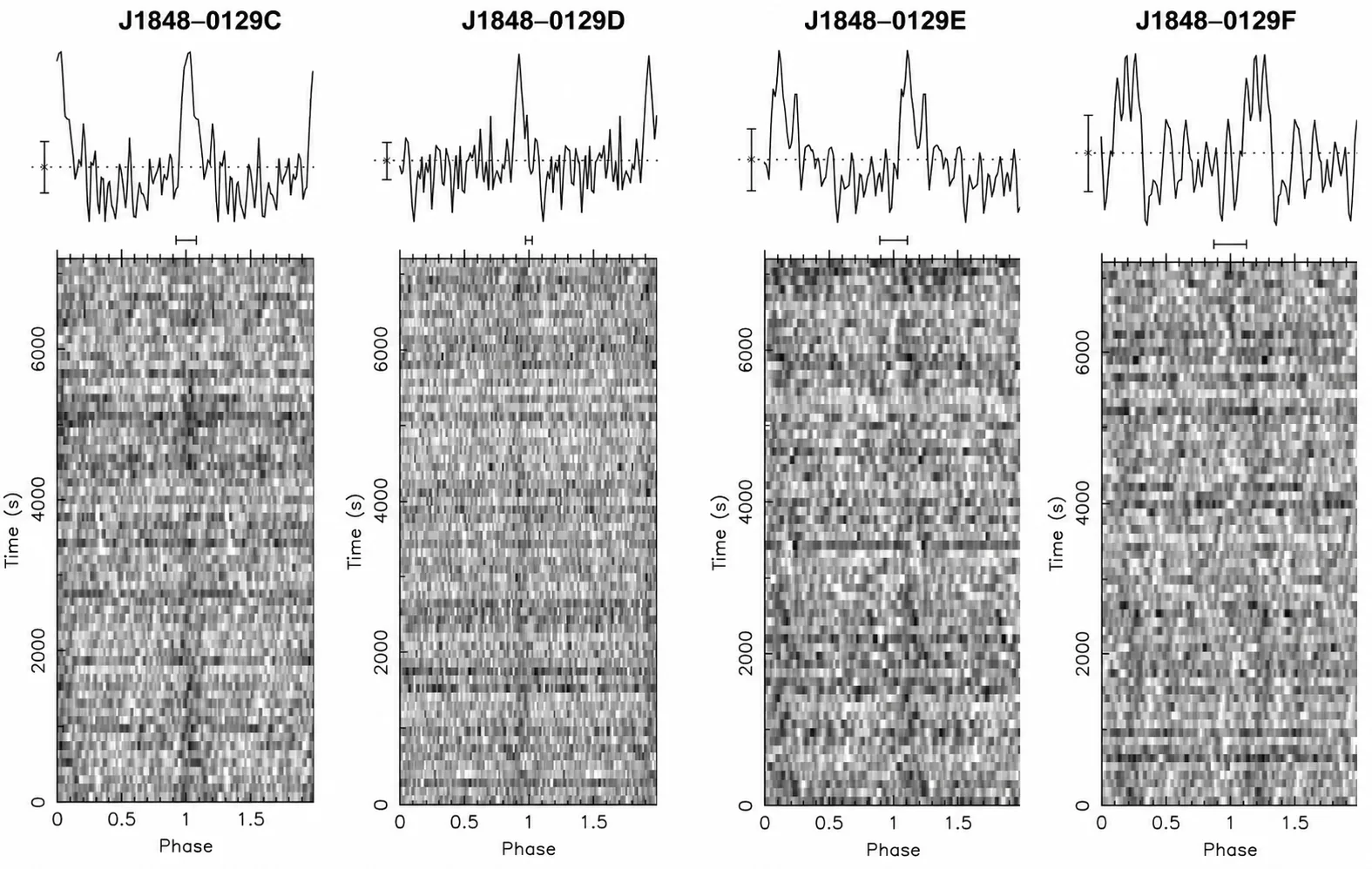
Shine a flashlight into fog and the beam turns dim and stubby. Radio waves from pulsars get lost in the interstellar medium in much the same way: free electrons blur the signal, just as water droplets blur light. Pulsars are neutron stars that spin hundreds of times per second and send out radio pulses like lighthouses. In globular clusters, dense balls of old stars, there ought to be plenty of them. But ordinary radio telescopes at 1.4 GHz often miss them, because the signal is too blurred.
Astronomers decided to try a higher frequency, around 2.4 GHz. They used the MeerKAT radio telescope in South Africa and observed 14 globular clusters. A higher frequency suffers less blurring, just as a shorter-wavelength flashlight beam cuts through fog better. The data were processed on a computer, searching for periodic signals and checking them by hand. In the cluster Glimpse-C01 they found four new pulsars. One of them, J1848−0129C, spins once every 6.44 milliseconds and orbits a companion every 5.03 days. The companion sometimes blocks it from our view, so the pulsar periodically disappears: that is called an eclipse. Another new pulsar, J1848−0129D, spins once every 17.1 milliseconds and has a massive companion.
Until now it was unclear how many pulsars we were losing to the fog. Now it is clear that a higher frequency helps find them. In the future, when MeerKAT becomes even more sensitive, we will be able to see many more of these lighthouses.
J1848−0129F has the largest dispersion measure of any pulsar ever associated with a globular cluster: 520.1 pc/cm³. That means the beam passed through an enormous number of free electrons on its way to us, like looking at a star through a fogged-up window.
In Arthur C. Clarke's novel Rendezvous with Rama, astronomers notice an anomalous object pushing through the interference. Our radio telescopes, punching through galactic dust at high frequencies, echo that image: we too are looking for needles in a haystack, but not in space, in data.