A Searchlight Cutting Through Fog: How MeerKAT Found Pulsars in a Shrouded Cluster ✛
At night in fog, a searchlight works worse than in daylight: tiny droplets scatter the beam, and distant objects drown in the murky haze. Much the same way, radio waves from pulsars get lost in the interstellar medium when there are many free electrons between us and the star. Astronomers have long been hunting for pulsars in globular clusters, dense balls of hundreds of thousands of old stars where frequent close encounters give birth to millisecond pulsars. However, conventional surveys at 1.4 GHz often miss fast signals from distant clusters: electrons smear the pulse the way fog blurs light.
To pierce the fog, the team used the MeerKAT radio telescope in South Africa at a higher frequency, about 2.4 GHz, in the so-called S-band. From March 2023 to 2024, they observed 14 globular clusters, pointing four beams simultaneously: two at the cluster center and two at the positions of already known pulsars. The data were searched in the Fourier domain with the PRESTO software, applying acceleration and jerk searches to compensate for the orbital motion of pulsars in tight binaries. To avoid missing fast systems, the data were split into segments of 15, 30, and 60 minutes, then folded and the candidates checked visually.
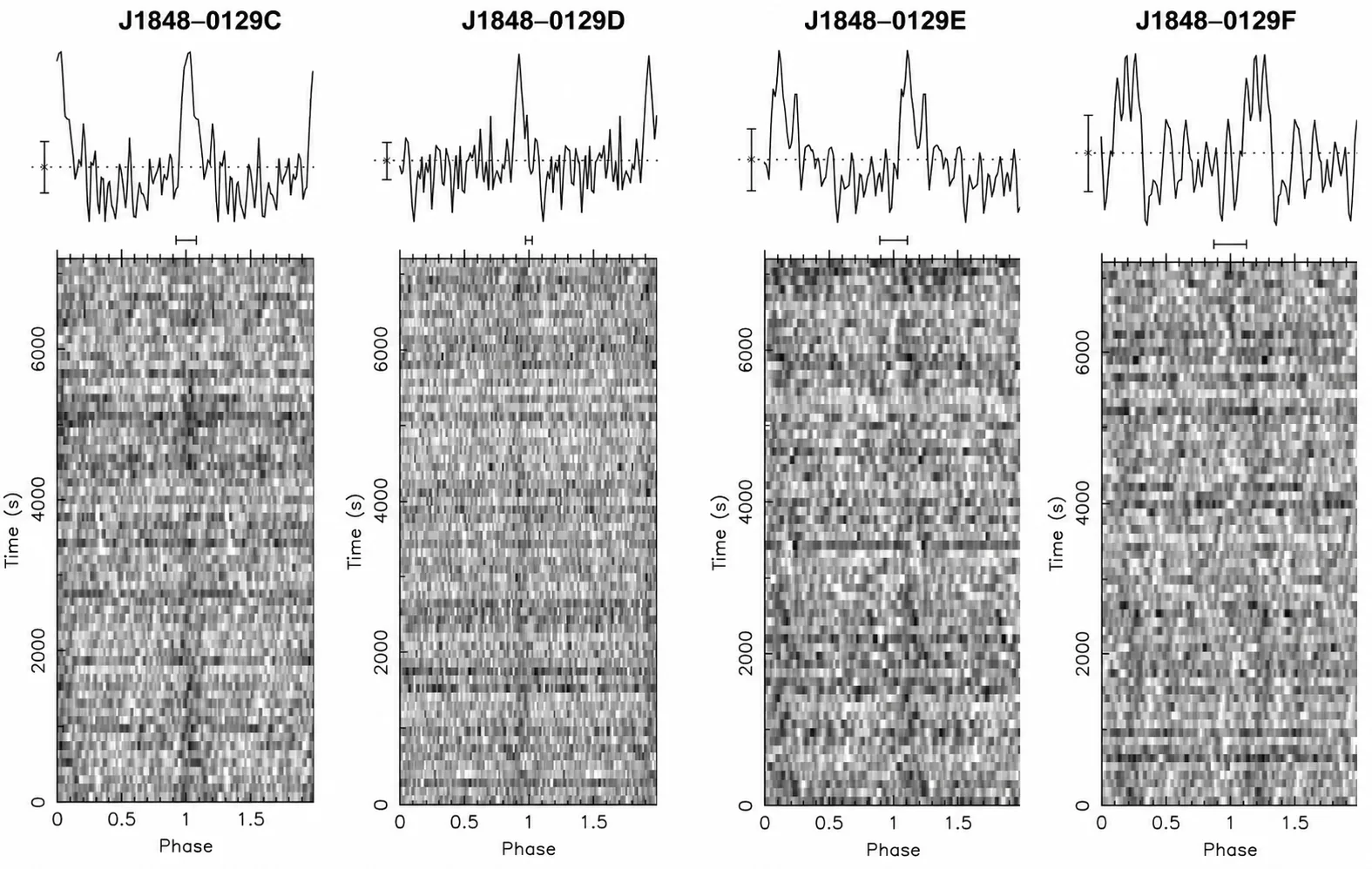
The result exceeded expectations. In the 14 clusters, 39 known pulsars were re-detected and four new ones were found in the cluster Glimpse-C01. One of them, J1848−0129C, is a millisecond pulsar with a period of 6.44 ms and an orbital period of 5.03 days. It is eclipsing: the companion periodically blocks it from us, like a cloud covering a lighthouse. The companion's mass is 0.35–0.42 solar masses, and this is the first candidate for the "huntsman" subclass in a globular cluster. Another new pulsar, J1848−0129D, spins in 17.1 ms in a nearly circular orbit with a massive white dwarf of about one solar mass. Two more, J1848−0129E and F, are faint binary millisecond pulsars.
Particularly interesting are the dispersion measures, the amount of free electrons along the line of sight. For pulsars D and F, they differ from the cluster average by tens of parsecs per cubic centimeter. This points to an inhomogeneous interstellar medium: the fog is not uniform, it has dense clumps. Comparing different clusters, the astronomers saw a pattern: the larger the average dispersion measure, the greater the spread of values within the cluster. Glimpse-C01 lies above the general trend, so for distant clusters the search windows in dispersion measure need to be widened.
Previously it was unclear how effective high frequencies are for finding pulsars in heavily obscured clusters and how many pulsars we lose to scattering at 1.4 GHz. Now it has been shown that MeerKAT's S-band reliably detects pulsars down to 10–20 microJanskys and uncovers new systems in Glimpse-C01, including an eclipsing one with a record orbital period. The technique can be applied right away to plan future surveys with MeerKAT+ and SKA-Mid, so as not to miss pulsars in dense regions of the Galaxy.
The high-frequency searchlight cut through the fog and showed that many undiscovered pulsars lurk in obscured clusters. When MeerKAT expands to MeerKAT+ and SKA-Mid comes online, sensitivity will grow, and we will be able to peer even deeper. Perhaps then the fog will finally part, and we will see all the lighthouses that were hidden before.
J1848−0129F has the largest dispersion measure of any pulsar ever associated with a globular cluster: 520.1 pc/cm³. That means the beam passed through an enormous number of free electrons on its way to us, like looking at a star through a fogged-up window.
In Arthur C. Clarke's novel Rendezvous with Rama, astronomers notice an anomalous object pushing through the interference. Our radio telescopes, punching through galactic dust at high frequencies, echo that image: we too are looking for needles in a haystack, but not in space, in data.