First S-band pulsar survey of globular clusters with MeerKAT ✛
Context
Globular clusters are dense stellar balls where frequent stellar encounters give birth to millisecond pulsars in binary systems. Most surveys look for them at frequencies of 1-1.4 GHz, but for distant clusters with a large dispersion measure (the amount of free electrons along the line of sight) the signal gets smeared and scattered, hiding fast pulsars. This work sits alongside recent studies of pulsars in clusters: neighboring papers describe radio echoes at the edge of a cluster, methods for pulling pulsars out of noise, and discoveries in Terzan 5 and other clusters. Our survey stands out because it is the first to systematically use the MeerKAT S-band for an entire sample of clusters rather than for single objects.
Methods
From March 2023 through 2024, 14 globular clusters were observed with MeerKAT in the S-band (1750-3500 MHz, effective bandwidth 875 MHz). Four tied-array beams were used: two on the cluster center (full array and 1-km core) and two on the positions of known pulsars. The data were searched in the Fourier domain with PRESTO, applying acceleration and jerk searches to compensate for orbital motion in tight binaries. To avoid missing fast systems, the data were split into segments of 15, 30 and 60 minutes. Candidates were folded and checked visually. Archival ephemerides were used for known pulsars. Flux densities were measured with the radiometer equation, comparing against archival L-band data.
Results
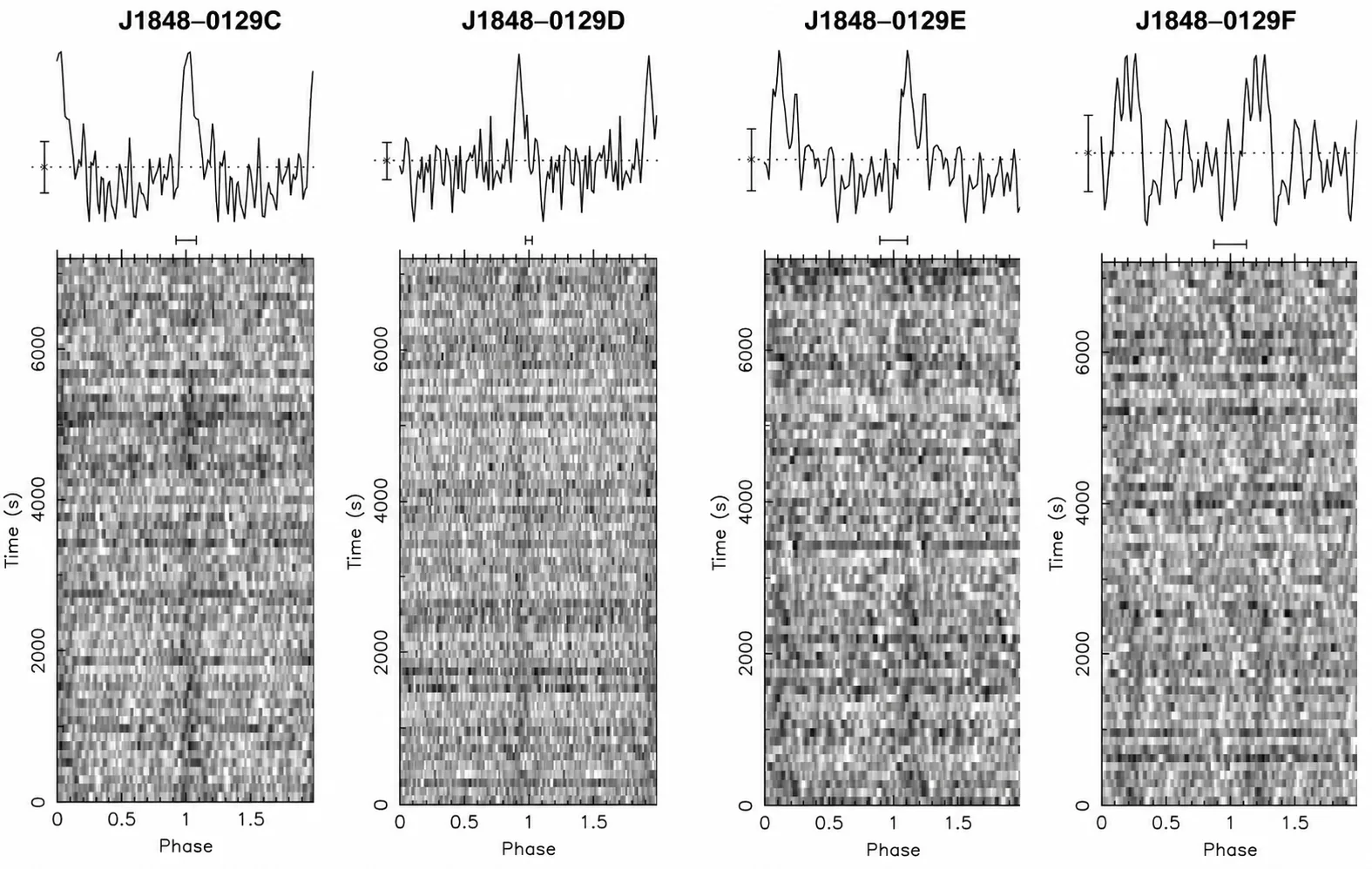
39 pulsars were re-detected in 14 clusters and four new ones were found in Glimpse-C01: J1848−0129C, D, E, F. J1848−0129C is a millisecond pulsar with a period of 6.44 ms and an orbital period of 5.03 days, eclipsing, with a companion mass of 0.35-0.42 M⊙. It is the first candidate for the "huntsman" subclass in a globular cluster. J1848−0129D is a pulsar with a period of 17.1 ms on a nearly circular 3.39-day orbit with a massive white dwarf of about 1 M⊙. J1848−0129E and F are faint binary millisecond pulsars. The dispersion measures of pulsars D and F differ from the cluster average by tens of pc/cm³, pointing to an inhomogeneous interstellar medium. Comparison with other clusters showed that the spread of dispersion measures grows with their mean value: Glimpse-C01 lies above the general trend. The practical sensitivity of a single S-band observation was 10-20 µJy.
Implications
The survey proves that MeerKAT's high frequencies effectively punch through dispersion and scattering in dense regions of the Galaxy, opening access to pulsars invisible at 1.4 GHz. Unlike neighboring works focused on individual clusters or methods, this is the first to yield a uniform sample of flux densities and spectral indices for many clusters, providing a reference sensitivity scale for future surveys. The discovery of a long-period eclipsing system expands the zoology of "spiders" in clusters.
Future development
With the expansion of MeerKAT+ and the move to SKA-Mid, S-band sensitivity will grow, allowing deeper penetration into obscured clusters and the discovery of more fast pulsars. Long-term timing campaigns are planned for the new systems, which will refine their orbits and possibly reveal relativistic effects. Searching at even higher frequencies could become the standard for distant clusters.
Impact
The results will influence the strategy of pulsar surveys in clusters, population models of binary systems, and the use of millisecond pulsars as gravitational-wave detectors.
Next steps
Continue timing observations of J1848−0129C and D to refine their orbits and search for post-Keplerian effects. Carry out deep S-band surveys of other heavily obscured clusters with widened dispersion windows.
Key open problems
The work is directly tied to the problem of completeness of the pulsar population in globular clusters: how many millisecond pulsars are we losing to scattering and dispersion? The discovery of four new systems in a single cluster hints that many undiscovered pulsars lurk in heavily obscured clusters, which skews estimates of formation rates and dynamical evolution.
The knowledge machine's view
This section is addressed to the author of the paper and their colleagues. Neighbouring works were found by meaning-based search across our archive, not by word overlap. We do not review: we show the field around the work.
What the work does
The first systematic survey of 14 globular clusters in the S band with MeerKAT has been carried out. 39 known pulsars were redetected and four new ones were discovered in Glimpse-C01, including an eclipsing system with an orbital period of 5.03 days. Flux densities and spectral indices were measured, and the scatter in dispersion measures was shown to grow with their mean value.
Where its strength is
A single sample of flux densities and spectral indices has been assembled for many clusters at high frequency, providing a reference scale for sensitivity. The discovery of a long-period eclipsing system expands the zoology of "spiders" in globular clusters.
Where it could go next
- It might be interesting to compare the detected radio pulsars with sources of non-thermal emission at the edge of the cluster, as in the work on MeerKAT radio echoes, in order to look for a connection between pulsars and diffuse glow.based on: Radio Echo at the Cluster's Edge: MeerKAT Catches a Ghostly Glow arXiv:2608.12042v1
- A related move is the search for single pulsars in clusters with MeerKAT, where methods for extracting faint signals were used; perhaps their approach to sensitivity could help estimate how many pulsars remain undiscovered in Glimpse-C01.based on: The Hidden Pulsar in a Globular Cluster arXiv:2603.06476
- There is a paper in the archive on pulsars as dark matter probes; using your sample with precise dispersion measures and positions could be interesting for such studies.based on: Pulsars as Cosmic Antennas for Dark Matter Detection arXiv:2605.31024
Worth trying
- Apply the single-pulsar search methods from paper 2603.06476 to the Glimpse-C01 data to look for even fainter sources.
- Check whether there is a correlation between the scatter in dispersion measures and the presence of diffuse radio emission, as in 2608.12042v1.
- Use the pulsar sample to constrain dark matter parameters, by analogy with 2605.31024.
Why this may matter
A single high-frequency sample of cluster pulsars sets a benchmark for future surveys and opens the way to studying the population of millisecond pulsars in regions with strong scattering, as well as to using them as tools for astrophysics and fundamental physics.
Nearby works in our archive
- Radio Echo at the Cluster's Edge: MeerKAT Catches a Ghostly Glowsimilarity 0.59
- The Hidden Pulsar in a Globular Clustersimilarity 0.57
- Radio Beacons from the Dark: 27 New Lighthouses in the Galaxysimilarity 0.57
- Six New Pulsars in Ancient Star Clusterssimilarity 0.57
- Hundreds of pulsars hide in the globular cluster Terzan 5similarity 0.56
- Pulsars as Cosmic Antennas for Dark Matter Detectionsimilarity 0.56
The archive is sparse around this work: the closest review is only 0.59, against a usual 0.64. It looks like few have drilled nearby.
J1848−0129F has the largest dispersion measure of any pulsar ever associated with a globular cluster: 520.1 pc/cm³. That means the beam passed through an enormous number of free electrons on its way to us, like looking at a star through a fogged-up window.
In Arthur C. Clarke's novel Rendezvous with Rama, astronomers notice an anomalous object pushing through the interference. Our radio telescopes, punching through galactic dust at high frequencies, echo that image: we too are looking for needles in a haystack, but not in space, in data.
Key numbers
- observation frequency: 2.4 GHz (S-band)
- number of clusters: 14
- new pulsars: 4
- re-detected pulsars: 39
- sensitivity: 10-20 µJy in 2 hours