How a Hole in Graphene Breaks Water ✛
A sheet of graphene looks like a mesh of carbon balls. Pull out one ball and you're left with a hole. It turns out this hole works like a two-faced Janus: one side is ready to grab hydrogen, the other to grab hydroxyl. In dry air, a water molecule splits at the hole in only one way, clearing a high barrier like a leap over a fence. But when liquid water surrounds it, the fence gets lower and two gates appear.
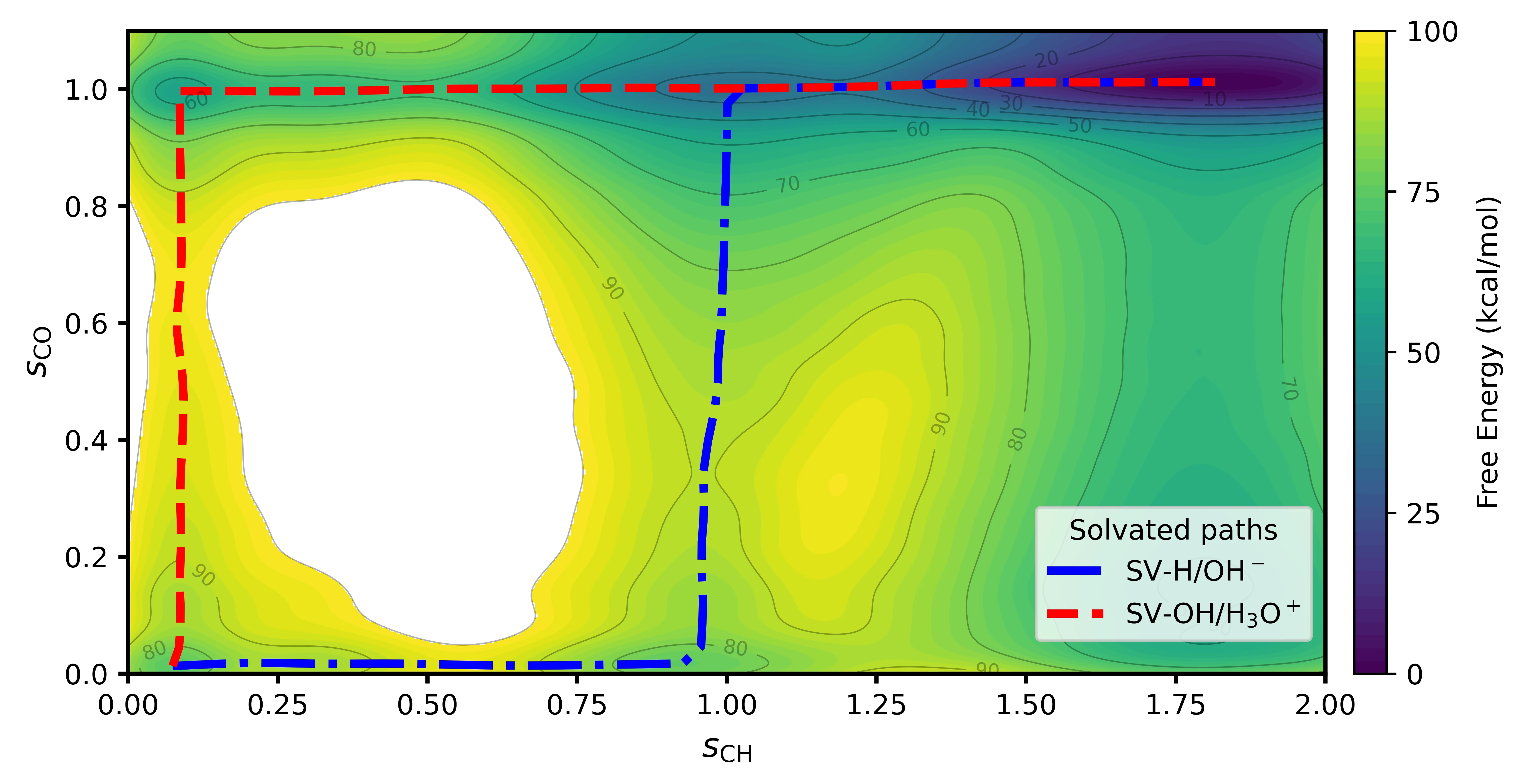
In liquid water, the hole splits a water molecule along two paths. The first path leaves hydrogen on the hole while a hydroxide ion drifts away into the water. The second path leaves hydroxyl on the hole while a hydronium ion drifts away into the water. Both paths require less energy than in dry air, because the surrounding water stabilizes the charged particles. After the reaction, the hole starts holding onto water like a sponge and stops repelling it.
This knowledge will help control the wettability of graphene membranes and electrodes. Returning to the Janus image: one side of the hole is ready to take hydrogen, the other hydroxyl, and water chooses which side to turn toward depending on whether it's dry or wet around it.
A single vacancy in graphene is a diradical with two unpaired electrons: one on a localized σ orbital, the other on a π orbital, making it resemble a molecular carbene. This "two-faced" nature allows the vacancy to act as both an acceptor and a donor of electron density, opening two different reaction pathways with water.
In Neal Stephenson's novel The Diamond Age, nanotechnology uses carbon structures to control chemical processes at the atomic level. Although the book deals with more complex systems, the idea of point defects as active centers for chemical transformations echoes the role of graphene vacancies in water dissociation.