Energy level splitting is the phenomenon where a set of degenerate energy levels—states that have the same energy—separate into distinct levels when a perturbation is applied. This perturbation can be an external magnetic or electric field, or an internal interaction such as spin-orbit coupling. The effect is fundamental to quantum mechanics because it reveals the hidden structure of atoms, molecules, and solids. For example, the Zeeman effect splits spectral lines in a magnetic field, and crystal field splitting explains the colors of transition metal compounds and the behavior of impurities in semiconductors.
History
The Zeeman effect was discovered by Pieter Zeeman in 1896, and the theoretical explanation was provided by Hendrik Lorentz, leading to their joint Nobel Prize in 1902. Crystal field splitting was developed in the 1930s by Hans Bethe and John Hasbrouck Van Vleck.
How it works
In an unperturbed system, degenerate states are symmetric and have identical energies. When a perturbation is introduced, it breaks the symmetry, and the states respond differently—some rise in energy, others fall. The magnitude of the splitting depends on the strength of the perturbation and the coupling between the states. In a magnetic field, for instance, states with different magnetic quantum numbers shift by different amounts due to their magnetic moments. In a crystal lattice, the electric field from surrounding ions splits the d-orbitals of a transition metal ion into groups with different energies, depending on their orientation relative to the lattice.
In practice
Energy level splitting is exploited in quantum dots for tunable light emission, in rare-earth doped lasers, and in electron spin resonance (ESR) spectroscopy to probe local environments in materials.
Fun fact
The splitting of spectral lines in a magnetic field is so sensitive that astronomers use it to measure the magnetic fields of distant stars—some stars show splittings that imply fields thousands of times stronger than Earth's.
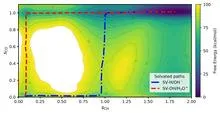
Picture a tiny hole in a sheet of graphene: a single missing carbon atom. It used to be thought that a water molecule splits apart at this defect only on its own, in dry gas. But if liquid water is sloshing all around, everything changes.
A polar molecule is like a tiny dumbbell with opposite charges at its ends. Normally, such particles quickly stick together or fly apart when they meet — electric forces are too strong. But the authors of the work found a way to turn this aggressiveness into a controlled game.
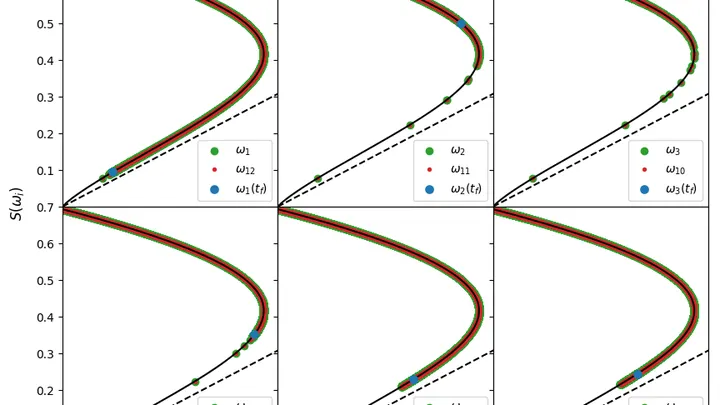
The quantum world is full of surprises. In a Kerr parametric oscillator, a device where light is trapped in a ring and driven by an external field, researchers recently noticed something strange: pairs of energy levels merge in an embrace. Physicists have dubbed this a "spectral kiss" spectroscopy.
Hot water sometimes freezes before cold: this is the Mpemba effect. In the quantum realm, a similar paradox appears: the more the equilibrium is disrupted, the faster it recovers. It's like fleeing from disorder (entropy) in reverse: the system rushes toward order, and a large initial imbalance only helps.
Neutrinos are nearly elusive particles that permeate everything around us. In a dense cloud, such as during a star explosion, they begin to collectively change their type, or 'flavor.' This process is like a crowd of people synchronously changing the color of their clothes, but not all at once — rather in waves.
Two quantum dots are like two tiny pockets in a piece of silicon where an electron can sit, like a ball in a cup. When the pockets are far apart, each electron lives on its own, and its energy resembles the levels of a solitary atom.
A quantum dot is a box so small that an electron inside cannot have just any energy, but only strictly defined values, like the steps of a staircase. Each step can accommodate several electrons, but exactly how many is the question. If a step is double, two electrons can stand on it; if single, only one.
A qubit is like a tenant in a tiny apartment: it usually takes the ground floor to avoid distractions from upstairs neighbors. In germanium quantum dots, where spin qubits live, this tenant is a hole: that is, a missing electron. The hole has a spin that acts like a tiny magnetic needle.
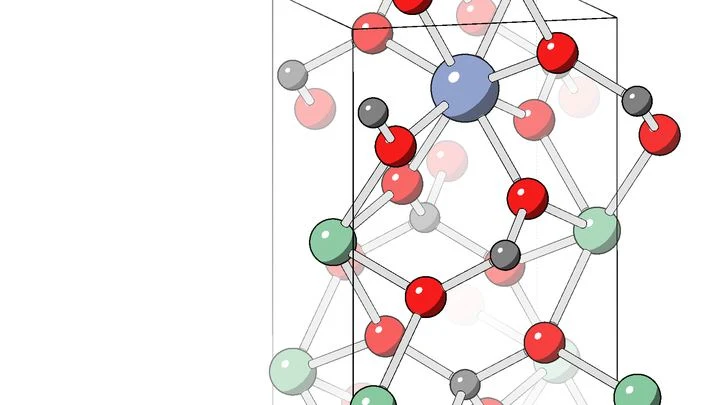
Quantum memory is like a fragile snowflake: one wrong move and it melts. Scientists are hunting for materials where such a "snowflake" can be held without fear of it melting. In the new work, they studied a calcium tungstate crystal doped with erbium, a rare-earth metal. It turned out that erbium inside this crystal has a hidden property that helps hold onto information.
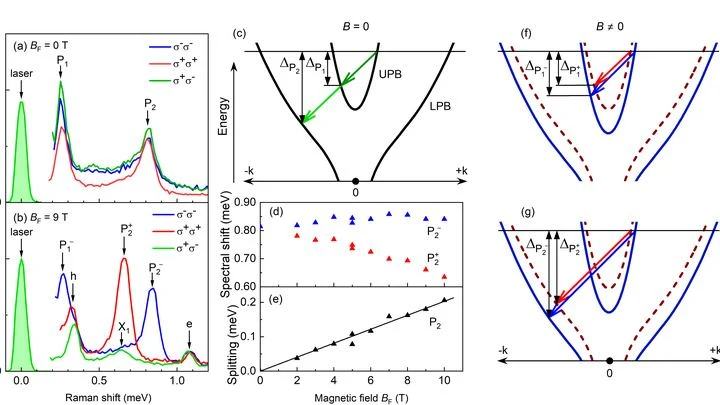
A laser beam hits a shiny crystal, and comes back different: slightly shifted in color, with a different polarization. In a magnetic field, this transformation of light becomes especially noticeable.
Electrons in a conductor usually behave like a gas: they dart around chaotically, collide, and don't hold formation. But if you spread them far apart and cool them down, their mutual repulsion can force them into place, like attendees in an overcrowded hall who settle into every other seat.
Two beams of light, red and blue, enter a tiny ring made of silicon nitride. The ring is smaller than the thickness of a human hair. At the input, both beams are equally bright. But inside the ring, one of them suddenly starts to outshine the other, like two equally matched people in a debate where one unexpectedly gains the upper hand.