Water Breaks on Graphene Defects ✛
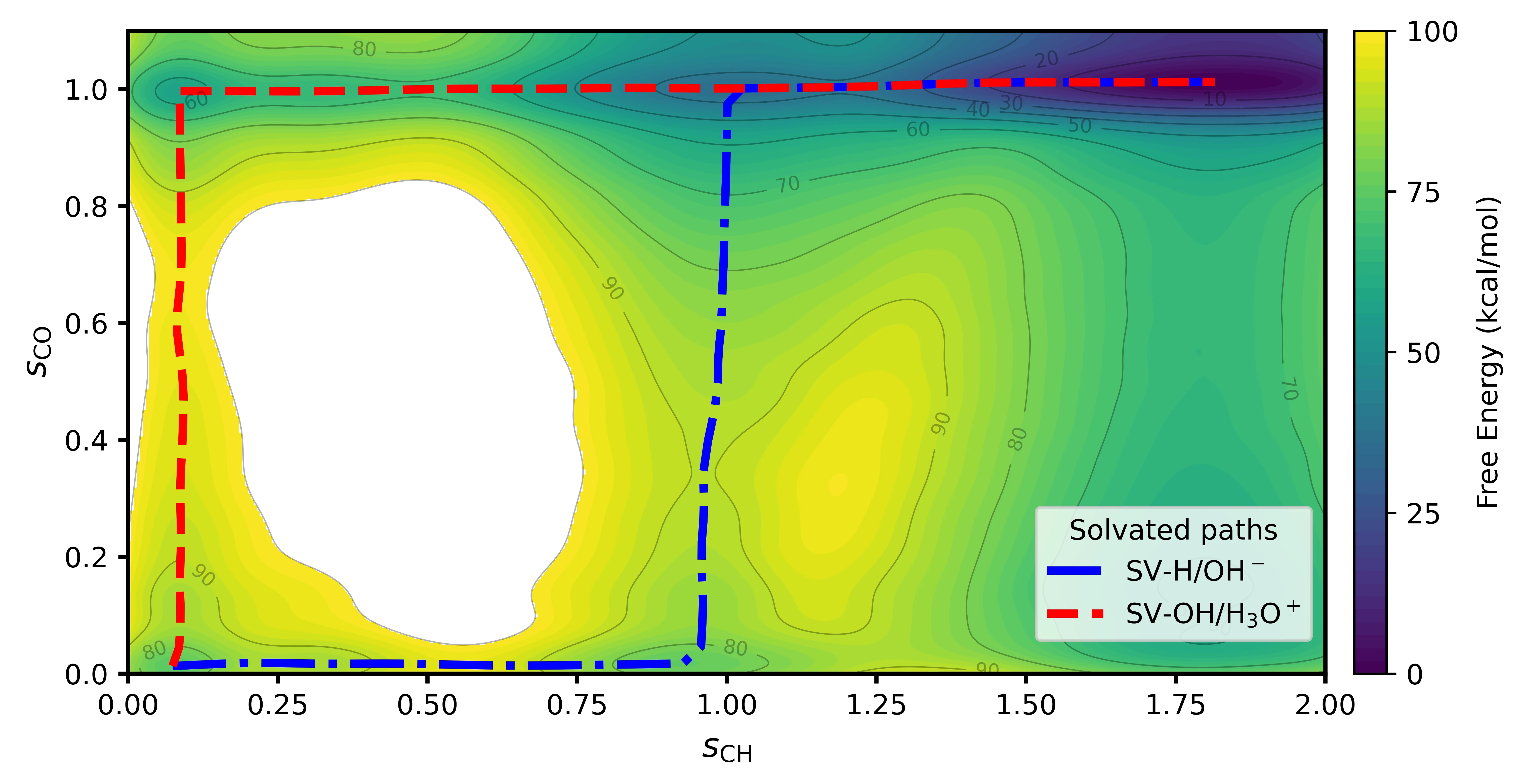
Picture a tiny hole in a sheet of graphene: a single missing carbon atom. It used to be thought that a water molecule splits apart at this defect only on its own, in dry gas. But if liquid water is sloshing all around, everything changes. The defect starts acting like a two-faced Janus: it can take on either a hydrogen or a hydroxyl, and water picks its route depending on its surroundings.
In the gas phase, water dissociates through a single concerted transition state with a barrier of 28.4 kcal/mol, forming the Hydroxy-SV intermediate. It's as if a lone molecule were jumping over a tall fence. But in solution the fence gets lower and two gates appear. The first, basic pathway yields SV-H and a hydroxide ion in solution with a barrier of 21.9 kcal/mol. The second, acidic pathway gives SV-OH and a hydronium ion with a barrier of 23.7 kcal/mol. Both barriers sit below the gas-phase one, because the solvent stabilizes the charged fragments.
The final product, SV-Ketone, lies 74 kcal/mol below the reactants in solution, compared with 78 kcal/mol in the gas phase. An analysis of water residence times showed that Hydroxy-SV holds onto water for 55 ps, SV-Ketone for 27 ps, whereas the bare vacancy and SV-Pyran are comparable to pristine graphene (a few picoseconds). This means that after the reaction the defect stops repelling water and starts attracting it, like a sponge.
Until now it was unclear how defects affect water dissociation under explicit-solvent conditions. It has now been shown that solvation qualitatively changes the reaction pathway: instead of a single concerted channel, two ionic routes appear, stabilized by the solvent. This highlights the need to treat the solvent explicitly when modeling reactions at the interfaces of 2D materials.
The results could be used to tune the wettability and reactivity of graphene membranes and electrodes through controlled defect creation. Returning to the Janus image: one face of the defect is ready to accept hydrogen, the other a hydroxyl, and water chooses which face to turn to depending on whether it's dry or wet around it.
A single vacancy in graphene is a diradical with two unpaired electrons: one on a localized σ orbital, the other on a π orbital, making it resemble a molecular carbene. This "two-faced" nature allows the vacancy to act as both an acceptor and a donor of electron density, opening two different reaction pathways with water.
In Neal Stephenson's novel The Diamond Age, nanotechnology uses carbon structures to control chemical processes at the atomic level. Although the book deals with more complex systems, the idea of point defects as active centers for chemical transformations echoes the role of graphene vacancies in water dissociation.