Water Breaks on Graphene Defects ✛
Context
The work sits off the beaten path: neighboring studies deal with electron wind in graphene, ultraviolet cleaning of graphene, vortices in liquid light, as well as droplets on a hair and hydrogen in steel. There are almost no direct neighbors on the topic of water dissociation at graphene defects, the closest one at a distance of 0.575. This means the work fills a gap: previously, water dissociation at a graphene vacancy had been studied only for a single molecule in the gas phase, and the influence of the solvent remained unknown.
Methods
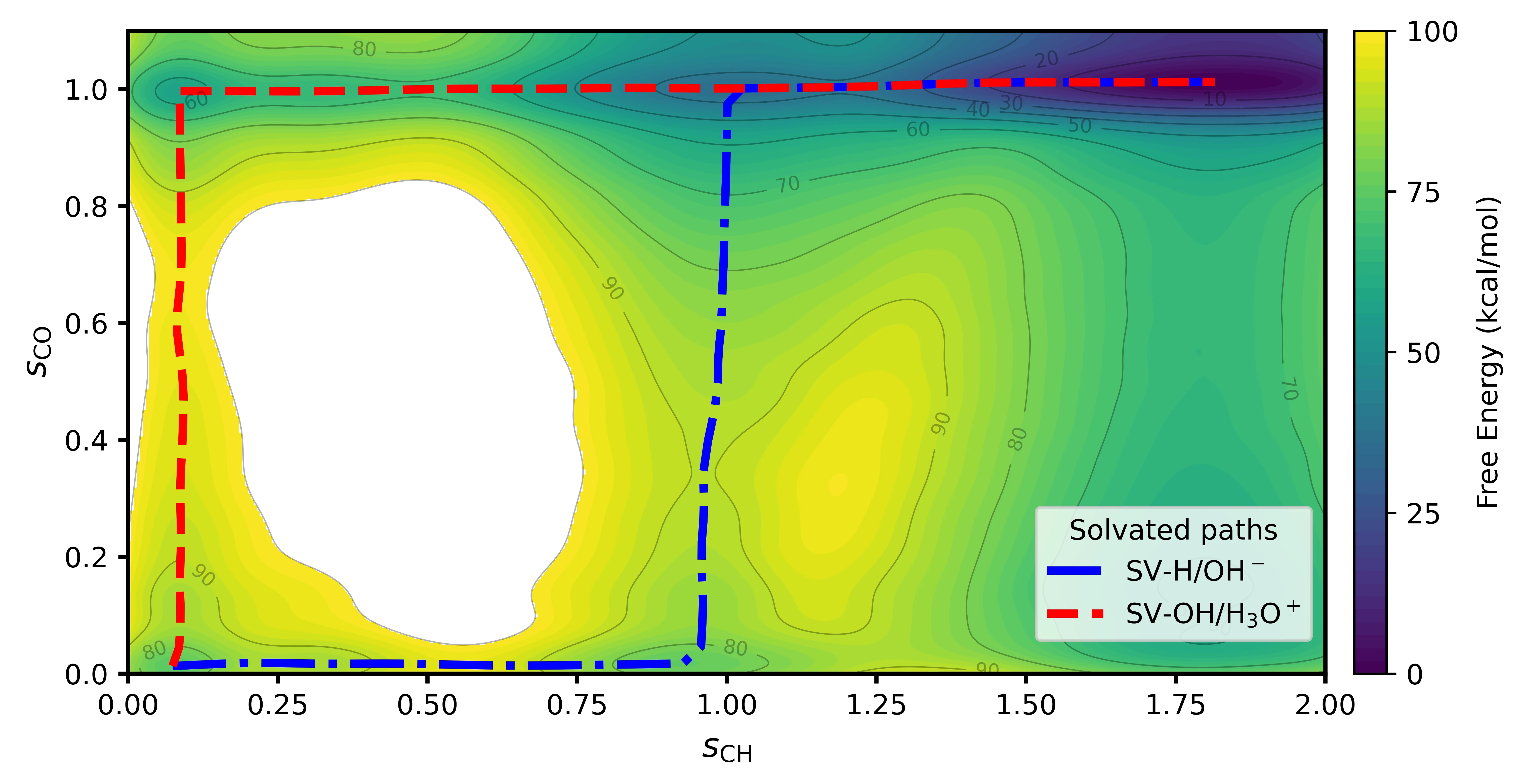
The authors trained an equivariant MACE potential on data from spin-polarized hybrid DFT (revPBE0-D3). The training set of about 9000 structures included vacancies in the gas phase, partially solvated, and fully solvated configurations. To accelerate rare events, they used multiple-walker well-tempered metadynamics in the LAMMPS+PLUMED software suite. The collective variables were carbon-hydrogen and carbon-oxygen coordination numbers, tracking the binding of water fragments to the vacancy. The gas phase was modeled with one water molecule in the cell, and the solvated system with about 60 water molecules. The total metadynamics time was 6 ns for the gas phase and 40 ns for the solution. Additionally, they ran 2 ns of unbiased molecular dynamics to analyze water residence times at the defects.
Results
In the gas phase, water dissociates at the vacancy through a single concerted transition state with a barrier of 28.4 kcal/mol, forming the Hydroxy-SV intermediate. In solution, two competing channels open up. The first, basic, leads to the formation of SV-H and a hydroxide ion in solution with a barrier of 21.9 kcal/mol. The second, acidic, gives SV-OH and a hydronium ion with a barrier of 23.7 kcal/mol. Both barriers are lower than the gas-phase one. The acidic intermediate is more stable than the basic one by about 20 kcal/mol, indicating a thermodynamic preference for the acidic pathway. The final product SV-Ketone lies 74 kcal/mol below the reactants in solution, compared with 78 kcal/mol in the gas phase. Analysis of water residence times showed that Hydroxy-SV holds water for 55 ps, SV-Ketone for 27 ps, whereas the bare vacancy and SV-Pyran are comparable to pristine graphene (a few picoseconds).
Implications
The work stands out from its neighbors in that it is the first to quantitatively compare water dissociation mechanisms at the same defect in the gas phase and in explicit solvent at the free energy level, using a machine-learned potential with hybrid DFT accuracy. Neighboring studies either deal with other properties of graphene or do not address the reactivity of defects in aqueous media. Here it is shown that solvation qualitatively changes the reaction pathway: instead of a single concerted channel, two ionic pathways emerge, stabilized by the solvent. This highlights the need to explicitly account for the solvent when modeling reactions at interfaces of 2D materials.
Future development
The topic could develop toward studying cooperative effects between neighboring vacancies: do they react independently or exhibit coupled reactivity that could be harnessed for selective surface chemistry? Also promising is extending the approach to other defective 2D materials, such as monolayer hexagonal boron nitride with strong surface charge effects. The methodology of machine-learned potentials with hybrid DFT and metadynamics can be applied to a broad class of reactive solid-liquid interfaces.
Impact
The results will influence the understanding of corrosion of carbon electrodes in fuel cells, the design of membranes and graphene-based nanofluidic devices, as well as strategies for functionalizing carbon materials through controlled defect chemistry.
Next steps
The next step will be to study the interaction of several vacancies and their combined effect on water dissociation. It is also important to check whether the discovered mechanisms hold for other defects, such as graphene edges or divacancies.
Key open problems
The work is directly related to the unsolved problem of controlling the wettability and reactivity of carbon materials in aqueous media. Until now, it was unclear how defects affect water dissociation under explicit solvent conditions, and this study closes that gap for a single vacancy in graphene.
The knowledge machine's view
This section is addressed to the author of the paper and their colleagues. Neighbouring works were found by meaning-based search across our archive, not by word overlap. We do not review: we show the field around the work.
What the work does
You investigated water dissociation at a single vacancy in graphene, both in the gas phase and in solution, using the machine-learned MACE potential at the hybrid DFT level together with multiple-walker metadynamics. Free energy surfaces were constructed, two competing dissociation channels in solution (acidic and basic) were identified with barriers lower than in the gas phase, and it was shown that chemisorbed intermediates enhance water adsorption, making the defect hydrophilic.
Where its strength is
For the first time, the mechanisms of water dissociation at the same defect in the gas phase and in explicit solvent have been quantitatively compared at the free energy level, using a machine-learned potential that reproduces hybrid DFT. It is shown that solvation qualitatively changes the reaction pathway, opening ionic channels stabilized by the solvent.
Where it could go next
- It might be interesting to see how the found intermediates and barriers depend on the charge state of the defect or an applied electric field; in our archive there is a nearby work on electron wind in graphene, which considers the effect of current on defect dynamics.based on: Electron wind flows around obstacles arXiv:2601.17229
- There is a nearby entry on ultraviolet cleaning of graphene: one could check how photoinduced processes or oxidative treatment change the reactivity of the vacancy toward water, using your methodology.based on: How Bacteria Stick to Surfaces arXiv:2601.06754
- Since you found that chemisorbed intermediates enhance water adsorption, it would be interesting to compare this with the behavior of droplets on surfaces where wettability matters; the archive contains a work on droplets held on a hair, which might suggest macroscopic manifestations.based on: Drops That Hang by a Hair arXiv:2601.00345
Worth trying
- Run metadynamics for a charged vacancy or in the presence of an external electric field to assess the shift in barriers and the stability of intermediates.
- Compare water adsorption on defects treated with UV radiation or ozone using the same ML potential, to reveal the effect of functionalization.
- Calculate the free energy of wetting for surfaces with different vacancy concentrations, using the obtained data on water residence times, and compare with experimental contact angles.
Why this may matter
The results may be important for understanding the reactivity of graphene in aqueous environments, which is relevant for applications in membranes, sensors, and electrochemical devices, where defects play a key role.
Nearby works in our archive
- Electron wind flows around obstaclessimilarity 0.51
- How Bacteria Stick to Surfacessimilarity 0.51
- Salt at the Graphene Sheet: Who Pushes Whom Asidesimilarity 0.50
- Suspended Graphene: How Bending a Sheet Changes Heat Flowsimilarity 0.50
- Charged Particles in Water: Why Like Attracts Likesimilarity 0.50
- Quantum Leapfrog: How Vortices Play in Liquid Lightsimilarity 0.50
- Drops That Hang by a Hairsimilarity 0.49
The archive is sparse around this work: the closest review is only 0.51, against a usual 0.64. It looks like few have drilled nearby.
A single vacancy in graphene is a diradical with two unpaired electrons: one on a localized σ orbital, the other on a π orbital, making it resemble a molecular carbene. This "two-faced" nature allows the vacancy to act as both an acceptor and a donor of electron density, opening two different reaction pathways with water.
In Neal Stephenson's novel The Diamond Age, nanotechnology uses carbon structures to control chemical processes at the atomic level. Although the book deals with more complex systems, the idea of point defects as active centers for chemical transformations echoes the role of graphene vacancies in water dissociation.
Key numbers
- Gas-phase barrier: 28.4 kcal/mol
- Barrier of the basic pathway in solution: 21.9 kcal/mol
- Barrier of the acidic pathway in solution: 23.7 kcal/mol
- Water residence time on Hydroxy-SV: 55 ps
- Binding energy of the final product: 74 kcal/mol below the reactants