Condensed matter spectroscopy is the study of how solids interact with electromagnetic radiation and particles to reveal their internal electronic and magnetic structure. By shining light, X-rays, or neutrons on a material and analyzing the energy and momentum of the scattered or emitted particles, researchers can map out the energy levels of electrons, the vibrations of atoms, and the arrangement of magnetic moments. This field is fundamental to understanding why materials have the properties they do — why some conduct electricity, others are magnetic, and others are transparent.
History
The field grew from early 20th-century optical spectroscopy, but modern condensed matter spectroscopy took shape in the 1950s–1970s with the development of synchrotron light sources and neutron reactors, which provided intense, tunable probes for solids.
How it works
The core idea is that a material absorbs or emits energy in discrete quanta. When radiation hits a solid, it can excite an electron from one state to another, create a vibration (phonon), or flip a magnetic spin. By measuring the energy and momentum of the incoming and outgoing particles, scientists reconstruct the spectrum of possible excitations. This spectrum acts as a fingerprint of the material's electronic and magnetic organization. Techniques like angle-resolved photoemission spectroscopy (ARPES) directly image electron bands, while neutron scattering reveals spin waves and magnetic ordering.
In practice
It is used to design and characterize materials for electronics, superconductors, batteries, and magnetic storage, as well as to study exotic states like topological insulators and high-temperature superconductors.
Fun fact
Some condensed matter spectroscopy techniques can detect the magnetic fields of a single atomic layer, which is how researchers image the magnetic patterns in thin films mentioned in the article titles.
A laser beam strikes a thin target hidden inside layers of another material. Within billionths of a second, the material is compressed to a density of 25 grams per cubic centimeter, as if a piece of lead became more than twice as heavy without moving an inch.
When matter is heated to millions of degrees, it turns into plasma — a mix of free electrons and ions, like a boiling soup of charged particles. You can't measure the temperature of such a 'soup' with an ordinary thermometer, but you can shine X-rays through it.
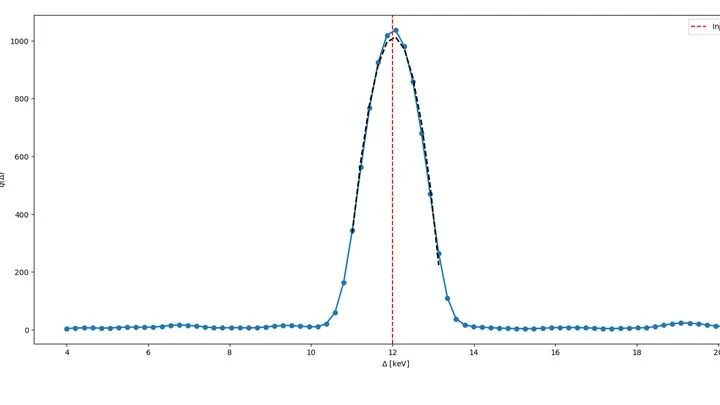
A gamma-ray spectrum looks like a picket fence: each line is the precise energy a nucleus released as a photon. But sometimes ghosts appear in that fence — faint lines shifted by the same amount from the main ones. Such a shift could mean that part of the energy went into creating a light particle we cannot yet see directly.
In a piece of manganese oxide just a few atomic layers thick, electrons behave like a crowd on an escalator: each moves by its own rules, but together they create a common flow. Physicists shone soft X-rays on such a film and knocked electrons out.
A tiny needle glides over the surface like a finger over a page written in Braille. That's how a scanning tunneling microscope works: it feels the atomic landscape and turns bumps into a picture. But when you need to add a magnetic field, the design hits a wall.