Warm Dense Matter: How Lasers Squeeze Material to 25 Grams per Cubic Centimeter express
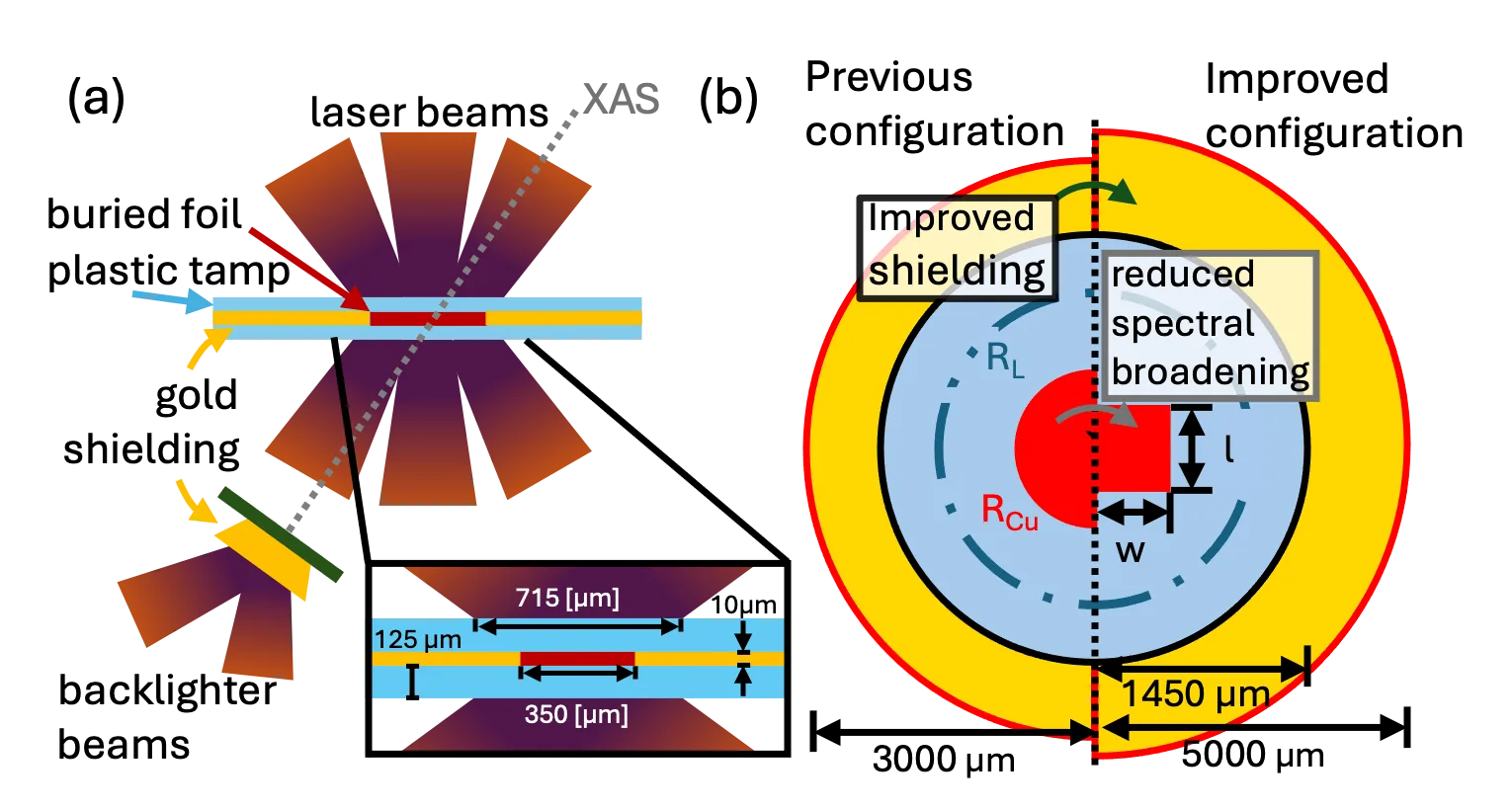
A laser beam strikes a thin target hidden inside layers of another material. Within billionths of a second, the material is compressed to a density of 25 grams per cubic centimeter, as if a piece of lead became more than twice as heavy without moving an inch. The temperature jumps to 20 electronvolts, which is roughly 230,000 times hotter than room temperature. This state is called warm dense matter: not a solid, not a gas, but something in between, where electrons have been stripped from atoms but haven't fully flown apart.
To peer inside this state, scientists shone X-rays through the plasma. Iron atoms in the target absorb X-rays at specific energies, and the shape of these absorption dips reveals how many electrons each atom has lost and how hot the medium is. It turned out that simple models that account for particle collisions and crudely add density effects don't match the measurements. A more sophisticated calculation based on quantum mechanics of many particles, however, reproduces the overall spectral shape better, though it's not perfect either.
The discrepancy between models shows that in dense hot plasma, electrons influence each other more strongly than previously assumed. This matters not only for laboratory experiments but also for understanding the interiors of Jupiter or processes in laser-driven fusion. No single theory yet captures all the details, but the path to a better description is now clearer.
At a density of 25 g/cm³, a cube the size of a die would weigh about 400 grams, like a good stick of butter, but dozens of times harder than steel.