Hunting Invisible Particles by Their Tracks in the Spectrum express
A gamma-ray spectrum looks like a picket fence: each line is the precise energy a nucleus released as a photon. But sometimes ghosts appear in that fence — faint lines shifted by the same amount from the main ones. Such a shift could mean that part of the energy went into creating a light particle we cannot yet see directly.
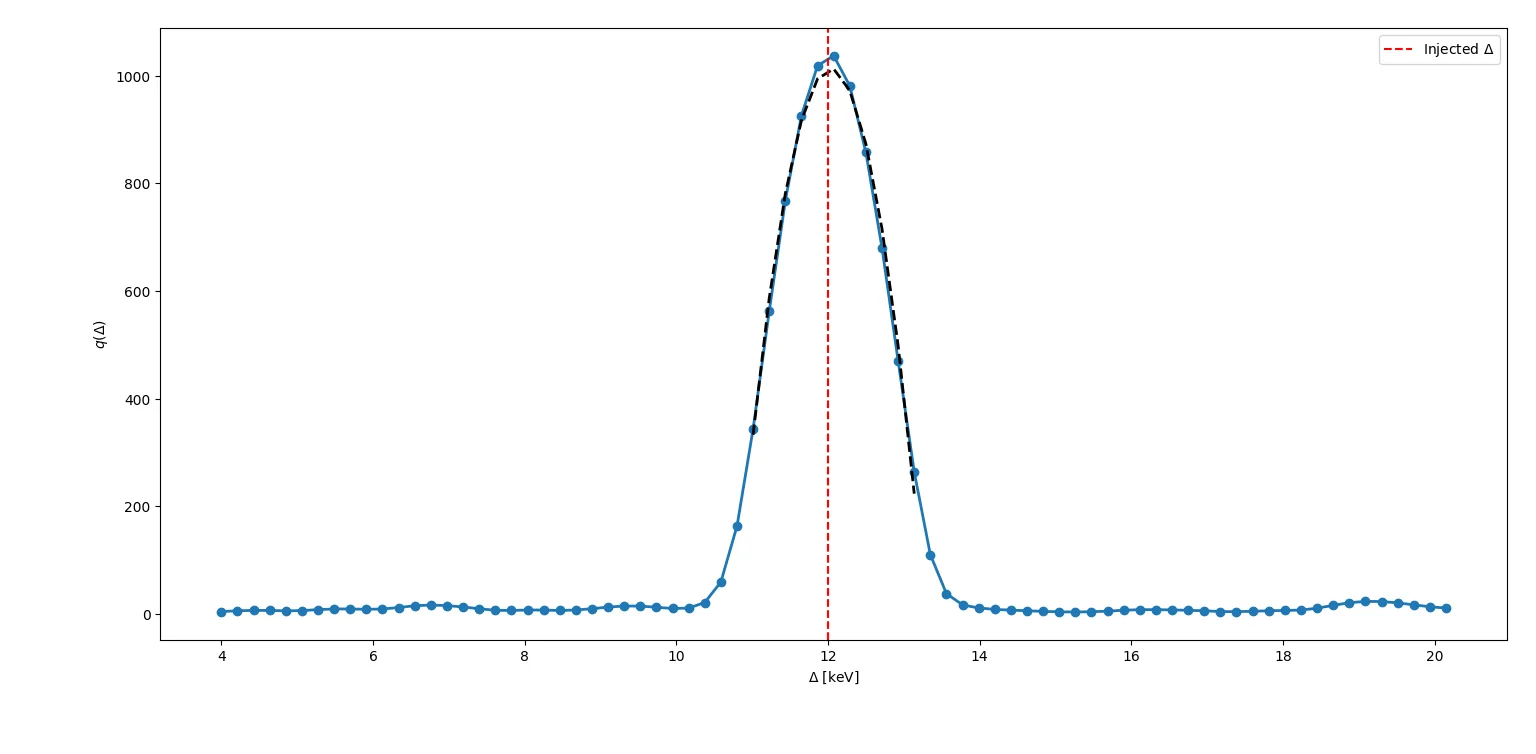
The authors suggest not staring at individual anomalies but looking for spectroscopic combs: several satellite lines offset from their parents by the same energy step Δ. If such combs show up for different target nuclei, that would be strong evidence for a new particle, not just random noise or a detector artifact.
The experiment requires high-resolution germanium detectors that can tell very close lines apart. Choosing the right target also matters: nuclei with simple structures produce fewer false candidates. This approach could open the door to detecting particles that interact weakly with ordinary matter but are born in nuclear transitions.
Original abstract
as written by the authors arXiv:2603.26472
We present a general, discovery-grade framework for searching for weakly coupled new particles emitted in nuclear de-excitation following neutron capture. Rather than relying on isolated spectral features, the method exploits correlated ``satellite-line combs'': multiple weak $$\gamma$$-ray lines appearing at a common energy offset $$\Delta$$ below known capture transitions. By combining likelihood information across many parent lines and multiple target nuclei, the approach strongly suppresses nuclear-structure ambiguities and instrumental artifacts. We also discuss optimal target selection and practical experimental implementation with high-resolution HPGe detectors.
Even a single gamma line can be narrower than the gap between neighboring lines — which is why germanium detectors are cooled with liquid nitrogen, so thermal noise doesn't smear the spectrum.
In the TV series Fringe, scientists searched spectra for signals from parallel universes: there, too, they had to separate faint shifts from noise.