A Crystal Trap for Light Dark Matter express
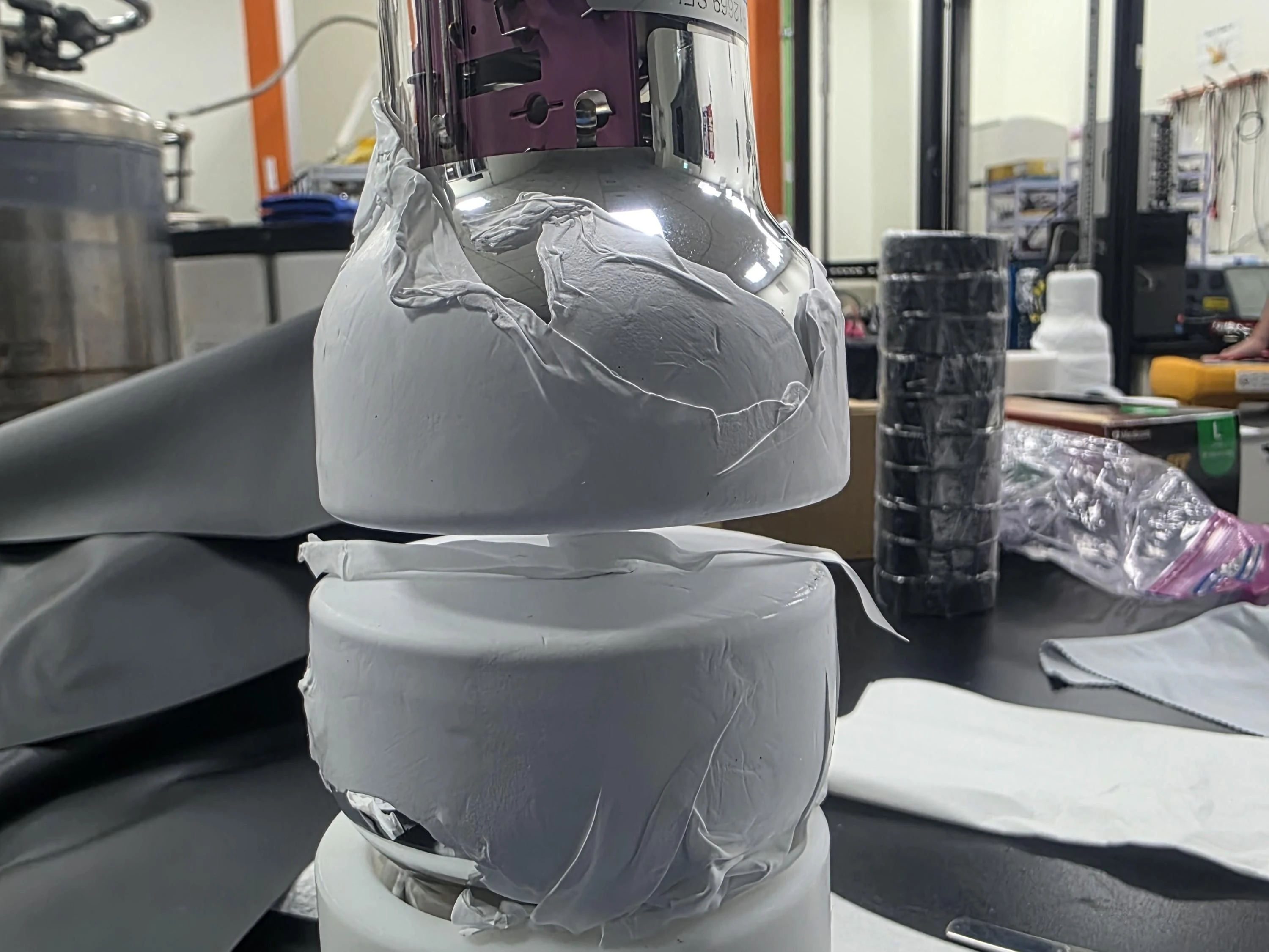
No one has ever seen dark matter, but it should pass through detectors like wind through leaves. Sometimes, very rarely, a dark matter particle bumps into an atomic nucleus, and then the detector must catch that jolt. The trouble is that light dark matter particles can hardly move heavy nuclei: it's like trying to knock down a bowling pin by throwing a feather at it. You need a target made of light nuclei, which are easier to shake.
Scientists took a trans-stilbene crystal — an organic material rich in hydrogen, the lightest nucleus. When a particle hits such a crystal, it flashes: a short pulse of light is born. This light was captured by two sensitive tubes pressed against the crystal's ends. The crystal, about the size of a pinky nail, roughly a centimeter in diameter and length, was irradiated with gamma rays from radioactive americium. A gamma quantum with an energy of 59.54 keV knocked out on average 3.37 light electrons per kiloelectronvolt of energy.
Such a bright and clear response shows that the crystal can distinguish weak events well and is suitable for hunting light dark matter. Now physicists have one more target that might catch those elusive particles.
Original abstract
as written by the authors arXiv:2608.17276v1
Direct searches for low-mass WIMPs require sensitivity to low-energy nuclear recoils. Hydrogen-containing targets offer favorable scattering kinematics because low-mass WIMPs can transfer a larger fraction of their kinetic energy to hydrogen nuclei than to heavier nuclei. Trans-stilbene (t-stilbene) is a hydrogen-rich organic crystal that combines this kinematic advantage with efficient scintillation and pulse-shape discrimination (PSD).In this work, we characterize the scintillation decay behavior and effective light yield of a solution-grown t-stilbene crystal to evaluate its suitability for dark matter detection. The detector consists of a cylindrical crystal approximately 1.1 cm in diameter and 1.1 cm in length, optically coupled at opposite ends to two Hamamatsu R12669 photomultiplier tubes. The scintillation waveforms are described by a triple-exponential decay model, yielding fraction-weighted decay time constants of $$8.3 \pm 0.2$$ ns (fast), $$20.1 \pm 0.3$$ ns (medium), and $$74.2 \pm 1.1$$ ns (slow). The effective light yield, determined using a 59.54 keV $$\gamma$$ ray from an $$^{241}$$Am source, is $$3.37 \pm 0.02$$ photoelectrons per keV.These measurements establish the baseline performance of the detector and support further evaluation of t-stilbene as a target material for rare-event and low-mass dark matter searches.
Trans-stilbene is an organic compound used in scintillators: it converts particle energy into visible light. Natural stilbene is found in some plants, such as pine trees.
In the TV series 'Dark Matter', characters search for a mysterious substance, while in reality physicists build detectors with crystals like this stilbene to catch invisible particles.